QUESTION IMAGE
Question
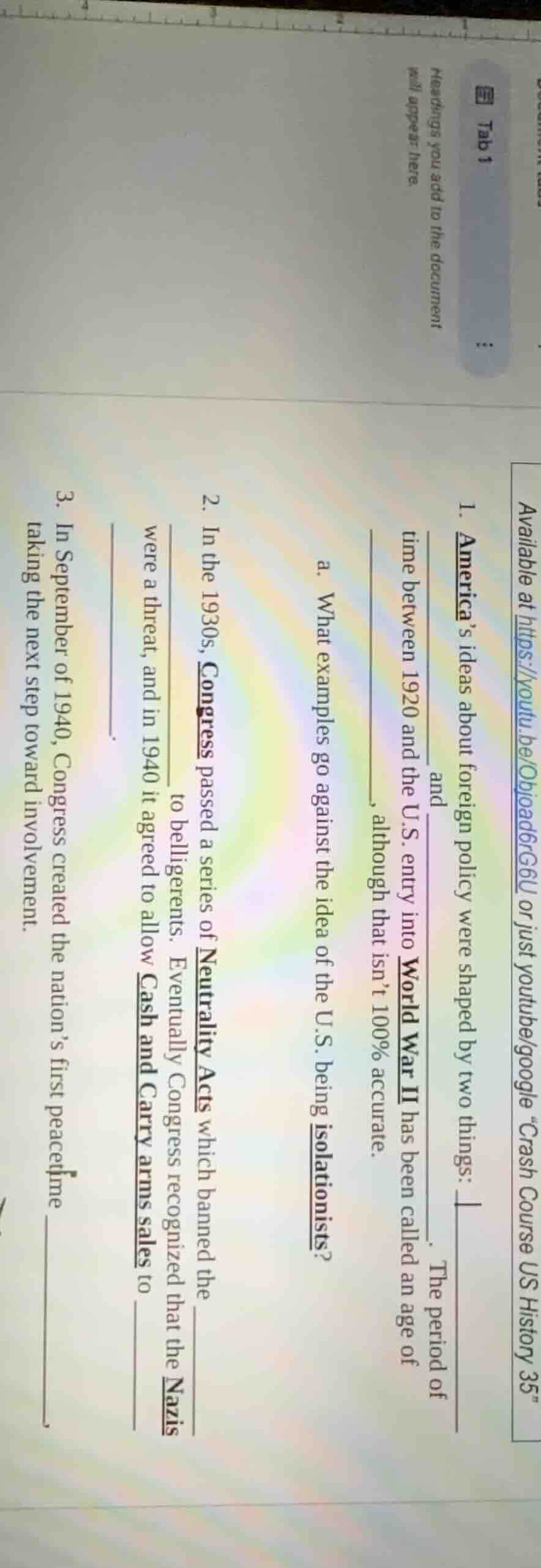
available at https://youtu.be/obioadr6rg6u/ or just youtube/google “crash course us history 35” 1. america’s ideas about foreign policy were shaped by two things: ____ and __. the period of time between 1920 and the u.s. entry into world war ii has been called an age of __, although that isn’t 100% accurate. a. what examples go against the idea of the u.s. being isolationists? 2. in the 1930s, congress passed a series of neutrality acts which banned the __ to belligerents. eventually congress recognized that the nazis were a threat, and in 1940 it agreed to allow cash and carry arms sales to __. 3. in september of 1940, congress created the nation’s first peacetime ____, taking the next step toward involvement.
Question 1
- America's foreign policy ideas in the interwar period (1920 - 1941) were shaped by isolationism (the desire to avoid foreign conflicts, especially after WWI's devastation) and economic interests (like protecting trade, repaying war debts, or dealing with the Great Depression's global impacts). The period between 1920 and U.S. entry into WWII (1941) is called the age of isolationism, though it's not absolute (e.g., some involvement in Latin America or economic ties).
- For part (a), examples against isolationism: U.S. involvement in the League of Nations’ economic sanctions (even if not joining the League, participating in some economic penalties against aggressors), Lend - Lease Act (1941, though pre - 1941, aiding Allies like sending supplies), or Neutrality Acts with “cash - and - carry” exceptions (allowing trade with belligerents, which was a partial step away from strict isolation).
In the 1930s, Congress passed Neutrality Acts to keep the U.S. out of foreign wars. These acts banned the sale of arms to belligerents (countries at war). The Nazis (Germany under Hitler) were a threat, so in 1940, Congress agreed to allow cash - and - carry arms sales to Allied powers (like Britain, France, later Soviet Union) to help them resist Axis aggression.
In September 1940, Congress created the nation’s first peacetime draft (Selective Training and Service Act). This was a major step toward involvement in WWII, as it prepared the U.S. military for potential war by conscripting men in peacetime (previously drafts were for wartime only).

Snap & solve any problem in the app
Get step-by-step solutions on Sovi AI
Photo-based solutions with guided steps
Explore more problems and detailed explanations
- Blanks: America’s ideas about foreign policy were shaped by isolationism and economic interests. The period of time between 1920 and the U.S. entry into World War II has been called an age of isolationism, although that isn’t 100% accurate.
- (a) Examples against isolationism: U.S. participation in League of Nations - related economic sanctions against aggressors; the “cash - and - carry” provision in Neutrality Acts (allowing trade with belligerents); U.S. aid to China against Japanese aggression (e.g., through loans or supplies).