QUESTION IMAGE
Question
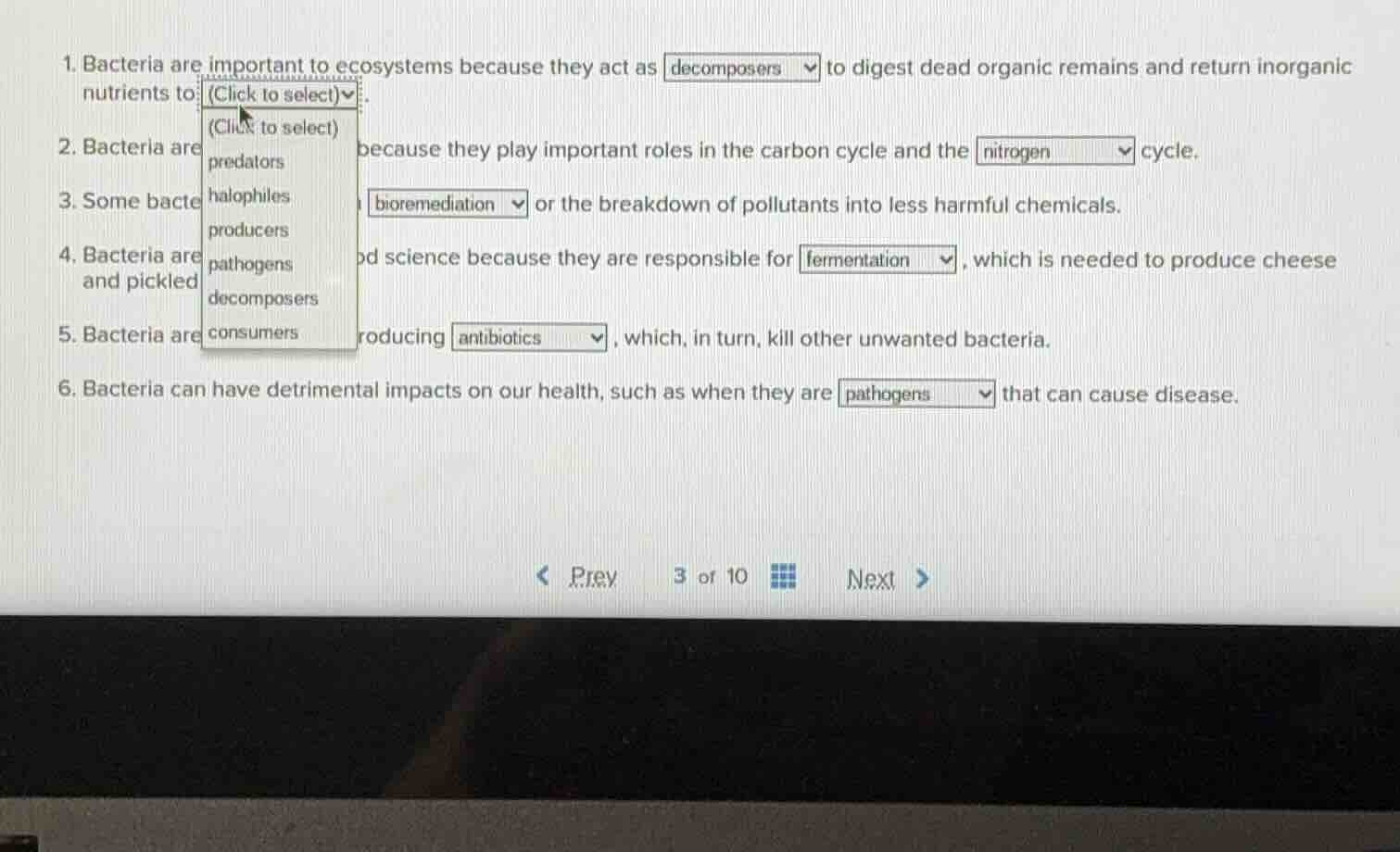
- bacteria are important to ecosystems because they act as decomposers to digest dead organic remains and return inorganic nutrients to (click to select).2. bacteria are because they play important roles in the carbon cycle and the nitrogen cycle.3. some bacte bioremediation or the breakdown of pollutants into less harmful chemicals.4. bacteria are od science because they are responsible for fermentation, which is needed to produce cheese and pickled5. bacteria are roducing antibiotics, which, in turn, kill other unwanted bacteria.6. bacteria can have detrimental impacts on our health, such as when they are pathogens that can cause disease.(click to select) options: predators, halophiles, producers, pathogens, decomposers, consumers
Brief Explanations
- Decomposers return inorganic nutrients to the ecosystem's environment (like soil/water) after breaking down organic matter.
- Bacteria drive key steps in both carbon and nitrogen biogeochemical cycles.
- Bioremediation uses microbes like bacteria to break down environmental pollutants.
- Fermentation by bacteria is critical for making fermented foods such as cheese and pickles.
- Certain bacteria naturally produce antibiotics to compete with other bacteria.
- Pathogenic bacteria are the type that cause infectious diseases in humans.

Snap & solve any problem in the app
Get step-by-step solutions on Sovi AI
Photo-based solutions with guided steps
Explore more problems and detailed explanations
- Bacteria are important to ecosystems because they act as decomposers to digest dead organic remains and return inorganic nutrients to consumers/producers (the ecosystem environment, specifically the soil/abiotic pool)
- Bacteria are important because they play important roles in the carbon cycle and the nitrogen cycle.
- Some bacteria are used in bioremediation or the breakdown of pollutants into less harmful chemicals.
- Bacteria are important in food science because they are responsible for fermentation, which is needed to produce cheese and pickled foods.
- Bacteria are useful for producing antibiotics, which, in turn, kill other unwanted bacteria.
- Bacteria can have detrimental impacts on our health, such as when they are pathogens that can cause disease.
Note for question 1: The most ecologically accurate term for the recipient of recycled inorganic nutrients is the abiotic environment (e.g., soil, water), which is then taken up by producers. From the dropdown options, producers is the correct biological group that absorbs these recycled nutrients.