QUESTION IMAGE
Question
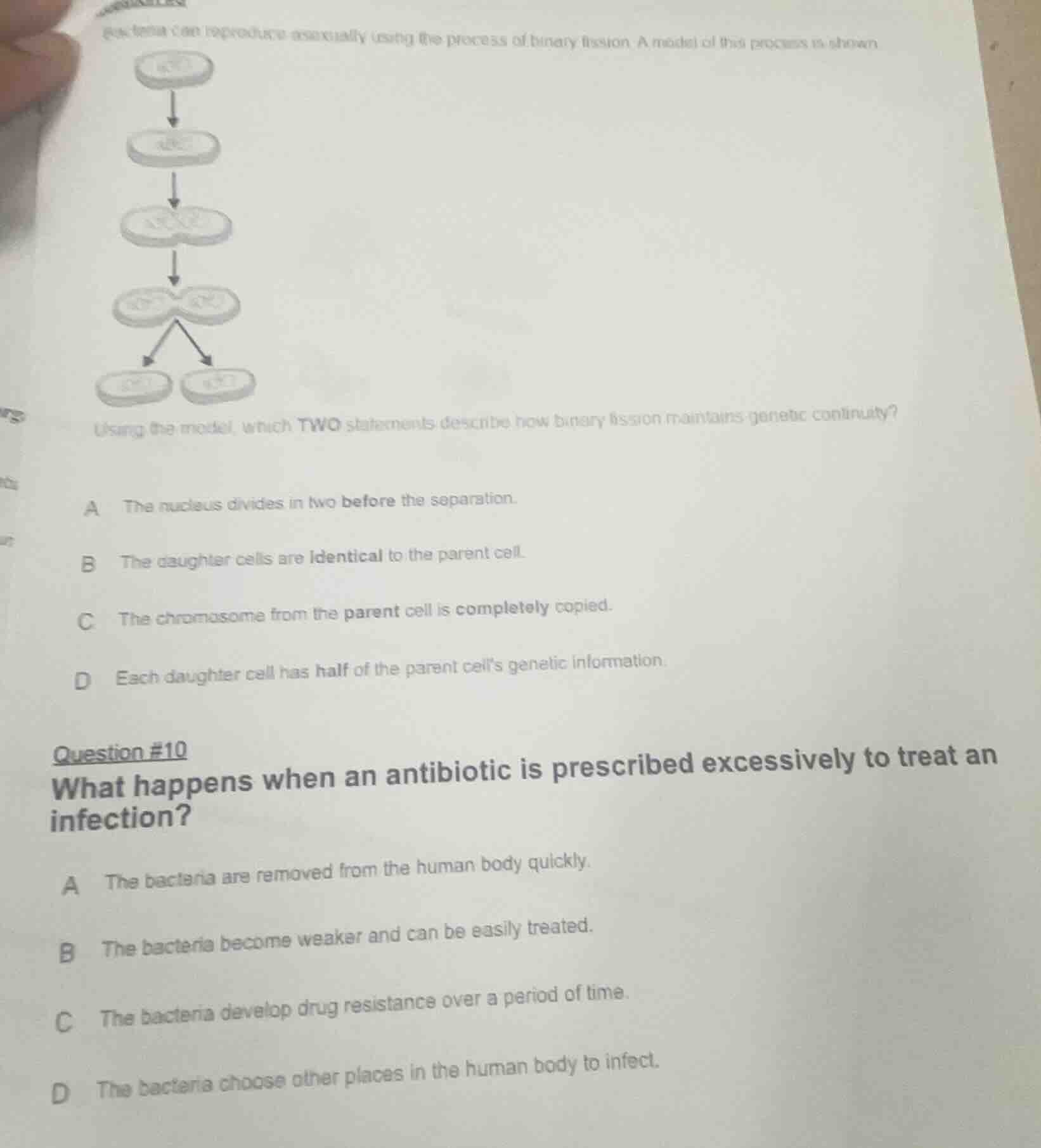
bacteria can reproduce asexually using the process of binary fission. a model of this process is shown
using the model, which two statements describe how binary fission maintains genetic continuity?
a the nucleus divides in two before the separation.
b the daughter cells are identical to the parent cell.
c the chromosome from the parent cell is completely copied.
d each daughter cell has half of the parent cells genetic information.
question #10
what happens when an antibiotic is prescribed excessively to treat an infection?
a the bacteria are removed from the human body quickly.
b the bacteria become weaker and can be easily treated.
c the bacteria develop drug resistance over a period of time.
d the bacteria choose other places in the human body to infect.
For the binary fission question:
- Option A is incorrect because bacteria are prokaryotes and lack a nucleus.
- Option B is correct: binary fission is asexual reproduction, so daughter cells are genetically identical to the parent, maintaining continuity.
- Option C is correct: the parent cell's single chromosome is fully copied before division, ensuring each daughter cell gets a complete set.
- Option D is incorrect: each daughter cell gets a full copy of the parent's genetic information, not half.
For Question #10:
- Options A, B, and D are incorrect. Excessive antibiotic use does not quickly remove bacteria, weaken them, or make them move to other body sites as a direct effect.
- Option C is correct: overuse of antibiotics creates selective pressure, leading bacteria to evolve drug resistance over time.

Snap & solve any problem in the app
Get step-by-step solutions on Sovi AI
Photo-based solutions with guided steps
Explore more problems and detailed explanations
Binary fission question:
B. The daughter cells are identical to the parent cell.
C. The chromosome from the parent cell is completely copied.
Question #10:
C. The bacteria develop drug resistance over a period of time.