QUESTION IMAGE
Question
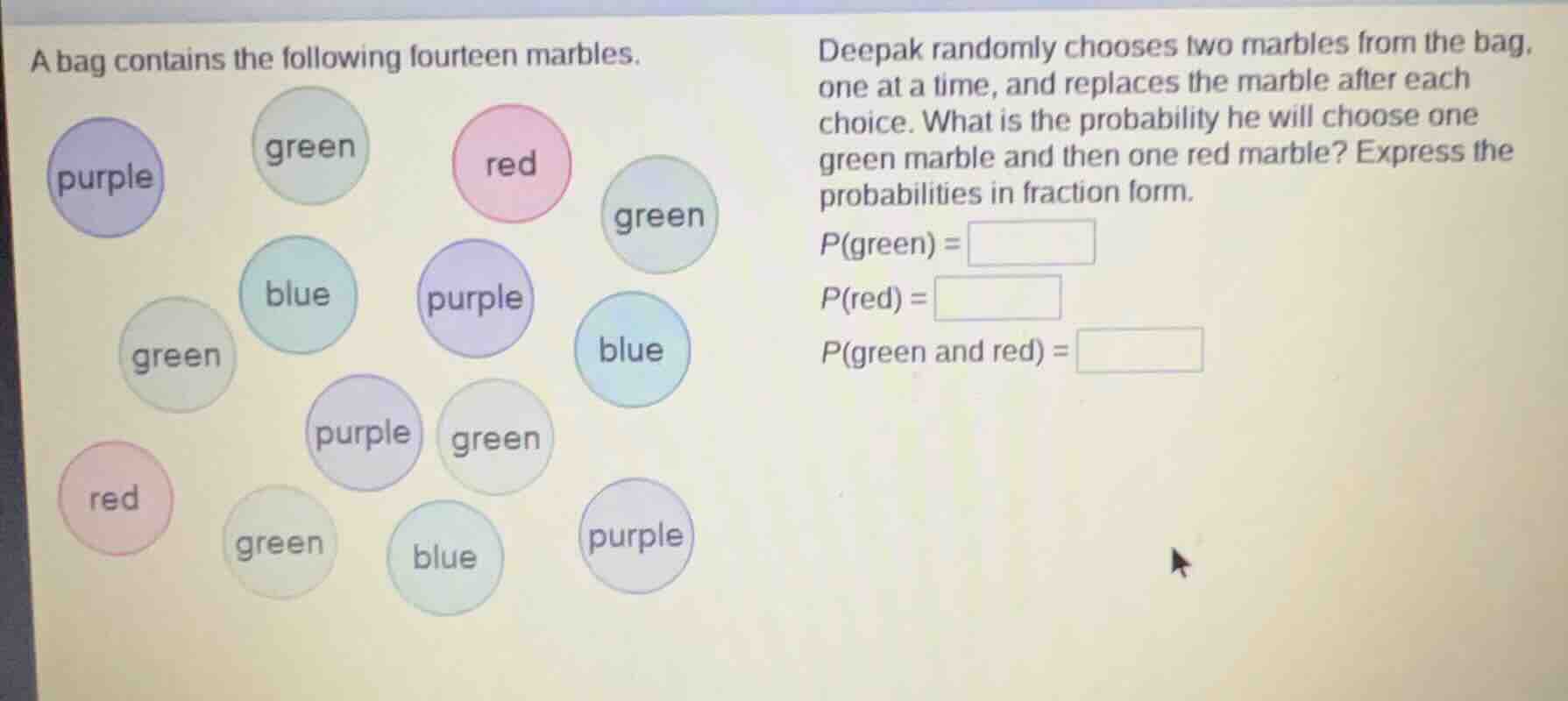
a bag contains the following fourteen marbles.
deepak randomly chooses two marbles from the bag, one at a time, and replaces the marble after each choice. what is the probability he will choose one green marble and then one red marble? express the probabilities in fraction form.
p(green) =
p(red) =
p(green and red) =
Step1: Count total and green marbles
Total marbles: 14. Green marbles: 5 (count the green ones: first row green, second row green, third row green, fourth row green, and another green? Wait, let's list all: purple, green, red, green, blue, purple, blue, red, purple, green, green, blue, purple, and the last? Wait, the marbles are: purple (1), green (let's count: first row green, second row green, third row green, fourth row green, and another? Wait the image shows:
First row: purple, green, red, green (2 greens)
Second row: blue, purple, blue (wait no, second row: green (left), blue, purple, blue? Wait no, let's count again. Let's list each marble:
- purple
- green
- red
- green
- blue
- purple
- blue
- red
- purple
- green
- green
- blue
- purple
- green? Wait no, the fourth row: green, blue, purple? Wait the user's image: let's count green marbles:
Looking at the marbles:
- Green: positions 2,4,10,11,14? Wait no, let's count again. Let's list all 14:
- purple
- green
- red
- green
- blue
- purple
- blue
- red
- purple
- green
- green
- blue
- purple
- green? Wait no, maybe I miscounted. Wait the problem says 14 marbles. Let's count green:
First row: green (2), second row: green (1), third row: green (2), fourth row: green (1)? Wait no, let's see the marbles:
- Green marbles: let's count the number of green circles. From the image:
First row: green (1), green (2)
Second row: green (1) [the left one in second row? Wait no, second row: green (left), blue, purple, blue? No, the second row (middle) has green, blue, purple, blue? Wait no, the user's image:
The marbles are arranged as:
Top row: purple, green, red, green (2 greens)
Second row: green (left), blue, purple, blue (1 green)
Third row: purple, green, green (2 greens)
Fourth row: green, blue, purple (1 green)
Wait total green: 2 +1 +2 +1 =6? No, wait the problem says 14 marbles. Wait maybe I made a mistake. Wait the correct count: let's see the green marbles:
Looking at the image, the green marbles are:
- First row: 2 (green, green)
- Second row: 1 (green)
- Third row: 2 (green, green)
- Fourth row: 1 (green)
Total: 2+1+2+1=6? No, wait the user's problem says 14 marbles. Let's count all:
Purple: 4 (positions 1,6,9,13)
Red: 2 (positions 3,8)
Blue: 3 (positions 5,7,12)
Green: 14 -4 -2 -3 =5? Wait 4+2+3=9, 14-9=5. Ah, that's better. So purple: 4, red:2, blue:3, green:5. Yes, because 4+2+3+5=14. So green marbles: 5.
So P(green) = number of green / total = 5/14.
Step2: Count red marbles
Red marbles: 2 (positions 3,8). So P(red) = 2/14 = 1/7.
Step3: Probability of green then red (with replacement)
Since replacement, the events are independent. So P(green and red) = P(green) P(red) = (5/14) (2/14) = 10/196 = 5/98? Wait no, wait red marbles: 2? Wait earlier count: red marbles: positions 3 and 8, so 2. So P(red) = 2/14 = 1/7.
Wait let's recheck:
Total marbles:14.
Green:5, Red:2, Blue:3, Purple:4. 5+2+3+4=14. Correct.
So P(green) = 5/14.
P(red) = 2/14 = 1/7.
Then P(green and red) = (5/14) (2/14) = 10/196 = 5/98? Wait no, 52=10, 14*14=196, simplify 10/196 = 5/98. Wait but let's check again.
Wait red marbles: 2? Let's count the red circles: first row red, second row red? Wait the image: first row red (1), second row red (1)? Wait no, first row: red (1), second row: red (1)? Wait the marbles:
- Red marbles: two (positions 3 and 8). So 2 red marbles. Correct.
So:
P(green) = 5/14.
P(red) = 2/14 = 1/7.
P(green and red) = (5/14) * (2/14) = 10/196 = 5/98. Wait but let's confirm…

Snap & solve any problem in the app
Get step-by-step solutions on Sovi AI
Photo-based solutions with guided steps
Explore more problems and detailed explanations
P(green) = $\frac{5}{14}$
P(red) = $\frac{1}{7}$
P(green and red) = $\frac{5}{98}$