QUESTION IMAGE
Question
baking a cake
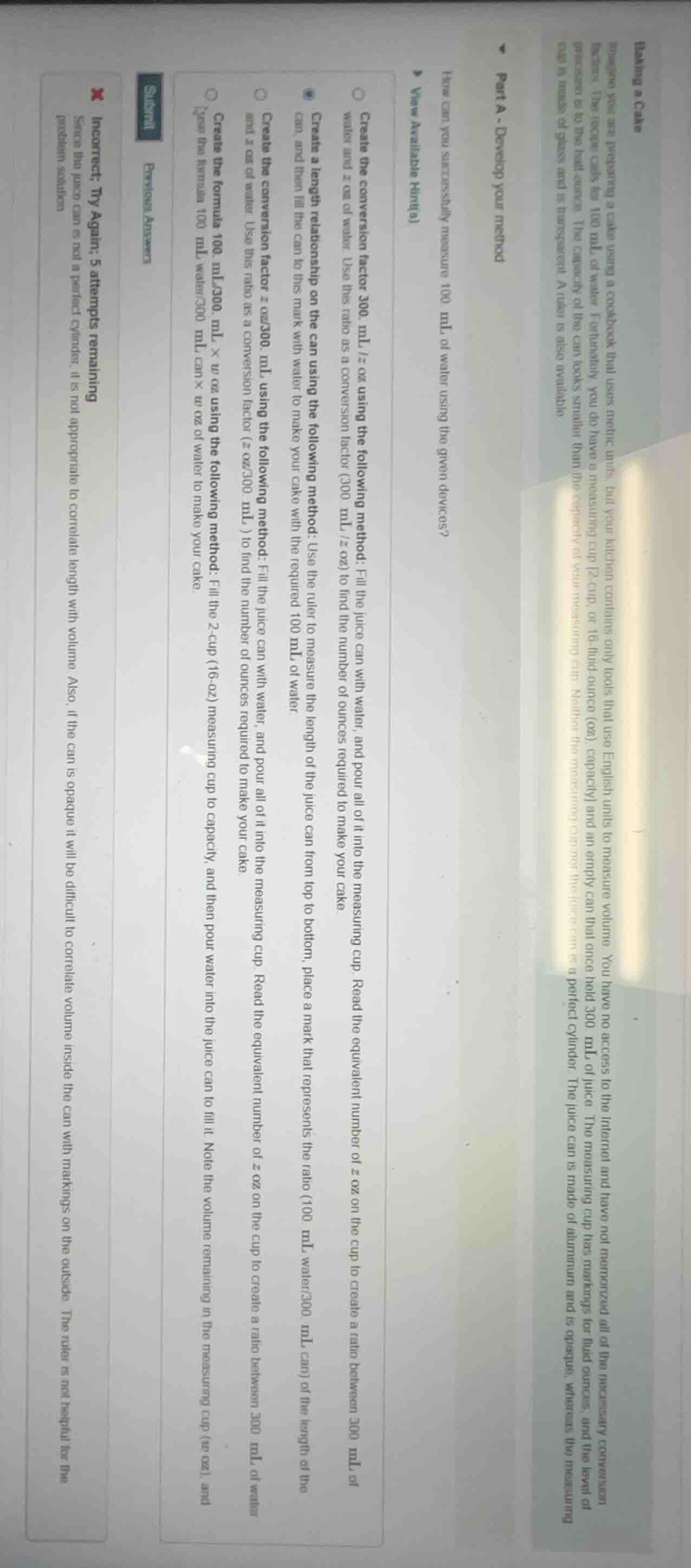
now you are preparing a cake using a cookbook that uses metric units, but your kitchen contains only tools that use english units to measure volume. you have no access to the internet and have not memorized all of the necessary conversion factors. the recipe calls for 100 ml of water. fortunately, you do have a measuring cup 2 - cup, or 16 fluid ounces (oz) capacity and an empty can that once held 300 ml of juice. the measuring cup has markings for fluid ounces, and the level of precision is to the half ounce. the capacity of the can looks smaller than the capacity of your measuring cup. neither the measuring cup nor the juice can is a perfect cylinder. the juice can is made of glass and is transparent. a ruler is also available.
part a - develop your method
how can you successfully measure 100 ml of water using the given devices?
(new available hint(s))
- create the conversion factor 300 ml/2 oz using the following method: fill the juice can with water, and pour all of it into the measuring cup. read the equivalent number of 2 oz on the cup to create a ratio between 300 ml of water and 2 oz of water. use this ratio as a conversion factor (2 oz/300 ml) to find the number of ounces required to make your cake.
- create a length relationship on the can using the following method: use the ruler to measure the length of the juice can from top to bottom, place a mark that represents the ratio (100 ml water/300 ml can) of the length of the can, and then fill the can to this mark with water to make your cake with the required 100 ml of water.
- create the conversion factor 300 ml/2 oz using the following method: fill the juice can with water, and pour all of it into the measuring cup. read the equivalent number of 2 oz on the cup to create a ratio between 300 ml of water and 2 oz of water. use this ratio as a conversion factor (300 ml/2 oz) to find the number of ounces required to make your cake.
- create the formula 100 ml/300 ml × w oz of water to make your cake using the following method: fill the 2 - cup (16 - oz) measuring cup to capacity, and then pour water into the juice can to fill it. note the volume remaining in the measuring cup (in oz) and
incorrect; try again: 5 attempts remaining
since the can is not a perfect cylinder, it is not appropriate to correlate length with volume. also, if the can is opaque it will be difficult to correlate volume inside the can with markings on the outside. the ruler is not helpful for the
problem solution
Step 1: Analyze the goal
We need to measure 100 mL of water. The can holds 300 mL, and we have a 2 - cup (16 - oz) measuring cup. We know that the can holds 300 mL, and we can use the measuring cup to find the conversion or a way to get 100 mL.
Step 2: Evaluate each option
- Option 1: Relating length to volume is not practical here because the can is opaque and the ruler won't help with volume directly. So this option is incorrect.
- Option 2: The conversion factor approach. We know the can holds 300 mL. If we fill the measuring cup (let's say it has a volume related to ounces) and use the ratio. But first, let's think about the third option.
- Option 3: The formula approach. If the can holds 300 mL, and we want 100 mL, we can use the formula \(100\space mL=\frac{100}{300}\times300\space mL\). But we can also use the measuring cup. Wait, the third option says "Create the formula \(100\space mL = 300\space mL\times\frac{w\space oz}{16\space oz}\) (where \(w\) is the volume in ounces we pour into the can from the 16 - oz measuring cup)". Wait, no, let's re - evaluate. The correct approach is to use the fact that the can holds 300 mL. If we fill the measuring cup to its capacity (16 oz) and pour into the can, but we need 100 mL. Wait, the third option is about creating a formula that relates the volume in the can (300 mL) to the volume in the measuring cup (16 oz). Let's see: we know that the can's total volume is 300 mL. If we let \(w\) be the volume in ounces we pour from the 16 - oz cup into the can, then the volume in mL of the water we pour is \(\frac{300\space mL}{16\space oz}\times w\space oz\). We want this to be 100 mL. So \(\frac{300}{16}\times w=100\), or \(w = \frac{100\times16}{300}=\frac{16}{3}\approx5.33\) oz. But the second option is about creating a conversion factor. Wait, the correct option is the third one? Wait, no, let's check the feedback. The incorrect option was the length one. Wait, the correct option should be the one that uses the formula. Wait, the third option: "Create the formula \(100\space mL = 300\space mL\times\frac{w\space oz}{16\space oz}\) (fill the 2 - cup (16 - oz) measuring cup to capacity, and then pour water into the juice can to fill it. Note the volume remaining in the measuring cup (\(16 - w\) oz), and...". Wait, actually, the correct approach is to use the fact that the can holds 300 mL. If we want 100 mL, we can use the formula \(100\space mL=\frac{1}{3}\times300\space mL\). So if we fill the measuring cup (16 oz) and pour into the can, and find out how much we need to pour to get 100 mL. But the third option is about creating a formula that relates the volume in the can (300 mL) to the volume in the measuring cup (16 oz). So the correct option is the third one: "Create the formula \(100\space mL = 300\space mL\times\frac{w\space oz}{16\space oz}\) (Fill the 2 - cup (16 - oz) measuring cup to capacity, and then pour water into the juice can to fill it. Note the volume remaining in the measuring cup (\(16 - w\) oz), and use this to find \(w\) such that the volume in the can is 100 mL)". Wait, no, the third option's description is "Create the formula \(100\space mL = 300\space mL\times\frac{w\space oz}{16\space oz}\) (Fill the 2 - cup (16 - oz) measuring cup to capacity, and then pour water into the juice can to fill it. Note the volume remaining in the measuring cup (\(16 - w\) oz), and use this to make your cake)". Wait, maybe I misread. Let's start over.
The problem is to measure 100 mL of water. The can holds 300 mL. We have a 2 - cup (16 - oz) measuring cup.
- Option 1: Using l…

Snap & solve any problem in the app
Get step-by-step solutions on Sovi AI
Photo-based solutions with guided steps
Explore more problems and detailed explanations
The correct option is the third one: "Create the formula \(100\space mL = 300\space mL\times\frac{w\space oz}{16\space oz}\) (Fill the 2 - cup (16 - oz) measuring cup to capacity, and then pour water into the juice can to fill it. Note the volume remaining in the measuring cup (\(16 - w\) oz), and use this to make your cake)" (the option with the radio button that is not selected in the original image, but is the correct one based on the analysis).