QUESTION IMAGE
Question
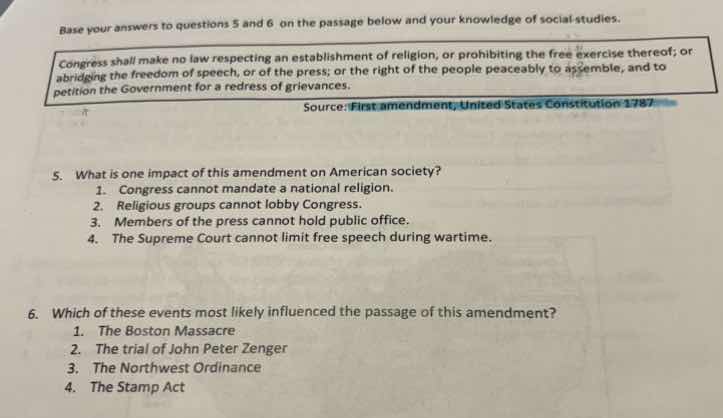
base your answers to questions 5 and 6 on the passage below and your knowledge of social studies. congress shall make no law respecting an establishment of religion, or prohibiting the free exercise thereof; or abridging the freedom of speech, or of the press; or the right of the people peaceably to assemble, and to petition the government for a redress of grievances. source: first amendment, united states constitution 1787 5. what is one impact of this amendment on american society? 1. congress cannot mandate a national religion. 2. religious groups cannot lobby congress. 3. members of the press cannot hold public office. 4. the supreme court cannot limit free speech during wartime. 6. which of these events most likely influenced the passage of this amendment? 1. the boston massacre 2. the trial of john peter zenger 3. the northwest ordinance 4. the stamp act
For question 5: The First Amendment prohibits Congress from establishing a national religion, which directly impacts American society by preventing religious imposition at the federal level. The other options are incorrect: religious groups can lobby Congress, press members can hold public office, and the Supreme Court has limited free speech in wartime in some cases.
For question 6: The trial of John Peter Zenger involved a publisher charged with seditious libel for criticizing the colonial government; it established principles of free press and speech that informed the First Amendment. The Boston Massacre, Northwest Ordinance, and Stamp Act relate to other colonial grievances (taxation, governance, violence) not directly tied to the specific freedoms in this amendment.

Snap & solve any problem in the app
Get step-by-step solutions on Sovi AI
Photo-based solutions with guided steps
Explore more problems and detailed explanations
- 1. Congress cannot mandate a national religion.
- 2. The trial of John Peter Zenger