QUESTION IMAGE
Question
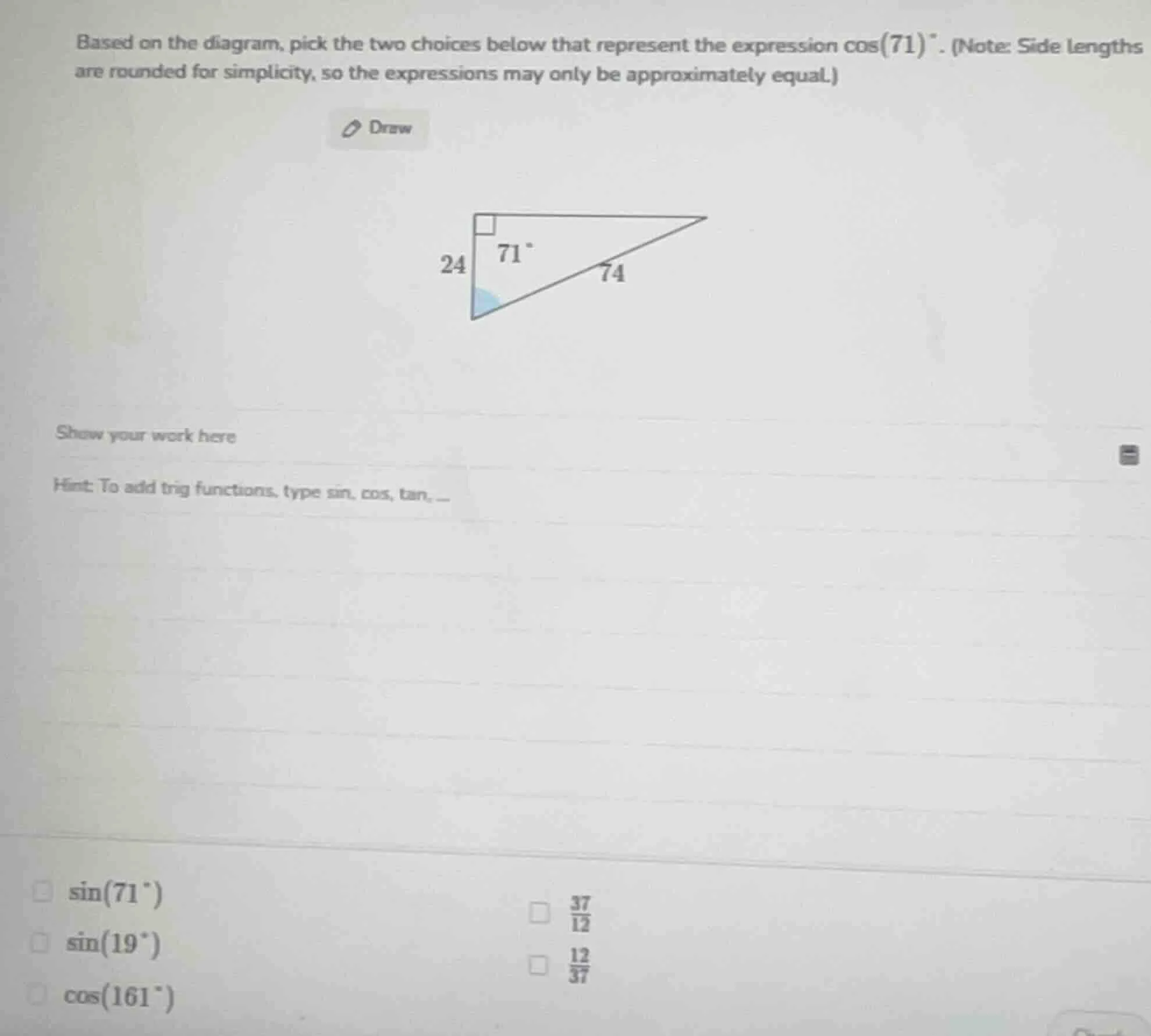
based on the diagram, pick the two choices below that represent the expression \\(\cos(71)\degree\\). (note: side lengths are rounded for simplicity, so the expressions may only be approximately equal.)
show your work here
hint: to add trig functions, type sin, cos, tan, ...
\\(\sin(71\degree)\\)
\\(\sin(19\degree)\\)
\\(\cos(161\degree)\\)
\\(\frac{37}{12}\\)
\\(\frac{12}{37}\\)
Step1: Recall trigonometric identities and right - triangle ratios
In a right - triangle, for an angle \(\theta\), \(\cos\theta=\frac{\text{adjacent}}{\text{hypotenuse}}\) and we also know the co - function identity \(\cos\theta=\sin(90^{\circ}-\theta)\) and the reference angle concept for cosine of supplementary angles (\(\cos(180^{\circ}-\alpha)=-\cos\alpha\), but we can also use the fact that in a right - triangle, the two non - right angles are complementary (\(90^{\circ}\) in total).
First, let's analyze the right - triangle. The right - triangle has a right angle, an angle of \(71^{\circ}\), so the third angle is \(19^{\circ}\) (since \(90 - 71=19\)). The hypotenuse is \(74\), the side adjacent to the \(71^{\circ}\) angle is \(24\)? Wait, no. Wait, in the right - triangle, the sides: the side with length \(24\) is adjacent to the \(71^{\circ}\) angle? Wait, no, let's re - check. The right angle is between the side of length \(24\) and the other leg. The angle of \(71^{\circ}\) is at the vertex where the side of length \(24\) and the hypotenuse (length \(74\)) meet? Wait, no, the hypotenuse is \(74\), the leg is \(24\). Let's calculate the other leg using Pythagoras: \(a=\sqrt{74^{2}-24^{2}}=\sqrt{(74 - 24)(74 + 24)}=\sqrt{50\times98}=\sqrt{4900}=70\). Wait, maybe I misread the diagram. Wait, the diagram shows a right - triangle with one leg \(24\), hypotenuse \(74\), and angle \(71^{\circ}\).
Step2: Use the co - function identity
We know that \(\cos\theta=\sin(90^{\circ}-\theta)\). For \(\theta = 71^{\circ}\), \(90^{\circ}-71^{\circ}=19^{\circ}\), so \(\cos(71^{\circ})=\sin(19^{\circ})\).
Step3: Use the right - triangle ratio for cosine
In a right - triangle, \(\cos\theta=\frac{\text{adjacent}}{\text{hypotenuse}}\). The adjacent side to the \(71^{\circ}\) angle: let's see, the leg of length \(24\) is adjacent to the \(71^{\circ}\) angle? Wait, no, the hypotenuse is \(74\), and if we simplify \(\frac{24}{74}=\frac{12}{37}\)? Wait, no, \(24\) and \(74\) can be simplified by dividing numerator and denominator by \(2\): \(\frac{24}{74}=\frac{12}{37}\). Wait, but let's check the options. The options include \(\frac{12}{37}\) (wait, the option is \(\frac{12}{37}\)? Wait, the options are \(\sin(71^{\circ})\), \(\frac{37}{12}\), \(\sin(19^{\circ})\), \(\frac{12}{37}\), \(\cos(161^{\circ})\).
Wait, \(\cos(71^{\circ})\): using the co - function identity, \(\cos(71^{\circ})=\sin(19^{\circ})\) (since \(71 + 19 = 90\), so they are complementary angles, and \(\cos\alpha=\sin(90-\alpha)\)). Also, \(\cos(71^{\circ})=\frac{\text{adjacent}}{\text{hypotenuse}}\). The adjacent side to the \(71^{\circ}\) angle: if the leg is \(24\) and hypotenuse is \(74\), then \(\cos(71^{\circ})=\frac{24}{74}=\frac{12}{37}\).
Now, let's check the options:
- Option \(\sin(71^{\circ})\): \(\sin(71^{\circ})
eq\cos(71^{\circ})\) (unless \(71^{\circ}=45^{\circ}\), which it's not).
- Option \(\frac{37}{12}\): This is the reciprocal of \(\frac{12}{37}\), so it's not equal to \(\cos(71^{\circ})\).
- Option \(\sin(19^{\circ})\): Since \(\cos(71^{\circ})=\sin(90 - 71)^{\circ}=\sin(19^{\circ})\), this is correct.
- Option \(\frac{12}{37}\): Since \(\cos(71^{\circ})=\frac{\text{adjacent}}{\text{hypotenuse}}=\frac{24}{74}=\frac{12}{37}\), this is correct.
- Option \(\cos(161^{\circ})\): \(\cos(161^{\circ})=\cos(180 - 19)^{\circ}=-\cos(19^{\circ})\approx-\sin(71^{\circ})\), which is not equal to \(\cos(71^{\circ})\) (except in magnitude, but the sign is different and the problem says "approximately equal" and we are dealing with positive values in the triangle,…

Snap & solve any problem in the app
Get step-by-step solutions on Sovi AI
Photo-based solutions with guided steps
Explore more problems and detailed explanations
\(\sin(19^{\circ})\), \(\frac{12}{37}\)