QUESTION IMAGE
Question
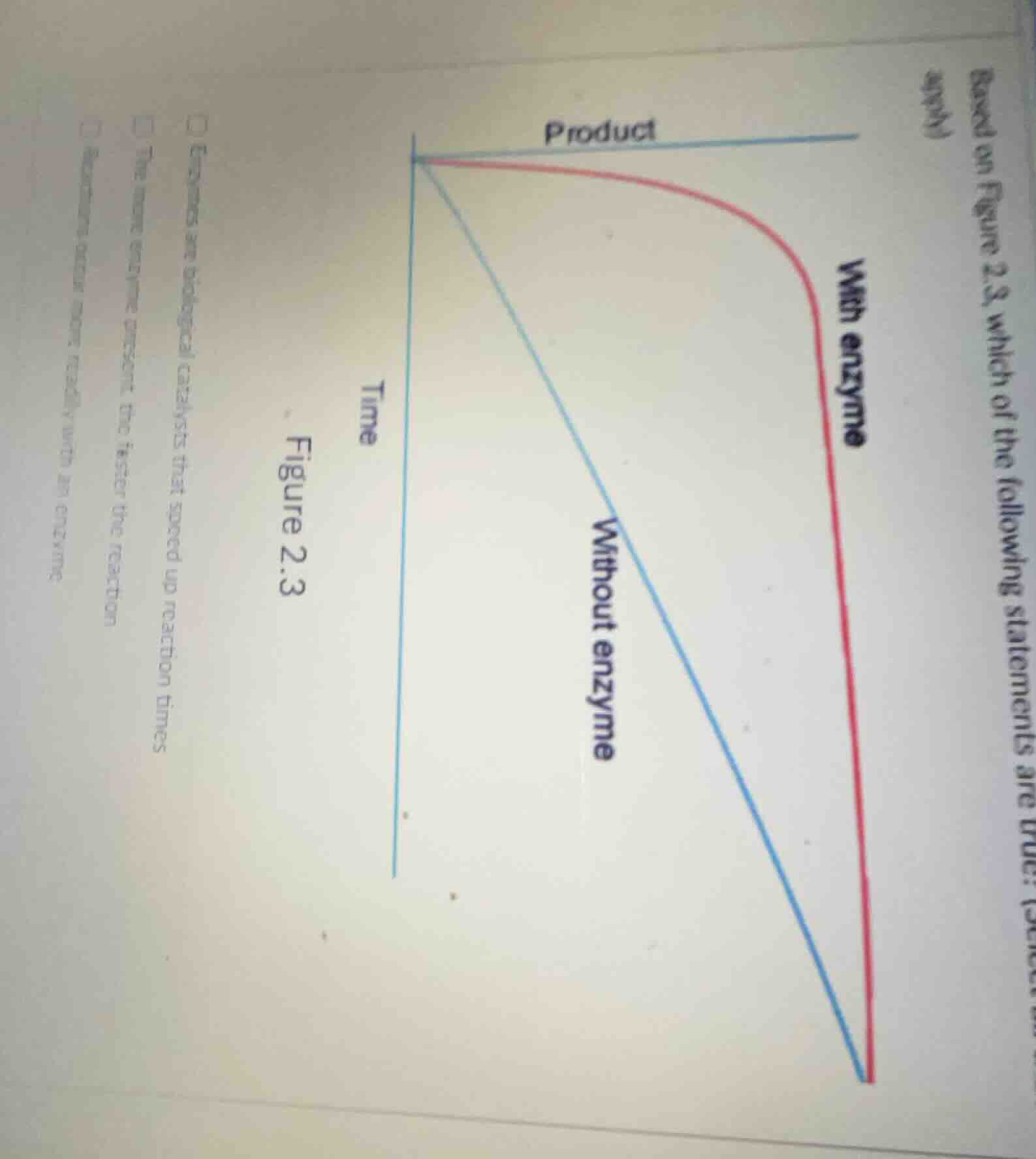
based on figure 2.3, which of the following statements are true: (select all apply)
figure 2.3
graph with product on y-axis, time on x-axis; three lines: product (horizontal), with enzyme (red curve), without enzyme (blue line)
options:
- enzymes are biological catalysts that speed up reaction times
- the more enzyme present, the faster the reaction
- substrates react more readily with an enzyme
- Analyze the first statement: Enzymes are biological catalysts that speed up reaction times. Enzymes are known to be biological catalysts (proteins or RNA) that increase the rate of chemical reactions by lowering activation energy, so this is a fundamental property of enzymes. The graph shows that with enzyme (red line) the reaction reaches product faster than without enzyme (blue line), supporting that enzymes speed up reactions.
- Analyze the second statement: The more enzyme present, the faster the reaction. While generally true (up to saturation), the graph provided only compares "with enzyme" and "without enzyme" (not varying enzyme concentration). However, the first statement is a core, universally accepted fact about enzymes as catalysts speeding reactions, and the graph directly shows the reaction is faster with enzyme (so the first statement is true based on enzyme function and the graph's comparison of with/without enzyme).
- Analyze the third statement: Reactions occur more rapidly with an enzyme. The graph clearly shows that the "With enzyme" line reaches the product (completes the reaction) in less time than the "Without enzyme" line, so this is supported by the graph. But the first statement ("Enzymes are biological catalysts that speed up reaction times") is a more fundamental, definitional statement about enzymes (their role as catalysts to speed reactions), and the graph confirms the rate increase. If we assume the options are the three checkboxes (first: "Enzymes are biological catalysts...", second: "The more enzyme...", third: "Reactions occur..."), the first and third are true (but let's check the graph again: the "With enzyme" curve has a steeper initial rate (faster reaction) and reaches product faster. The first statement defines enzymes as catalysts (speeding reactions), which is a basic enzyme property. The third statement is also true from the graph. However, the first statement is a key biological fact about enzymes.

Snap & solve any problem in the app
Get step-by-step solutions on Sovi AI
Photo-based solutions with guided steps
Explore more problems and detailed explanations
(Assuming the options are the three checkboxes: )
- Enzymes are biological catalysts that speed up reaction times (True, as enzymes are catalysts increasing reaction rate, graph shows faster reaction with enzyme).
- The more enzyme present, the faster the reaction (Not directly shown in the graph, as graph only has with/without, not varying enzyme amount, so this statement's truth isn't confirmed by this graph alone).
- Reactions occur more rapidly with an enzyme (True, as the "With enzyme" line reaches product faster than "Without enzyme" line, showing faster reaction rate).
If we have to pick the most fundamental/always - true (and supported by the graph's with/without comparison), the first statement ("Enzymes are biological catalysts that speed up reaction times") and the third ("Reactions occur more rapidly with an enzyme") are true. If the question is to select which statements apply, these two (and potentially the first is a core enzyme definition).