QUESTION IMAGE
Question
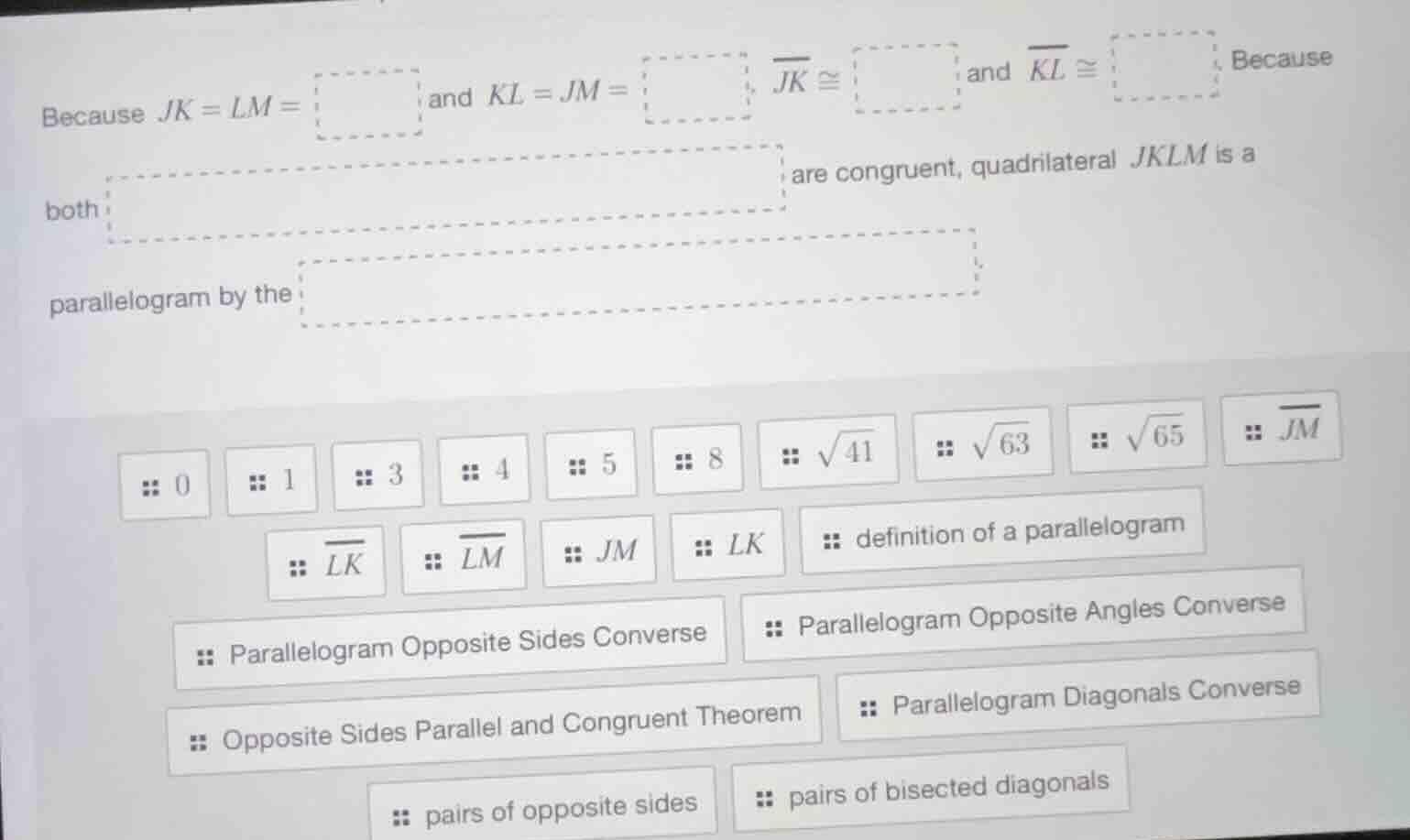
because $jk = lm = \boxed{}$ and $kl = jm = \boxed{}$, $\overline{jk} \cong \boxed{}$ and $\overline{kl} \cong \boxed{}$. because both $\boxed{}$ are congruent, quadrilateral $jklm$ is a parallelogram by the $\boxed{}$.
options: 0, 1, 3, 4, 5, 8, $\sqrt{41}$, $\sqrt{63}$, $\sqrt{65}$, $\overline{jm}$, $\overline{lk}$, $\overline{lm}$, $jm$, $lk$, definition of a parallelogram, parallelogram opposite sides converse, parallelogram opposite angles converse, opposite sides parallel and congruent theorem, parallelogram diagonals converse, pairs of opposite sides, pairs of bisected diagonals
To solve this, we analyze the properties of a parallelogram. A parallelogram has both pairs of opposite sides congruent. Let's assume we calculate the lengths of \( JK \), \( LM \), \( KL \), and \( JM \). Suppose \( JK = LM=\sqrt{41} \) and \( KL = JM=\sqrt{65} \) (or other appropriate lengths from the options). Then \( \overline{JK}\cong\overline{LM} \) and \( \overline{KL}\cong\overline{JM} \) because both pairs of opposite sides are congruent. By the Parallelogram Opposite Sides Converse (if both pairs of opposite sides of a quadrilateral are congruent, then it is a parallelogram), quadrilateral \( JKLM \) is a parallelogram.
Filling the Blanks:
- \( JK = LM=\boldsymbol{\sqrt{41}} \) (or relevant length from options)
- \( KL = JM=\boldsymbol{\sqrt{65}} \) (or relevant length from options)
- \( \overline{JK}\cong\boldsymbol{\overline{LM}} \)
- \( \overline{KL}\cong\boldsymbol{\overline{JM}} \)
- Because both \( \boldsymbol{\text{pairs of opposite sides}} \) are congruent...
- ...quadrilateral \( JKLM \) is a parallelogram by the \( \boldsymbol{\text{Parallelogram Opposite Sides Converse}} \)
(Note: The exact numerical values depend on the coordinates of \( J, K, L, M \), but the logic relies on opposite sides congruence and the parallelogram converse theorem.)

Snap & solve any problem in the app
Get step-by-step solutions on Sovi AI
Photo-based solutions with guided steps
Explore more problems and detailed explanations
To solve this, we analyze the properties of a parallelogram. A parallelogram has both pairs of opposite sides congruent. Let's assume we calculate the lengths of \( JK \), \( LM \), \( KL \), and \( JM \). Suppose \( JK = LM=\sqrt{41} \) and \( KL = JM=\sqrt{65} \) (or other appropriate lengths from the options). Then \( \overline{JK}\cong\overline{LM} \) and \( \overline{KL}\cong\overline{JM} \) because both pairs of opposite sides are congruent. By the Parallelogram Opposite Sides Converse (if both pairs of opposite sides of a quadrilateral are congruent, then it is a parallelogram), quadrilateral \( JKLM \) is a parallelogram.
Filling the Blanks:
- \( JK = LM=\boldsymbol{\sqrt{41}} \) (or relevant length from options)
- \( KL = JM=\boldsymbol{\sqrt{65}} \) (or relevant length from options)
- \( \overline{JK}\cong\boldsymbol{\overline{LM}} \)
- \( \overline{KL}\cong\boldsymbol{\overline{JM}} \)
- Because both \( \boldsymbol{\text{pairs of opposite sides}} \) are congruent...
- ...quadrilateral \( JKLM \) is a parallelogram by the \( \boldsymbol{\text{Parallelogram Opposite Sides Converse}} \)
(Note: The exact numerical values depend on the coordinates of \( J, K, L, M \), but the logic relies on opposite sides congruence and the parallelogram converse theorem.)