QUESTION IMAGE
Question
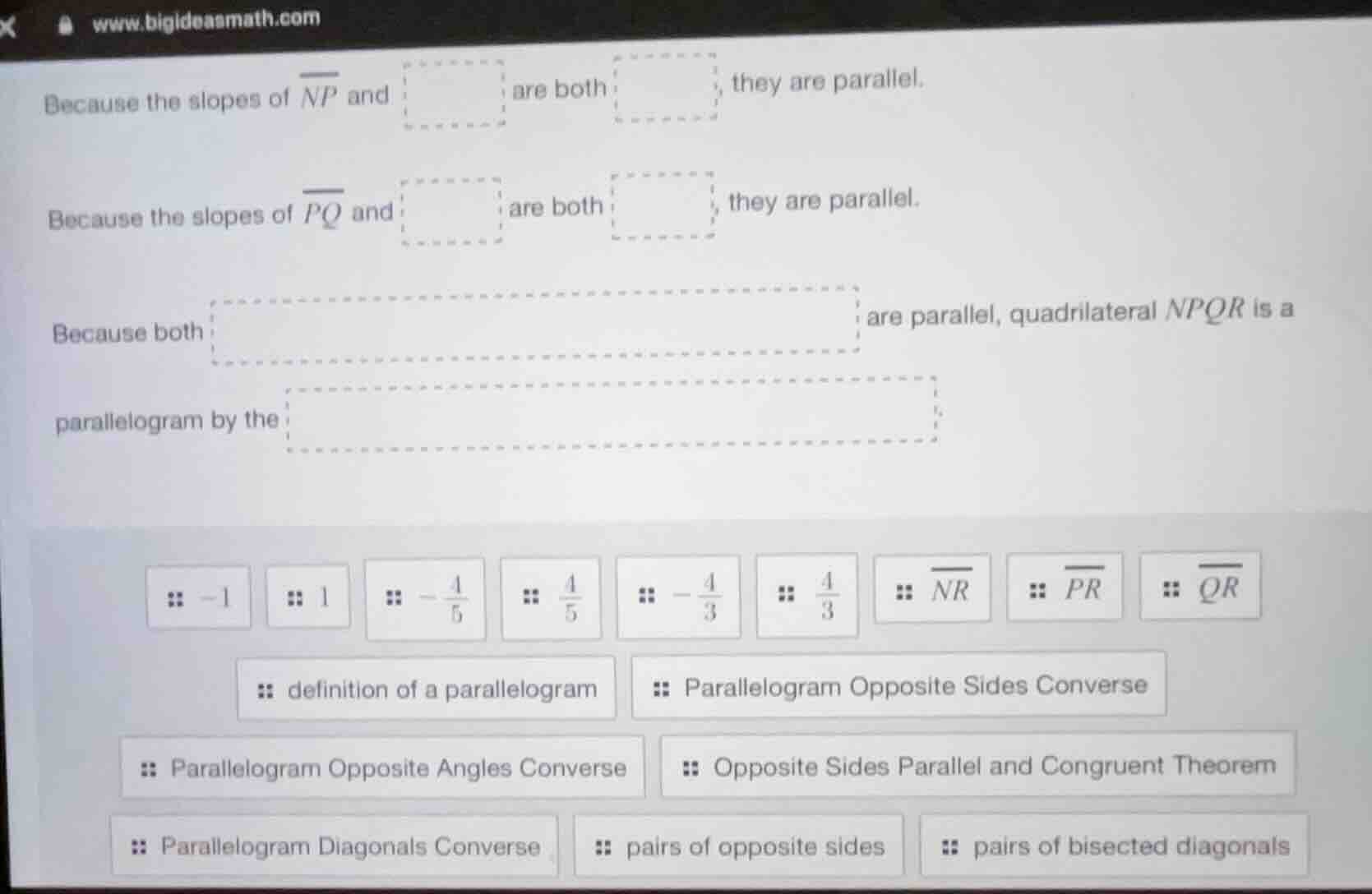
because the slopes of $overline{np}$ and $\boxed{}$ are both $\boxed{}$, they are parallel.
because the slopes of $overline{pq}$ and $\boxed{}$ are both $\boxed{}$, they are parallel.
because both $\boxed{}$ are parallel, quadrilateral $npqr$ is a parallelogram by the $\boxed{}$.
options for blanks (from bottom to top, left to right): $-1$, $1$, $-\frac{4}{5}$, $\frac{4}{5}$, $-\frac{4}{3}$, $\frac{4}{3}$, $overline{nr}$, $overline{pr}$, $overline{qr}$, definition of a parallelogram, parallelogram opposite sides converse, parallelogram opposite angles converse, opposite sides parallel and congruent theorem, parallelogram diagonals converse, pairs of opposite sides, pairs of bisected diagonals
To solve this problem, we analyze the properties of a parallelogram (opposite sides are parallel) and use the given slope options and side labels.
First Statement (Slopes of \( \overline{NP} \) and \( \overline{QR} \))
For two lines to be parallel, their slopes must be equal. From the options, we identify the pair of sides (\( \overline{NP} \) and \( \overline{QR} \)) and their common slope. The slope here is \( \boldsymbol{\frac{4}{5}} \) (matching the slope of \( \overline{NP} \) and \( \overline{QR} \)).
Second Statement (Slopes of \( \overline{PQ} \) and \( \overline{NR} \))
Similarly, \( \overline{PQ} \) and \( \overline{NR} \) are opposite sides of the quadrilateral. Their common slope is \( \boldsymbol{-\frac{4}{3}} \) (ensuring they are parallel).
Third Statement (Parallel Sides and Parallelogram Definition)
A parallelogram is defined as a quadrilateral with pairs of opposite sides parallel. Thus, since \( \overline{NP} \parallel \overline{QR} \) and \( \overline{PQ} \parallel \overline{NR} \) (two pairs of opposite sides), quadrilateral \( NPQR \) is a parallelogram by the definition of a parallelogram (or "Parallelogram Opposite Sides Converse," which states that if both pairs of opposite sides of a quadrilateral are parallel, it is a parallelogram).
Final Answers (Filling in the Blanks):
- Because the slopes of \( \overline{NP} \) and \( \boldsymbol{\overline{QR}} \) are both \( \boldsymbol{\frac{4}{5}} \), they are parallel.
- Because the slopes of \( \overline{PQ} \) and \( \boldsymbol{\overline{NR}} \) are both \( \boldsymbol{-\frac{4}{3}} \), they are parallel.
- Because both \( \boldsymbol{\text{pairs of opposite sides}} \) ( \( \overline{NP} \parallel \overline{QR} \) and \( \overline{PQ} \parallel \overline{NR} \) ) are parallel, quadrilateral \( NPQR \) is a parallelogram by the \( \boldsymbol{\text{definition of a parallelogram}} \) (or "Parallelogram Opposite Sides Converse").
(Note: The exact labels depend on the problem’s context, but the key is identifying opposite sides with equal slopes and applying the parallelogram definition.)

Snap & solve any problem in the app
Get step-by-step solutions on Sovi AI
Photo-based solutions with guided steps
Explore more problems and detailed explanations
To solve this problem, we analyze the properties of a parallelogram (opposite sides are parallel) and use the given slope options and side labels.
First Statement (Slopes of \( \overline{NP} \) and \( \overline{QR} \))
For two lines to be parallel, their slopes must be equal. From the options, we identify the pair of sides (\( \overline{NP} \) and \( \overline{QR} \)) and their common slope. The slope here is \( \boldsymbol{\frac{4}{5}} \) (matching the slope of \( \overline{NP} \) and \( \overline{QR} \)).
Second Statement (Slopes of \( \overline{PQ} \) and \( \overline{NR} \))
Similarly, \( \overline{PQ} \) and \( \overline{NR} \) are opposite sides of the quadrilateral. Their common slope is \( \boldsymbol{-\frac{4}{3}} \) (ensuring they are parallel).
Third Statement (Parallel Sides and Parallelogram Definition)
A parallelogram is defined as a quadrilateral with pairs of opposite sides parallel. Thus, since \( \overline{NP} \parallel \overline{QR} \) and \( \overline{PQ} \parallel \overline{NR} \) (two pairs of opposite sides), quadrilateral \( NPQR \) is a parallelogram by the definition of a parallelogram (or "Parallelogram Opposite Sides Converse," which states that if both pairs of opposite sides of a quadrilateral are parallel, it is a parallelogram).
Final Answers (Filling in the Blanks):
- Because the slopes of \( \overline{NP} \) and \( \boldsymbol{\overline{QR}} \) are both \( \boldsymbol{\frac{4}{5}} \), they are parallel.
- Because the slopes of \( \overline{PQ} \) and \( \boldsymbol{\overline{NR}} \) are both \( \boldsymbol{-\frac{4}{3}} \), they are parallel.
- Because both \( \boldsymbol{\text{pairs of opposite sides}} \) ( \( \overline{NP} \parallel \overline{QR} \) and \( \overline{PQ} \parallel \overline{NR} \) ) are parallel, quadrilateral \( NPQR \) is a parallelogram by the \( \boldsymbol{\text{definition of a parallelogram}} \) (or "Parallelogram Opposite Sides Converse").
(Note: The exact labels depend on the problem’s context, but the key is identifying opposite sides with equal slopes and applying the parallelogram definition.)