QUESTION IMAGE
Question
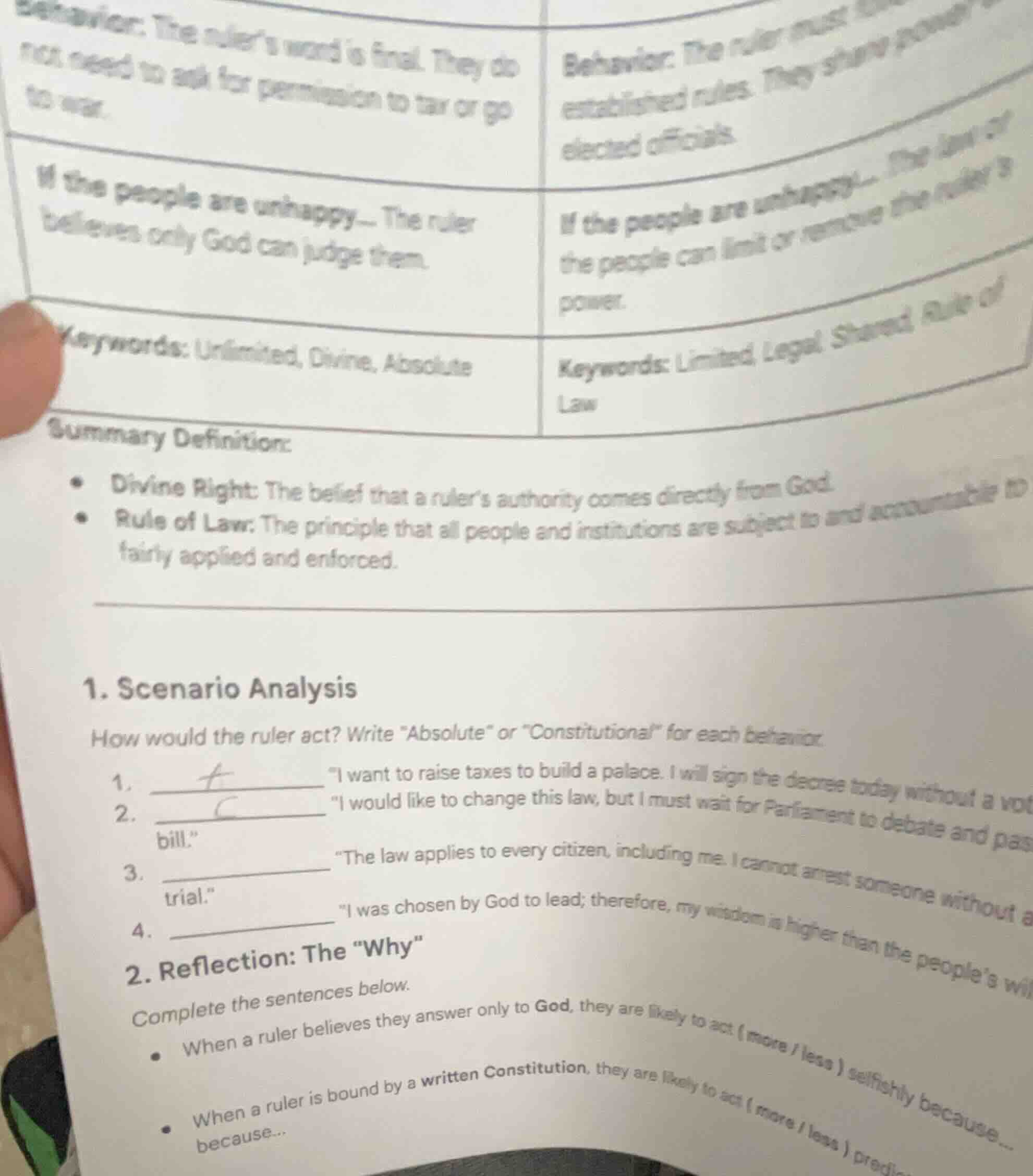
behavior: the ruler’s word is final. they do not need to ask for permission to tax or go to war.
behavior: the ruler must follow established rules. they share power with elected officials.
if the people are unhappy— the ruler believes only god can judge them.
if the people are unhappy— the law of the people can limit or remove the ruler’s power.
keywords: unlimited, divine, absolute
keywords: limited, legal, shared, rule of law
summary definition:
- divine right: the belief that a ruler’s authority comes directly from god.
- rule of law: the principle that all people and institutions are subject to and accountable to fairly applied and enforced.
- scenario analysis
how would the ruler act? write “absolute” or “constitutional” for each behavior.
- ______ “i want to raise taxes to build a palace. i will sign the decree today without a vot
- ______ “i would like to change this law, but i must wait for parliament to debate and pass bill.”
- ______ “the law applies to every citizen, including me. i cannot arrest someone without a trial.”
- ______ “i was chosen by god to lead; therefore, my wisdom is higher than the people’s wi
- reflection: the “why”
complete the sentences below.
- when a ruler believes they answer only to god, they are likely to act (more / less) selfishly because…
- when a ruler is bound by a written constitution, they are likely to act (more / less) predic because…
Brief Explanations
- For scenario 3: The ruler acknowledges the law applies to everyone, including themselves, which aligns with constitutional (limited, rule of law) governance.
- For scenario 4: The ruler claims divine appointment and superiority over the people's will, which matches absolute (divine right, unlimited power) rule.
- For reflection 1: A ruler accountable only to God faces no human checks, so they act more selfishly.
- For reflection 2: A ruler bound by a constitution is limited by law, so they act more predictably.

Snap & solve any problem in the app
Get step-by-step solutions on Sovi AI
Photo-based solutions with guided steps
Explore more problems and detailed explanations
- Absolute
- Constitutional
- Constitutional
- Absolute
- When a ruler believes they answer only to God, they are likely to act more selfishly because... they face no accountability to the people and claim unlimited, divine authority.
- When a ruler is bound by a written Constitution, they are likely to act more predictably because... their power is limited by established laws and shared with governing bodies.