QUESTION IMAGE
Question
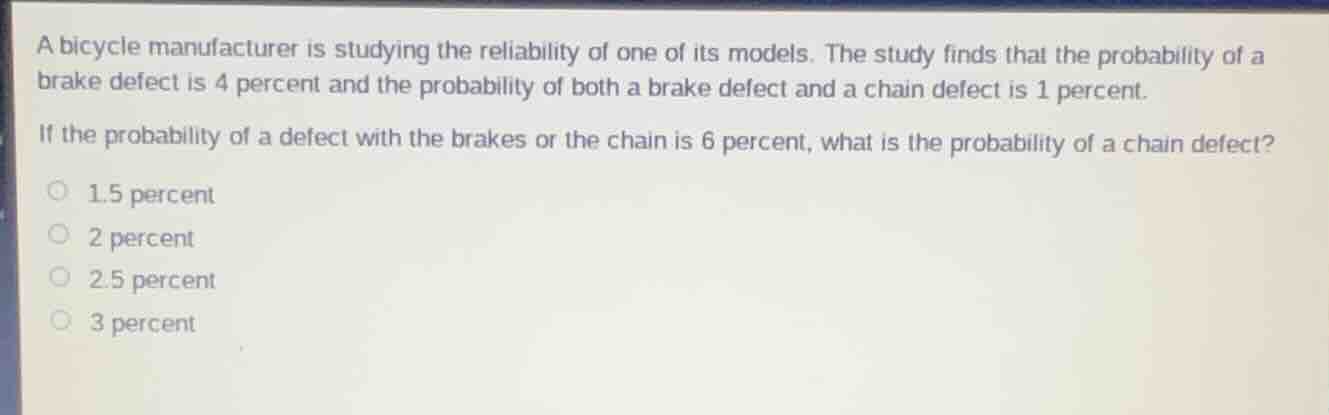
a bicycle manufacturer is studying the reliability of one of its models. the study finds that the probability of a brake defect is 4 percent and the probability of both a brake defect and a chain defect is 1 percent. if the probability of a defect with the brakes or the chain is 6 percent, what is the probability of a chain defect? 1.5 percent 2 percent 2.5 percent 3 percent
Step1: Recall the formula for the probability of the union of two events
The formula for the probability of the union of two events \( A \) and \( B \) is \( P(A \cup B) = P(A) + P(B) - P(A \cap B) \). Let \( A \) be the event of a brake defect and \( B \) be the event of a chain defect. We know \( P(A) = 0.04 \), \( P(A \cap B) = 0.01 \), and \( P(A \cup B) = 0.06 \). We need to find \( P(B) \).
Step2: Rearrange the formula to solve for \( P(B) \)
From \( P(A \cup B) = P(A) + P(B) - P(A \cap B) \), we can rearrange it to \( P(B) = P(A \cup B) - P(A) + P(A \cap B) \).
Step3: Substitute the known values into the formula
Substitute \( P(A \cup B) = 0.06 \), \( P(A) = 0.04 \), and \( P(A \cap B) = 0.01 \) into the formula: \( P(B) = 0.06 - 0.04 + 0.01 \).
Step4: Calculate the value of \( P(B) \)
First, \( 0.06 - 0.04 = 0.02 \), then \( 0.02 + 0.01 = 0.03 \). So \( P(B) = 0.03 \) or 3 percent.

Snap & solve any problem in the app
Get step-by-step solutions on Sovi AI
Photo-based solutions with guided steps
Explore more problems and detailed explanations
3 percent