QUESTION IMAGE
Question
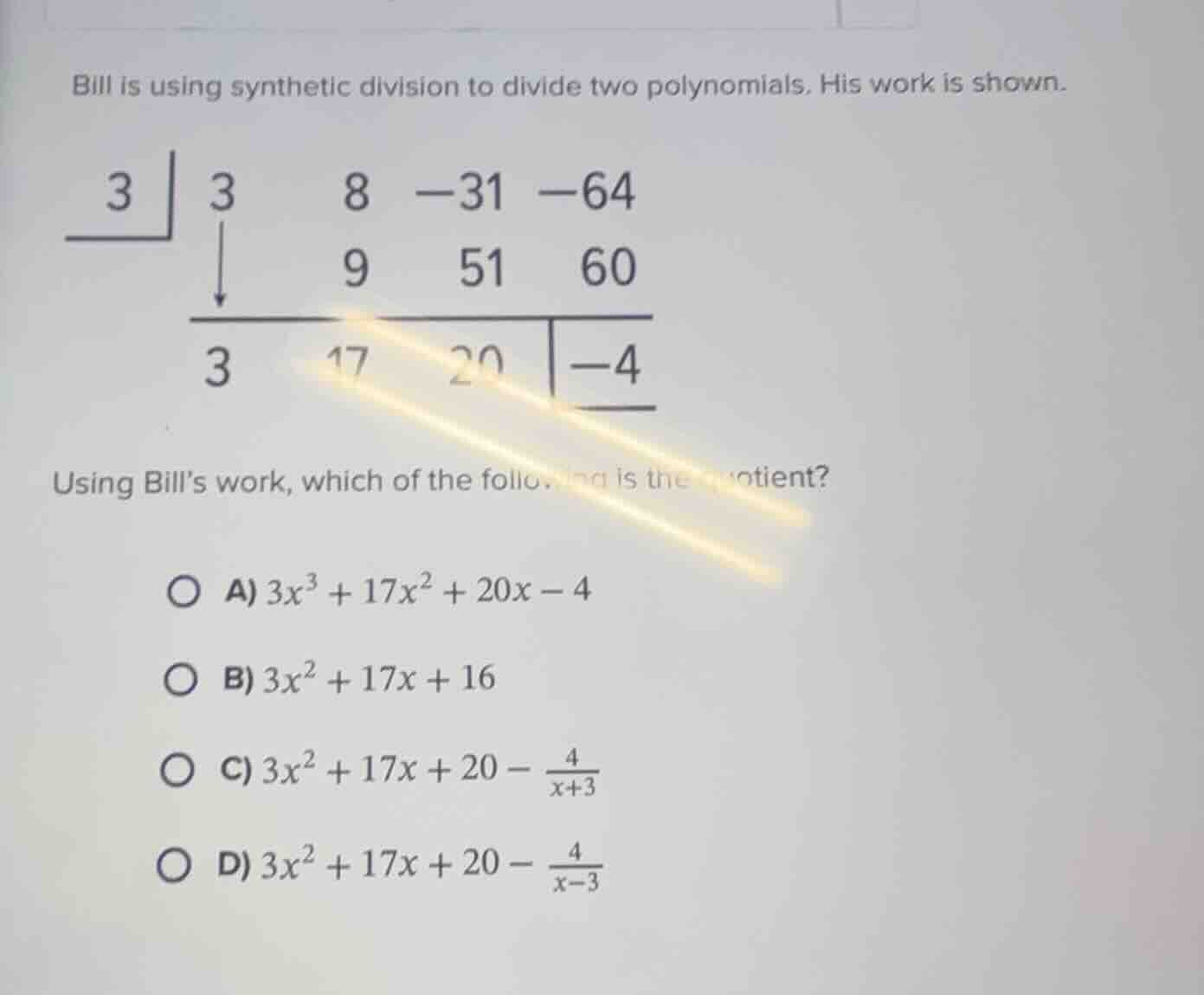
bill is using synthetic division to divide two polynomials. his work is shown.
using bill’s work, which of the following is the quotient?
a) $3x^3 + 17x^2 + 20x - 4$
b) $3x^2 + 17x + 16$
c) $3x^2 + 17x + 20 - \frac{4}{x + 3}$
d) $3x^2 + 17x + 20 - \frac{4}{x - 3}$
Step1: Recall Synthetic Division
Synthetic division is used to divide a polynomial \( f(x) \) by \( (x - c) \). The coefficients of the dividend are used, and the root \( c \) is the number outside (here, \( c = 3 \), so we're dividing by \( x - 3 \)). The bottom row (excluding the last number) gives the coefficients of the quotient polynomial, and the last number is the remainder.
Step2: Analyze the Coefficients
The dividend polynomial (from the top row) has coefficients \( 3, 8, -31, -64 \), so it's a cubic polynomial \( 3x^3 + 8x^2 - 31x - 64 \). We divide by \( x - 3 \) (since \( c = 3 \)).
The bottom row after division is \( 3, 17, 20, -4 \). The first three numbers (\( 3, 17, 20 \)) are the coefficients of the quotient polynomial, and \( -4 \) is the remainder.
Step3: Form the Quotient and Remainder
The quotient polynomial will be of degree one less than the dividend (since we divided by a linear term). The dividend is cubic (\( \text{degree } 3 \)), so the quotient is quadratic (\( \text{degree } 2 \)). Using the coefficients \( 3, 17, 20 \), the quotient polynomial is \( 3x^2 + 17x + 20 \), and the remainder is \( -4 \).
In polynomial division, \( \frac{f(x)}{x - c} = \text{quotient} + \frac{\text{remainder}}{x - c} \). So here, \( \frac{3x^3 + 8x^2 - 31x - 64}{x - 3} = 3x^2 + 17x + 20 + \frac{-4}{x - 3} \), which simplifies to \( 3x^2 + 17x + 20 - \frac{4}{x - 3} \).

Snap & solve any problem in the app
Get step-by-step solutions on Sovi AI
Photo-based solutions with guided steps
Explore more problems and detailed explanations
D) \( 3x^2 + 17x + 20 - \frac{4}{x - 3} \)