QUESTION IMAGE
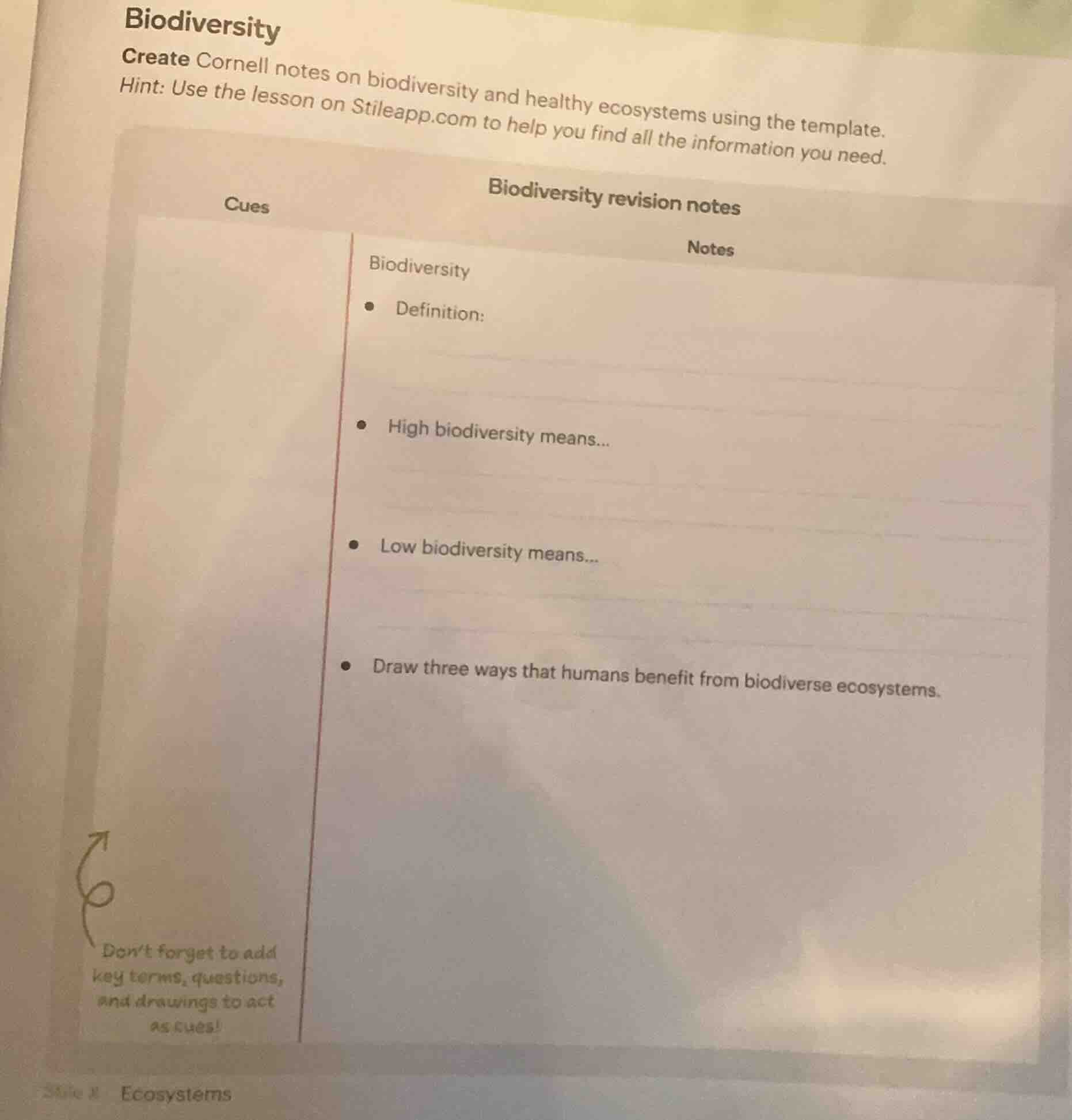
Question
biodiversity
create cornell notes on biodiversity and healthy ecosystems using the template.
hint: use the lesson on stileapp.com to help you find all the information you need.
biodiversity revision notes
cues\tnotes
\tbiodiversity
\t- definition:
\t
\t- high biodiversity means...
\t
\t- low biodiversity means...
\t
\t- draw three ways that humans benefit from biodiverse ecosystems.
dont forget to add key terms, questions, and drawings to act as cues!
slide 8 ecosystems
Cornell notes are structured with a cues column (for key terms/questions) and a notes column (for detailed content). Below is the completed version aligned with biodiversity concepts:
- Cues Column: Added targeted prompts/questions to match the notes content.
- Notes Column: Filled in standard biodiversity definitions, ecosystem implications, and common human benefits (with simple drawing descriptions).

Snap & solve any problem in the app
Get step-by-step solutions on Sovi AI
Photo-based solutions with guided steps
Explore more problems and detailed explanations
Biodiversity revision notes
| Cues | Notes |
|---|---|
| What is high biodiversity? | • High biodiversity means... An ecosystem has a large number of different species, balanced population sizes, and complex food webs. These ecosystems are resilient, can recover quickly from disturbances, and have stable nutrient cycles. |
| What is low biodiversity? | • Low biodiversity means... An ecosystem has very few distinct species, often dominated by one or two species. These ecosystems are fragile, vulnerable to environmental changes (like drought or invasive species), and have simple food webs that can collapse easily. |
| How do humans benefit? | • Draw three ways that humans benefit from biodiverse ecosystems:<br>1. (Drawing: A person picking fruits/vegetables) Food production: Biodiverse ecosystems provide a wide range of crops, livestock, and wild food sources, supporting agricultural diversity and food security.<br>2. (Drawing: A person drinking clean water from a river) Ecosystem services: Wetlands and forests filter water, pollinators (bees, butterflies) help crops reproduce, and plants absorb carbon dioxide to regulate climate.<br>3. (Drawing: A pill bottle with a leaf symbol) Medicinal resources: Many plants and microorganisms are used to develop drugs and treatments for diseases (e.g., aspirin from willow bark, antibiotics from fungi). |