QUESTION IMAGE
Question
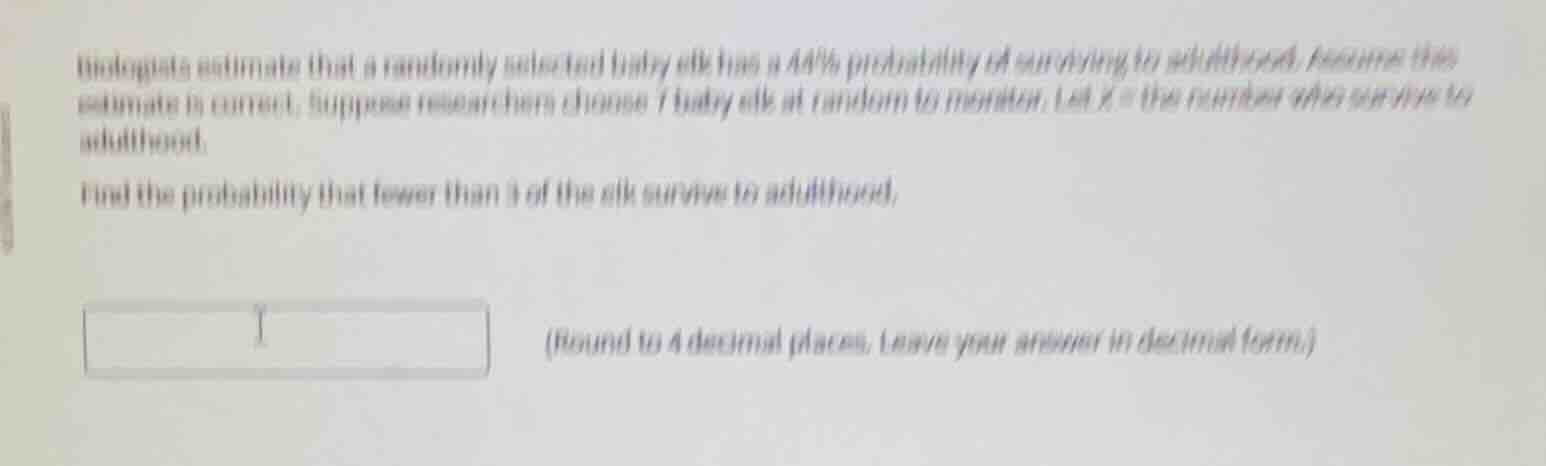
biologists estimate that a randomly selected baby elk has a 44% probability of surviving to adulthood. assume this estimate is correct. suppose researchers choose 7 baby elk at random to monitor. let x = the number who survive to adulthood. find the probability that fewer than 3 of the elk survive to adulthood. (round to 4 decimal places. leave your answer in decimal form.)
This is a binomial probability problem. The binomial probability formula is \( P(X = k) = \binom{n}{k} p^k (1 - p)^{n - k} \), where \( n \) is the number of trials, \( k \) is the number of successes, \( p \) is the probability of success on a single trial, and \( \binom{n}{k} \) is the combination of \( n \) things taken \( k \) at a time.
We have \( n = 7 \) (number of baby elk), \( p = 0.44 \) (probability of surviving to adulthood), and we need to find \( P(X < 3) \), which is \( P(X = 0) + P(X = 1) + P(X = 2) \).
Step 1: Calculate \( P(X = 0) \)
Using the binomial formula:
\( P(X = 0) = \binom{7}{0} (0.44)^0 (1 - 0.44)^{7 - 0} \)
\( \binom{7}{0} = 1 \), \( (0.44)^0 = 1 \), \( (0.56)^7 \approx 0.0225 \)
So, \( P(X = 0) \approx 1 \times 1 \times 0.0225 = 0.0225 \)
Step 2: Calculate \( P(X = 1) \)
\( P(X = 1) = \binom{7}{1} (0.44)^1 (0.56)^{6} \)
\( \binom{7}{1} = 7 \), \( (0.44)^1 = 0.44 \), \( (0.56)^6 \approx 0.0402 \)
So, \( P(X = 1) \approx 7 \times 0.44 \times 0.0402 \approx 7 \times 0.0177 = 0.1239 \)
Step 3: Calculate \( P(X = 2) \)
\( P(X = 2) = \binom{7}{2} (0.44)^2 (0.56)^{5} \)
\( \binom{7}{2} = \frac{7!}{2!(7 - 2)!} = 21 \), \( (0.44)^2 = 0.1936 \), \( (0.56)^5 \approx 0.0718 \)
So, \( P(X = 2) \approx 21 \times 0.1936 \times 0.0718 \approx 21 \times 0.0139 = 0.2919 \)
Step 4: Sum the probabilities
\( P(X < 3) = P(X = 0) + P(X = 1) + P(X = 2) \approx 0.0225 + 0.1239 + 0.2919 = 0.4383 \)

Snap & solve any problem in the app
Get step-by-step solutions on Sovi AI
Photo-based solutions with guided steps
Explore more problems and detailed explanations
0.4383