QUESTION IMAGE
Question
biology
all year - write the letter of the word on the correct line.
____1.
____2.
____3.
____4.
a. atp
b. passive transport
c. active transport
d. glucose
yesterday - answer the questions below.
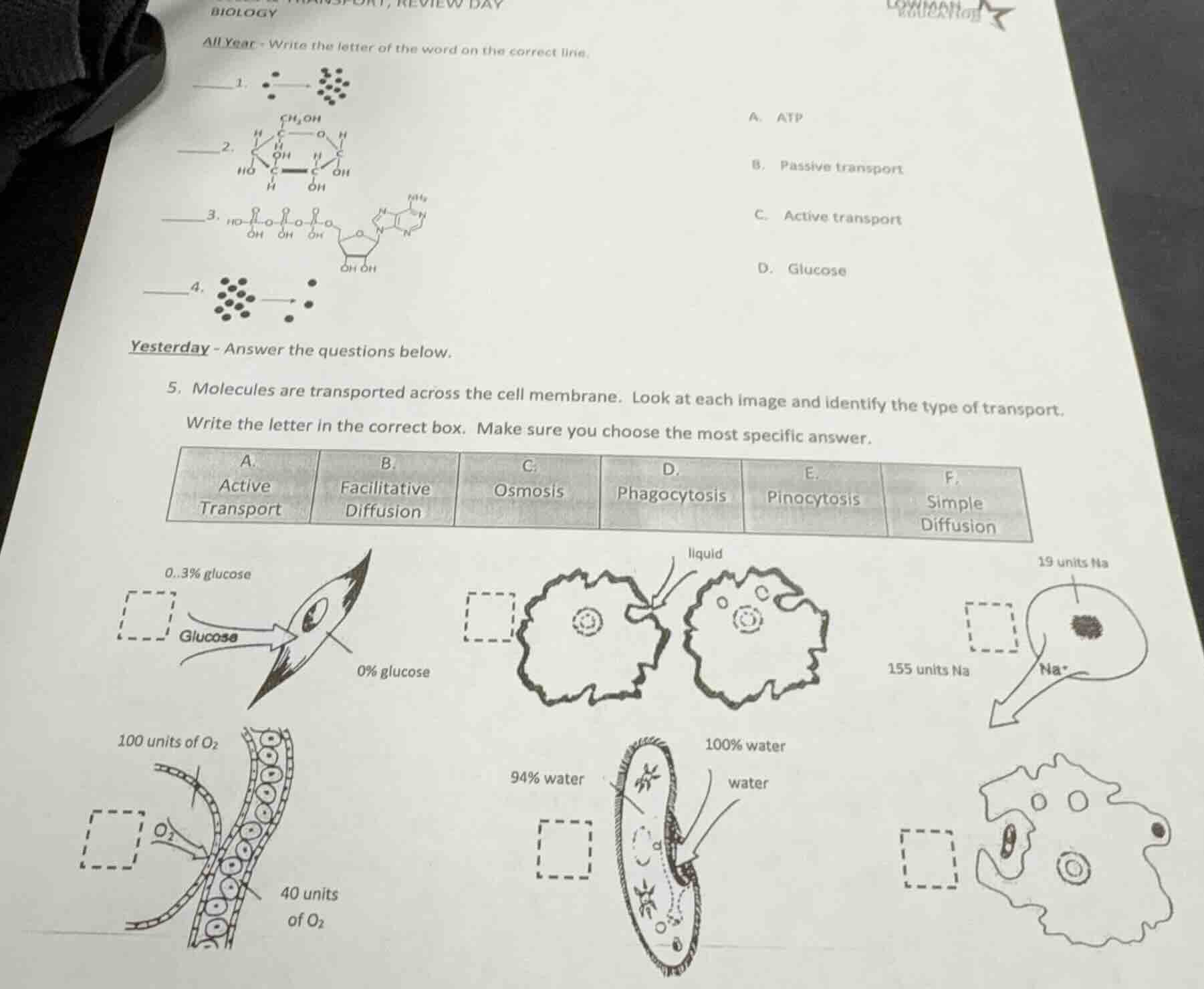
- molecules are transported across the cell membrane. look at each image and identify the type of transport.
write the letter in the correct box. make sure you choose the most specific answer.
a. active transport b. facilitative diffusion c. osmosis d. phagocytosis e. pinocytosis f. simple diffusion
Response
All Year Section (1 - 4)
1.
- Explanation: The diagram shows molecules moving from low to high concentration (against the gradient), which requires energy, so it's Active transport (C).
- Answer: C. Active transport
2.
- Explanation: The structure is a glucose molecule (a 6 - carbon sugar structure), so it's D.
- Answer: D. Glucose
3.
- Explanation: The structure has adenine, ribose, and three phosphate groups, which is ATP (A).
- Answer: A. ATP
4.
- Explanation: Molecules are moving from high to low concentration (down the gradient) without energy, so it's Passive transport (B).
- Answer: B. Passive transport
Yesterday Section (5 - Image - based)
First Image (Glucose transport: 0.3% to 0% glucose)
- Explanation: Glucose moving from higher to lower concentration but through a protein (since glucose is polar), so it's Facilitative Diffusion (B).
- Answer: B. Facilitative Diffusion
Second Image (Liquid uptake)
- Explanation: Cell taking in liquid, which is Pinocytosis (E).
- Answer: E. Pinocytosis
Third Image (Na⁺ transport: 155 to 19 units)
- Explanation: Na⁺ moving from low to high concentration (against gradient), so it's Active Transport (A).
- Answer: A. Active Transport
Fourth Image (O₂ transport: 100 to 40 units)
- Explanation: O₂ is non - polar, moving from high to low concentration directly through membrane, so it's Simple Diffusion (F).
- Answer: F. Simple Diffusion
Fifth Image (Water transport: 100% to 94% water)
- Explanation: Water moving across membrane, so it's Osmosis (C).
- Answer: C. Osmosis
Sixth Image (Large particle uptake)
- Explanation: Cell taking in a large particle, which is Phagocytosis (D).
- Answer: D. Phagocytosis

Snap & solve any problem in the app
Get step-by-step solutions on Sovi AI
Photo-based solutions with guided steps
Explore more problems and detailed explanations
All Year Section (1 - 4)
1.
- Explanation: The diagram shows molecules moving from low to high concentration (against the gradient), which requires energy, so it's Active transport (C).
- Answer: C. Active transport
2.
- Explanation: The structure is a glucose molecule (a 6 - carbon sugar structure), so it's D.
- Answer: D. Glucose
3.
- Explanation: The structure has adenine, ribose, and three phosphate groups, which is ATP (A).
- Answer: A. ATP
4.
- Explanation: Molecules are moving from high to low concentration (down the gradient) without energy, so it's Passive transport (B).
- Answer: B. Passive transport
Yesterday Section (5 - Image - based)
First Image (Glucose transport: 0.3% to 0% glucose)
- Explanation: Glucose moving from higher to lower concentration but through a protein (since glucose is polar), so it's Facilitative Diffusion (B).
- Answer: B. Facilitative Diffusion
Second Image (Liquid uptake)
- Explanation: Cell taking in liquid, which is Pinocytosis (E).
- Answer: E. Pinocytosis
Third Image (Na⁺ transport: 155 to 19 units)
- Explanation: Na⁺ moving from low to high concentration (against gradient), so it's Active Transport (A).
- Answer: A. Active Transport
Fourth Image (O₂ transport: 100 to 40 units)
- Explanation: O₂ is non - polar, moving from high to low concentration directly through membrane, so it's Simple Diffusion (F).
- Answer: F. Simple Diffusion
Fifth Image (Water transport: 100% to 94% water)
- Explanation: Water moving across membrane, so it's Osmosis (C).
- Answer: C. Osmosis
Sixth Image (Large particle uptake)
- Explanation: Cell taking in a large particle, which is Phagocytosis (D).
- Answer: D. Phagocytosis