QUESTION IMAGE
Question
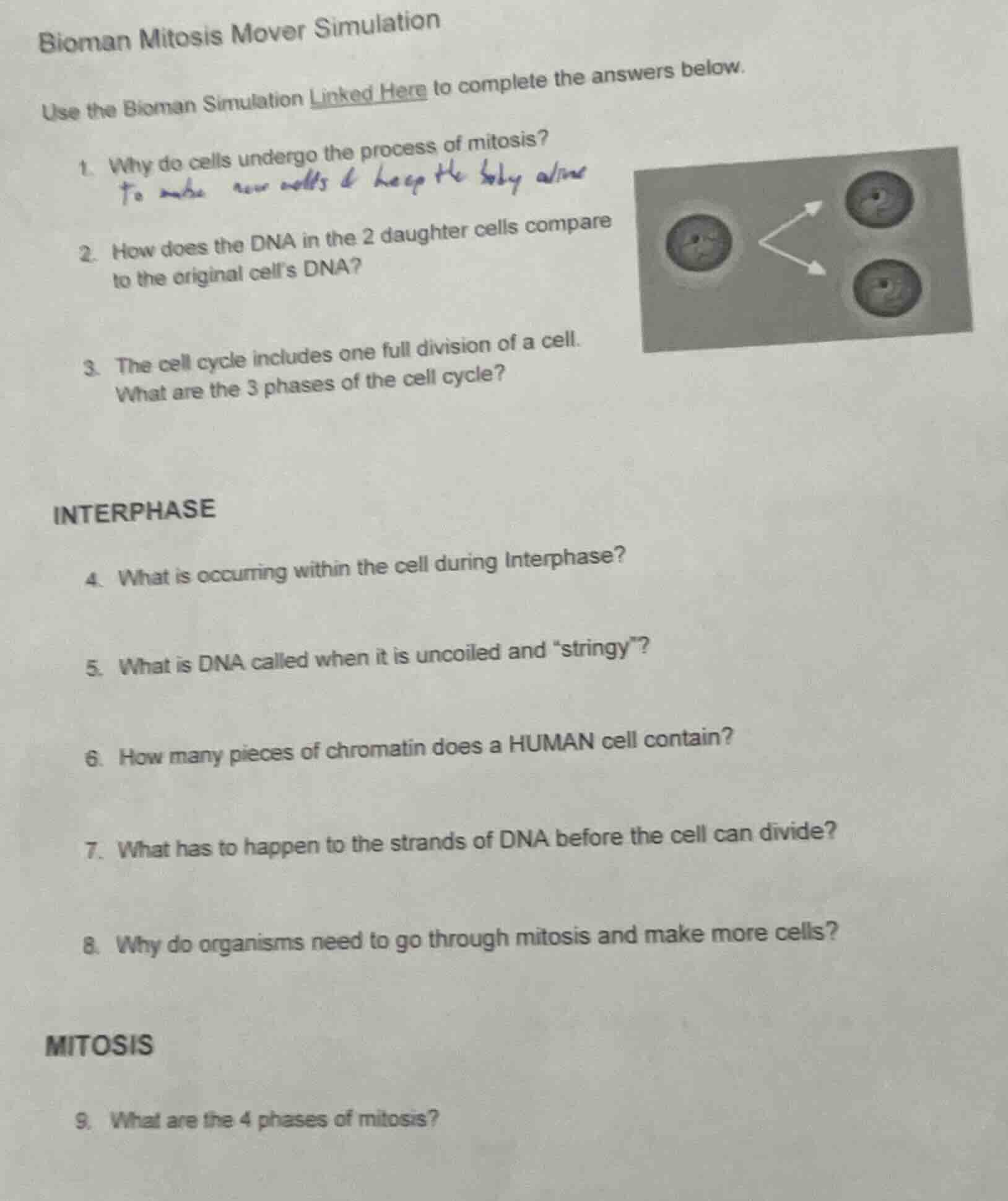
bioman mitosis mover simulation
use the bioman simulation linked here to complete the answers below.
- why do cells undergo the process of mitosis?
- how does the dna in the 2 daughter cells compare to the original cell’s dna?
- the cell cycle includes one full division of a cell. what are the 3 phases of the cell cycle?
interphase
- what is occurring within the cell during interphase?
- what is dna called when it is uncoiled and \stringy\?
- how many pieces of chromatin does a human cell contain?
- what has to happen to the strands of dna before the cell can divide?
- why do organisms need to go through mitosis and make more cells?
mitosis
- what are the 4 phases of mitosis?
Brief Explanations
- Mitosis creates new cells for growth, repair, and replacing old/damaged cells, as well as asexual reproduction in some organisms.
- Mitosis produces genetically identical cells, so the DNA in the two daughter cells is an exact copy of the original cell's DNA.
- The three core phases of the full cell cycle are the growth and preparation phase, the nuclear division phase, and the final cytoplasmic division phase.
- During interphase, the cell grows in size, carries out its normal metabolic functions, duplicates its DNA, and prepares the necessary structures for cell division.
- Uncoiled, stringy DNA (the form present when the cell is not dividing) is called chromatin.
- Human somatic cells have 46 pieces of chromatin (matching the 46 chromosomes they contain).
- For a cell to divide, the DNA strands must replicate (make an exact copy of themselves) so each daughter cell gets a full set of genetic material.
- Organisms need mitosis to grow in size, repair injured or damaged tissues, replace dead or worn-out cells, and in some cases, reproduce asexually.
- The four sequential phases of mitosis are the phase where chromosomes condense and the nuclear envelope breaks down, the phase where chromosomes line up at the cell's equator, the phase where sister chromatids separate and move to opposite poles, and the phase where chromosomes decondense and new nuclear envelopes form.

Snap & solve any problem in the app
Get step-by-step solutions on Sovi AI
Photo-based solutions with guided steps
Explore more problems and detailed explanations
- To grow, repair damaged tissue, replace old cells, and (for some organisms) reproduce asexually.
- The DNA in the two daughter cells is genetically identical to the original cell's DNA (it is an exact copy).
- Interphase, Mitosis, Cytokinesis
- The cell grows, performs normal functions, replicates its DNA, and prepares for division.
- Chromatin
- 46
- The DNA strands must replicate (make an exact copy of themselves).
- For growth, repair of damaged cells/tissues, replacement of old cells, and asexual reproduction (in some organisms).
- Prophase, Metaphase, Anaphase, Telophase