QUESTION IMAGE
Question
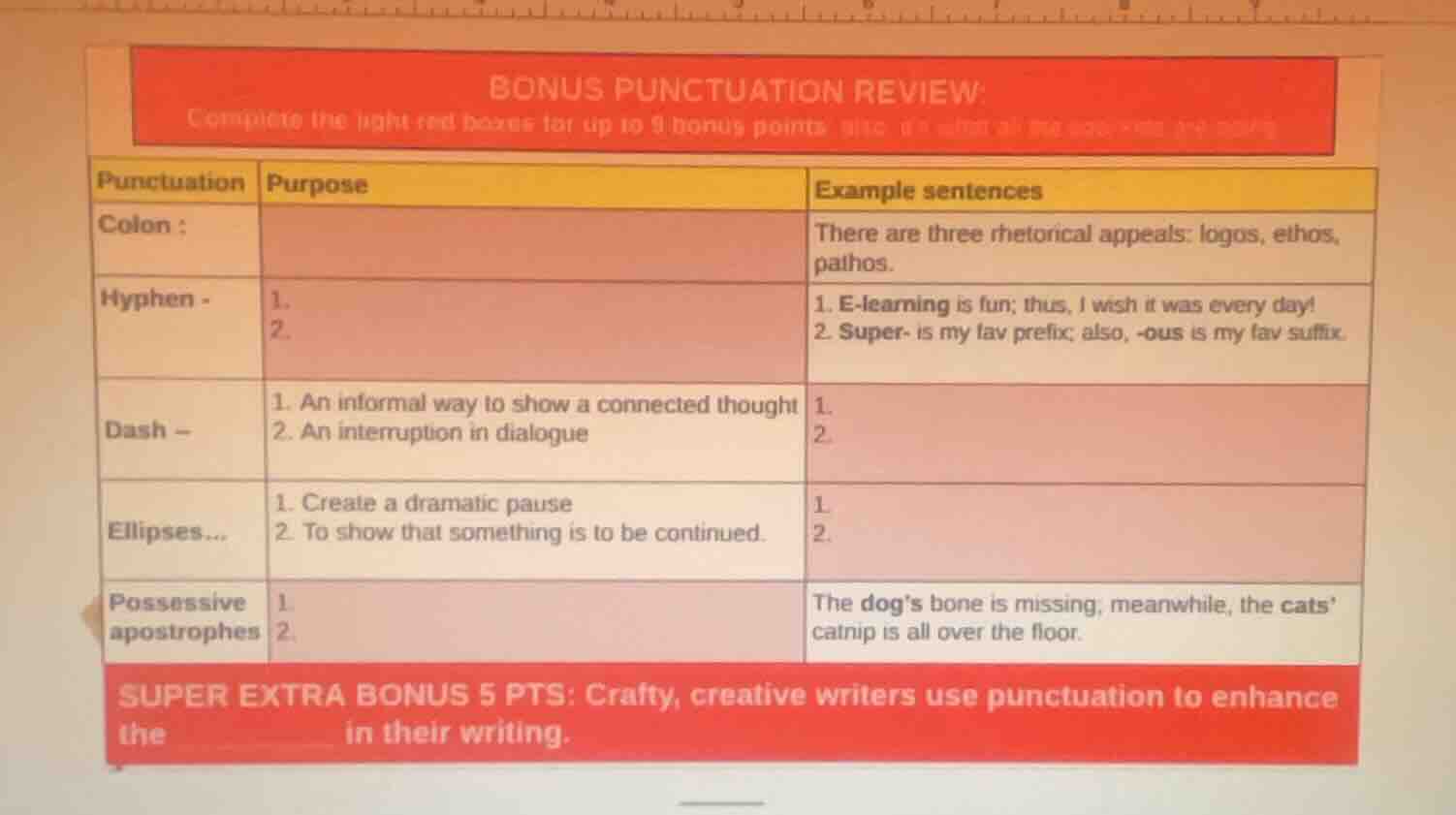
bonus punctuation review: complete the light red boxes for up to 9 bonus points. also, its what all the cool kids are doing.
| punctuation | purpose | example sentences |
|---|
| hyphen - | 1.
- | 1. e - learning is fun; thus, i wish it was every day!
- super - is my fav prefix; also, - ous is my fav suffix. |
| dash – | 1. an informal way to show a connected thought
- an interruption in dialogue | 1.
- |
| ellipses... | 1. create a dramatic pause
- to show that something is to be continued. | 1.
- |
| possessive apostrophes | 1.
- | the dogs bone is missing; meanwhile, the cats catnip is all over the floor. |
super extra bonus 5 pts: crafty, creative writers use punctuation to enhance the ______ in their writing.
To solve this punctuation review, we analyze each punctuation mark:
Colon (:)
- Purpose: To introduce a list, explanation, or clarification.
- Example matches (introduces list of rhetorical appeals).
Hyphen (-)
- Purpose 1: To join compound words (e.g., E-learning).
- Purpose 2: To separate prefixes/suffixes from root words (e.g., Super-, -ous).
Dash (–)
- Example 1: I love reading—especially fantasy novels. (shows connected thought).
- Example 2: “I was going to say—” she paused, “never mind.” (interruption in dialogue).
Ellipses (…)
- Example 1: She walked slowly… as if lost in thought. (dramatic pause).
- Example 2: The story continued… to be told another day. (something to be continued).
Possessive Apostrophes (’/’)
- Purpose 1: To show singular possession (e.g., dog’s).
- Purpose 2: To show plural possession (e.g., cats’).
Super Extra Bonus
Crafty writers use punctuation to enhance the tone, flow, or emphasis in their writing.
Final Answers (Filling the Table):
- Colon Purpose: To introduce a list, explanation, or clarification.
- Hyphen Purposes: 1. Join compound words; 2. Separate prefixes/suffixes from root words
- Dash Examples: 1. I love reading—especially fantasy novels.; 2. “I was going to say—” she paused, “never mind.”
- Ellipses Examples: 1. She walked slowly… as if lost in thought.; 2. The story continued… to be told another day.
- Possessive Apostrophes Purposes: 1. Show singular possession; 2. Show plural possession
- Super Extra Bonus: tone (or flow/emphasis)

Snap & solve any problem in the app
Get step-by-step solutions on Sovi AI
Photo-based solutions with guided steps
Explore more problems and detailed explanations
To solve this punctuation review, we analyze each punctuation mark:
Colon (:)
- Purpose: To introduce a list, explanation, or clarification.
- Example matches (introduces list of rhetorical appeals).
Hyphen (-)
- Purpose 1: To join compound words (e.g., E-learning).
- Purpose 2: To separate prefixes/suffixes from root words (e.g., Super-, -ous).
Dash (–)
- Example 1: I love reading—especially fantasy novels. (shows connected thought).
- Example 2: “I was going to say—” she paused, “never mind.” (interruption in dialogue).
Ellipses (…)
- Example 1: She walked slowly… as if lost in thought. (dramatic pause).
- Example 2: The story continued… to be told another day. (something to be continued).
Possessive Apostrophes (’/’)
- Purpose 1: To show singular possession (e.g., dog’s).
- Purpose 2: To show plural possession (e.g., cats’).
Super Extra Bonus
Crafty writers use punctuation to enhance the tone, flow, or emphasis in their writing.
Final Answers (Filling the Table):
- Colon Purpose: To introduce a list, explanation, or clarification.
- Hyphen Purposes: 1. Join compound words; 2. Separate prefixes/suffixes from root words
- Dash Examples: 1. I love reading—especially fantasy novels.; 2. “I was going to say—” she paused, “never mind.”
- Ellipses Examples: 1. She walked slowly… as if lost in thought.; 2. The story continued… to be told another day.
- Possessive Apostrophes Purposes: 1. Show singular possession; 2. Show plural possession
- Super Extra Bonus: tone (or flow/emphasis)