QUESTION IMAGE
Question
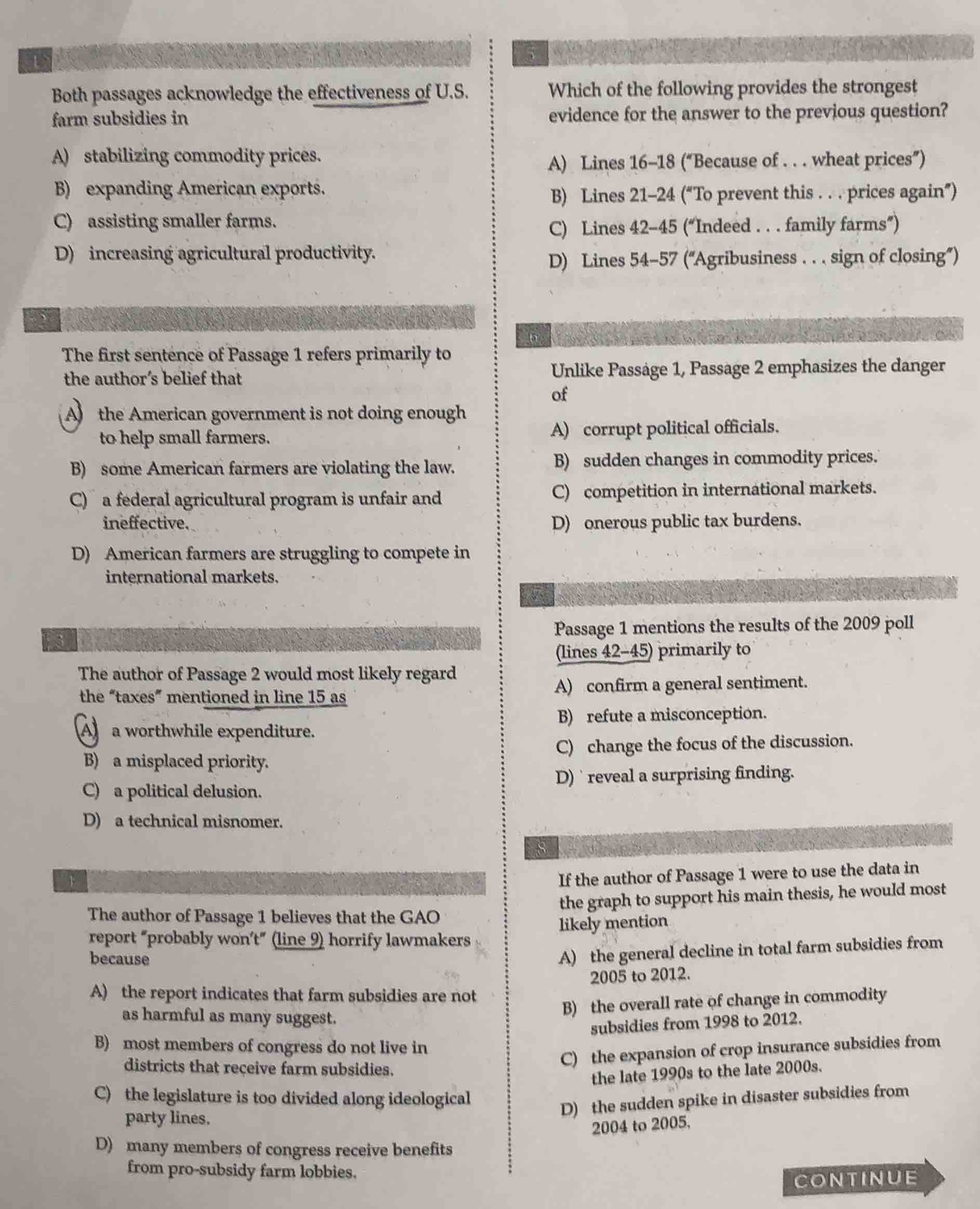
1
both passages acknowledge the effectiveness of u.s. farm subsidies in
a) stabilizing commodity prices.
b) expanding american exports.
c) assisting smaller farms.
d) increasing agricultural productivity.
2
the first sentence of passage 1 refers primarily to the author’s belief that
a) the american government is not doing enough to help small farmers.
b) some american farmers are violating the law.
c) a federal agricultural program is unfair and ineffective.
d) american farmers are struggling to compete in international markets.
3
the author of passage 2 would most likely regard the “taxes” mentioned in line 15 as
a) a worthwhile expenditure.
b) a misplaced priority.
c) a political delusion.
d) a technical misnomer.
4
the author of passage 1 believes that the gao report “probably won’t” (line 9) horrify lawmakers because
a) the report indicates that farm subsidies are not as harmful as many suggest.
b) most members of congress do not live in districts that receive farm subsidies.
c) the legislature is too divided along ideological party lines.
d) many members of congress receive benefits from pro - subsidy farm lobbies.
5
which of the following provides the strongest evidence for the answer to the previous question?
a) lines 16 - 18 (“because of... wheat prices”)
b) lines 21 - 24 (“to prevent this... prices again”)
c) lines 42 - 45 (“indeed... family farms”)
d) lines 54 - 57 (“agribusiness... sign of closing”)
6
unlike passage 1, passage 2 emphasizes the danger of
a) corrupt political officials.
b) sudden changes in commodity prices.
c) competition in international markets.
d) onerous public tax burdens.
7
passage 1 mentions the results of the 2009 poll (lines 42 - 45) primarily to
a) confirm a general sentiment.
b) refute a misconception.
c) change the focus of the discussion.
d) reveal a surprising finding.
8
if the author of passage 1 were to use the data in the graph to support his main thesis, he would most likely mention
a) the general decline in total farm subsidies from 2005 to 2012.
b) the overall rate of change in commodity subsidies from 1998 to 2012.
c) the expansion of crop insurance subsidies from the late 1990s to the late 2000s.
d) the sudden spike in disaster subsidies from 2004 to 2005.
Question 1
To solve this, we analyze each option. For U.S. farm subsidies, stabilizing commodity prices is a known effect (e.g., subsidies can buffer price fluctuations). Expanding exports isn't a core acknowledged effect by both passages, assisting smaller farms is often debated (subsidies may favor large farms), and increasing productivity isn't the main acknowledged effect. So A is correct.
The first sentence of Passage 1 (contextually about farm subsidies) likely critiques the program. Option C says the federal agricultural program is unfair and ineffective, which aligns with a critical view. A is about government effort (not the focus), B about law - violation (unrelated), D about international competition (not the first sentence's focus).
The "taxes" in line 15 (related to farm subsidies) – the author of Passage 2 likely sees them as a worthwhile expenditure (A) if the passage views subsidies positively. B (misplaced priority) is negative, C (political delusion) is too extreme, D (technical misnomer) is irrelevant.

Snap & solve any problem in the app
Get step-by-step solutions on Sovi AI
Photo-based solutions with guided steps
Explore more problems and detailed explanations
A) stabilizing commodity prices.