QUESTION IMAGE
Question
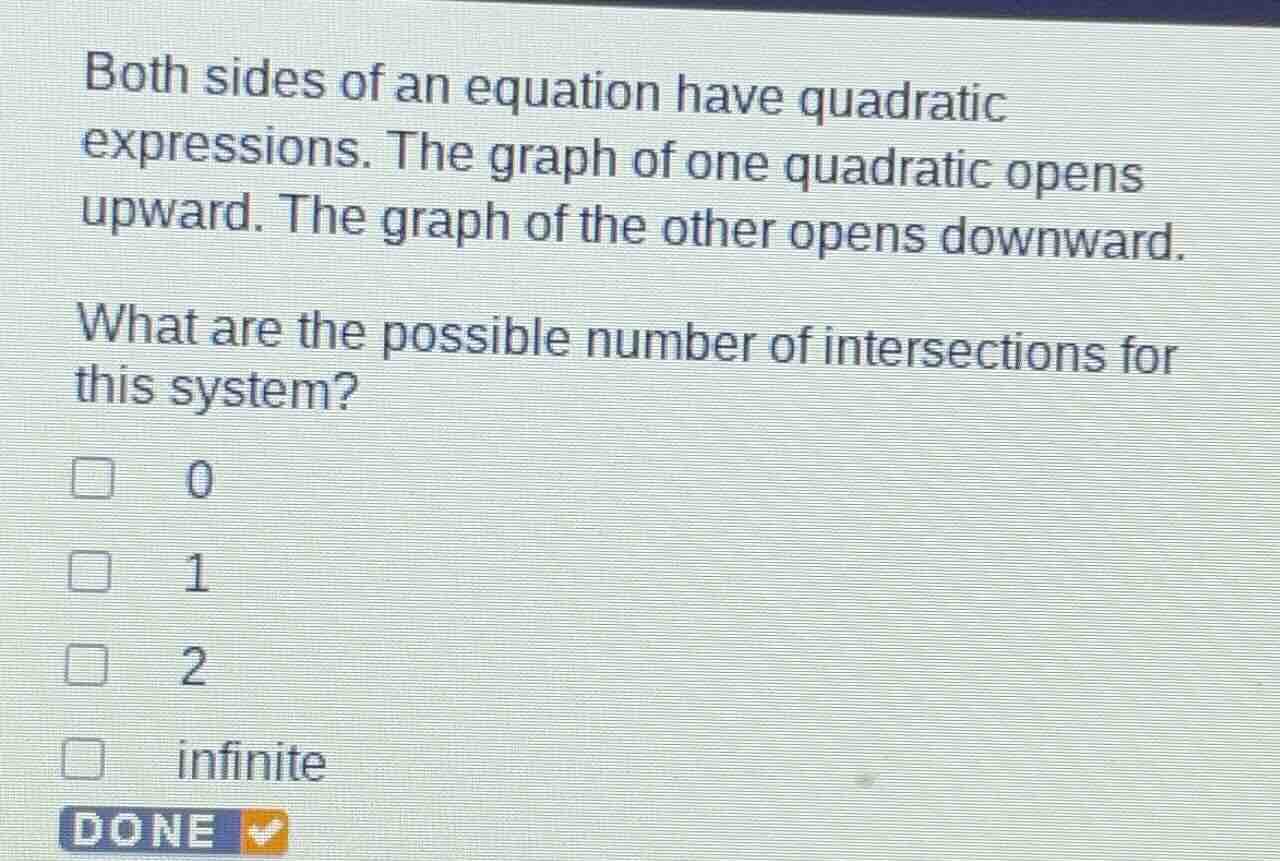
both sides of an equation have quadratic expressions. the graph of one quadratic opens upward. the graph of the other opens downward. what are the possible number of intersections for this system? 0 1 2 infinite done
Step1: Set up the system
Let upward quadratic: $y = ax^2+bx+c$ ($a>0$), downward quadratic: $y = dx^2+ex+f$ ($d<0$). Set equal: $ax^2+bx+c = dx^2+ex+f$
Step2: Simplify to single quadratic
Rearrange: $(a-d)x^2+(b-e)x+(c-f)=0$. Since $a-d>0$ (sum of positive and positive, as $d<0$), this is a quadratic opening upward.
Step3: Analyze discriminant
For quadratic $Ax^2+Bx+C=0$, discriminant $\Delta=B^2-4AC$.
- $\Delta<0$: 0 real solutions (0 intersections)
- $\Delta=0$: 1 real solution (1 intersection)
- $\Delta>0$: 2 real solutions (2 intersections)
Infinite intersections only if quadratics are identical, impossible here (one opens up, one down).

Snap & solve any problem in the app
Get step-by-step solutions on Sovi AI
Photo-based solutions with guided steps
Explore more problems and detailed explanations
0, 1, 2