QUESTION IMAGE
Question
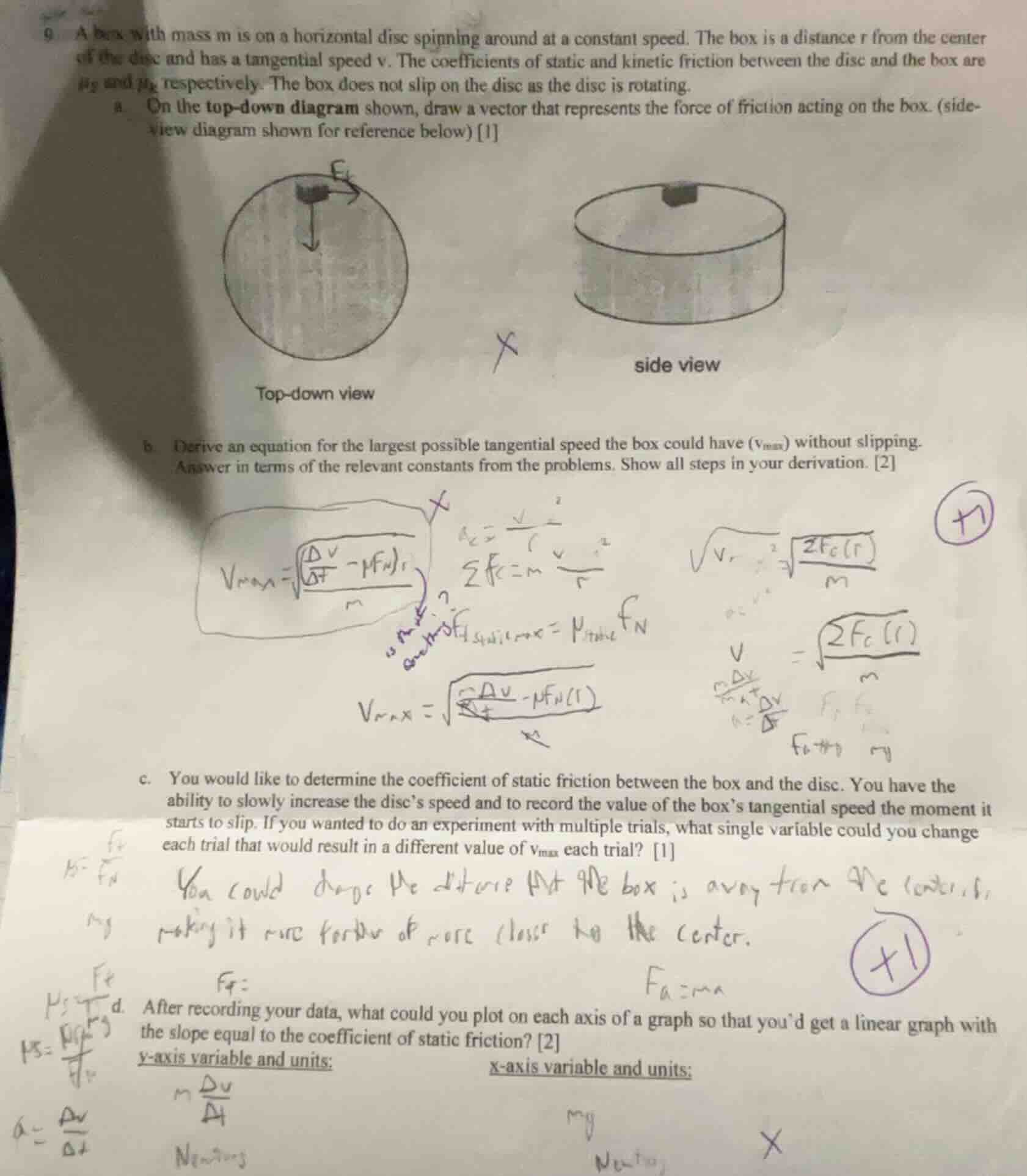
- a box with mass m is on a horizontal disc spinning around at a constant speed. the box is a distance r from the center of the disc and has a tangential speed v. the coefficients of static and kinetic friction between the disc and the box are $mu_s$ and $mu_k$ respectively. the box does not slip on the disc as the disc is rotating.
a. on the top-down diagram shown, draw a vector that represents the force of friction acting on the box. (side-view diagram shown for reference below) 1
b. derive an equation for the largest possible tangential speed the box could have ($v_{max}$) without slipping. answer in terms of the relevant constants from the problems. show all steps in your derivation. 2
c. you would like to determine the coefficient of static friction between the box and the disc. you have the ability to slowly increase the discs speed and to record the value of the boxs tangential speed the moment it starts to slip. if you wanted to do an experiment with multiple trials, what single variable could you change each trial that would result in a different value of $v_{max}$ each trial? 1
d. after recording your data, what could you plot on each axis of a graph so that youd get a linear graph with the slope equal to the coefficient of static friction? 2
y-axis variable and units:
x-axis variable and units:
Step1: (Part a) Identify friction direction
The static friction provides the centripetal force needed for circular motion, so the vector points toward the center of the disc in the top-down view.
Step2: (Part b) Relate friction to centripetal force
Maximum static friction equals centripetal force at $v_{max}$:
$$f_{s,max} = m\frac{v_{max}^2}{r}$$
Step3: (Part b) Substitute max static friction
Maximum static friction is $f_{s,max} = \mu_s F_N$, and for horizontal surface $F_N = mg$:
$$\mu_s mg = m\frac{v_{max}^2}{r}$$
Step4: (Part b) Solve for $v_{max}$
Cancel $m$ and rearrange to isolate $v_{max}$:
$$v_{max} = \sqrt{\mu_s g r}$$
Step5: (Part c) Identify variable for $v_{max}$
From $v_{max} = \sqrt{\mu_s g r}$, changing the radius $r$ (distance from center) will change $v_{max}$.
Step6: (Part d) Linearize the $v_{max}$ equation
Square both sides of $v_{max} = \sqrt{\mu_s g r}$:
$$v_{max}^2 = \mu_s g r$$
This matches the linear form $y = mx$, where $y = v_{max}^2$, $m = \mu_s g$, and $x = r$.

Snap & solve any problem in the app
Get step-by-step solutions on Sovi AI
Photo-based solutions with guided steps
Explore more problems and detailed explanations
a) Draw a vector in the top-down view pointing directly from the box to the center of the disc.
b) $\boldsymbol{v_{max} = \sqrt{\mu_s g r}}$
c) The distance $r$ of the box from the center of the disc.
d)
y-axis variable and units: $v^2$ (meters squared per second squared, $\text{m}^2/\text{s}^2$)
x-axis variable and units: $r$ (meters, $\text{m}$)