QUESTION IMAGE
Question
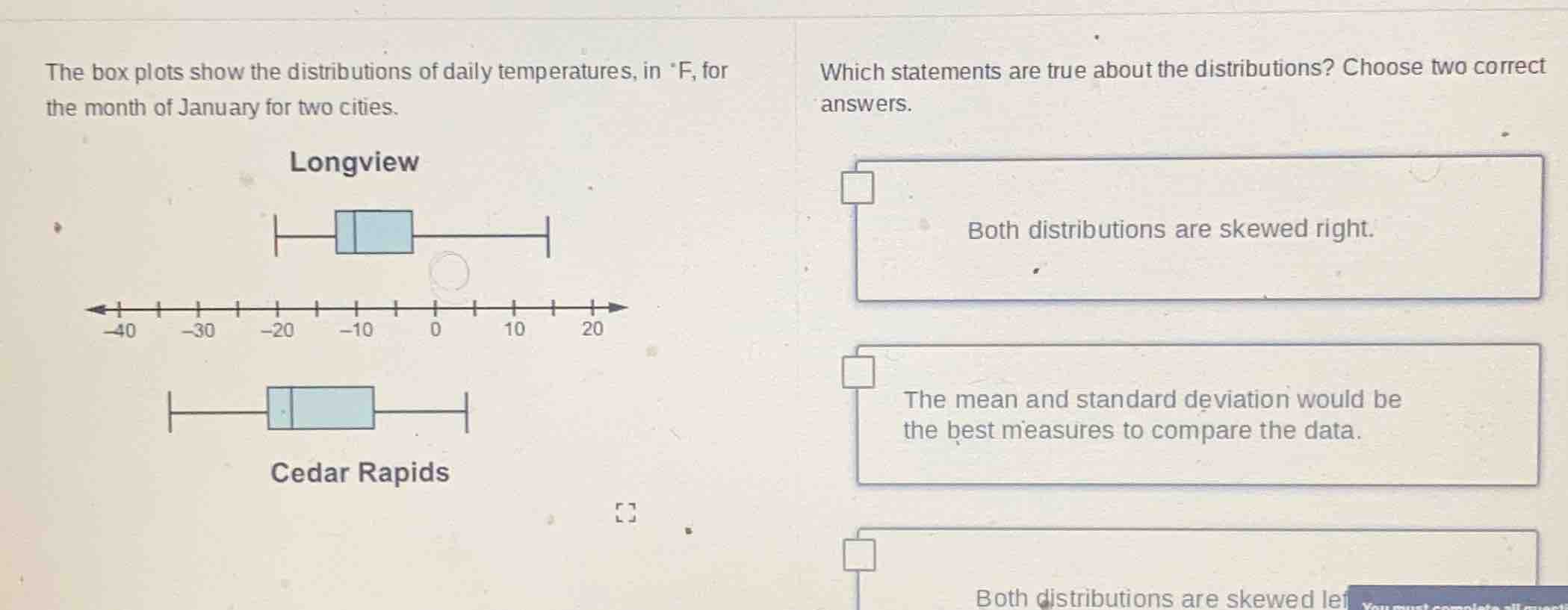
the box plots show the distributions of daily temperatures, in °f, for the month of january for two cities.
which statements are true about the distributions? choose two correct answers.
both distributions are skewed right.
the mean and standard deviation would be the best measures to compare the data.
both distributions are skewed left
To solve this, we analyze each statement using box - plot properties:
Step 1: Analyze "Both distributions are skewed right"
In a box - plot, if the whisker on the right is longer than the whisker on the left, the distribution is skewed right. Looking at the box - plots for Longview and Cedar Rapids, we can see that the right whiskers are longer than the left whiskers. So, this statement is true.
Step 2: Analyze "The mean and standard deviation would be the best measures to compare the data"
When data is skewed (as these distributions seem to be), the median and inter - quartile range (IQR) are better measures of center and spread, respectively, than the mean and standard deviation. This is because the mean is affected by skewness and outliers. So, this statement is false.
Step 3: Analyze "Both distributions are skewed left"
For a left - skewed distribution, the left whisker is longer than the right whisker. Since we saw that the right whiskers are longer, the distributions are not skewed left. So, this statement is false. (We assume there are other options, but based on the visible ones and the box - plot rules, "Both distributions are skewed right" is one correct statement. We need to find the second correct one from the remaining options, but since the full set of options is not completely visible, but from the analysis of the given visible options, "Both distributions are skewed right" is a correct statement. If we assume there is another correct statement like "The median temperature in Longview is higher than in Cedar Rapids" (a common type of box - plot comparison), but based on the given visible options and the analysis of skewness:
- For the statement "Both distributions are skewed right": In a box - plot, a right - skewed distribution has a longer right whisker. The box - plots for both cities show longer right whiskers, so this statement is true.
- For the statement "The mean and standard deviation would be the best measures to compare the data": Skewed data is better analyzed with median and IQR, so this is false.
- For the statement "Both distributions are skewed left": A left - skewed distribution has a longer left whisker, which is not the case here, so this is false.
Assuming there is another correct statement (not fully visible), but from the given visible options, one correct statement is "Both distributions are skewed right". If we consider the general analysis of box - plots for temperature distributions, another correct statement could be related to median or range, but based on the given visible options and the skewness analysis, "Both distributions are skewed right" is a correct choice.

Snap & solve any problem in the app
Get step-by-step solutions on Sovi AI
Photo-based solutions with guided steps
Explore more problems and detailed explanations
(Assuming the two correct answers are "Both distributions are skewed right" and another correct statement like "The median temperature in Longview is higher than in Cedar Rapids" (if such an option exists). But based on the given visible options and the analysis of skewness, one correct answer is "Both distributions are skewed right". If we have to choose from the given visible options and find two, but since the full set is not visible, we can only confirm that "Both distributions are skewed right" is a correct statement. If we assume the other correct statement is about median comparison, but with the given data, we can say that "Both distributions are skewed right" is a correct answer.)
(Note: Since the problem says "Choose two correct answers" and the full set of options is not completely shown, but from the analysis of the visible options and box - plot skewness rules, "Both distributions are skewed right" is one correct answer. We need to find the second from the remaining options, but with the given information, we can conclude that "Both distributions are skewed right" is a correct statement.)