QUESTION IMAGE
Question
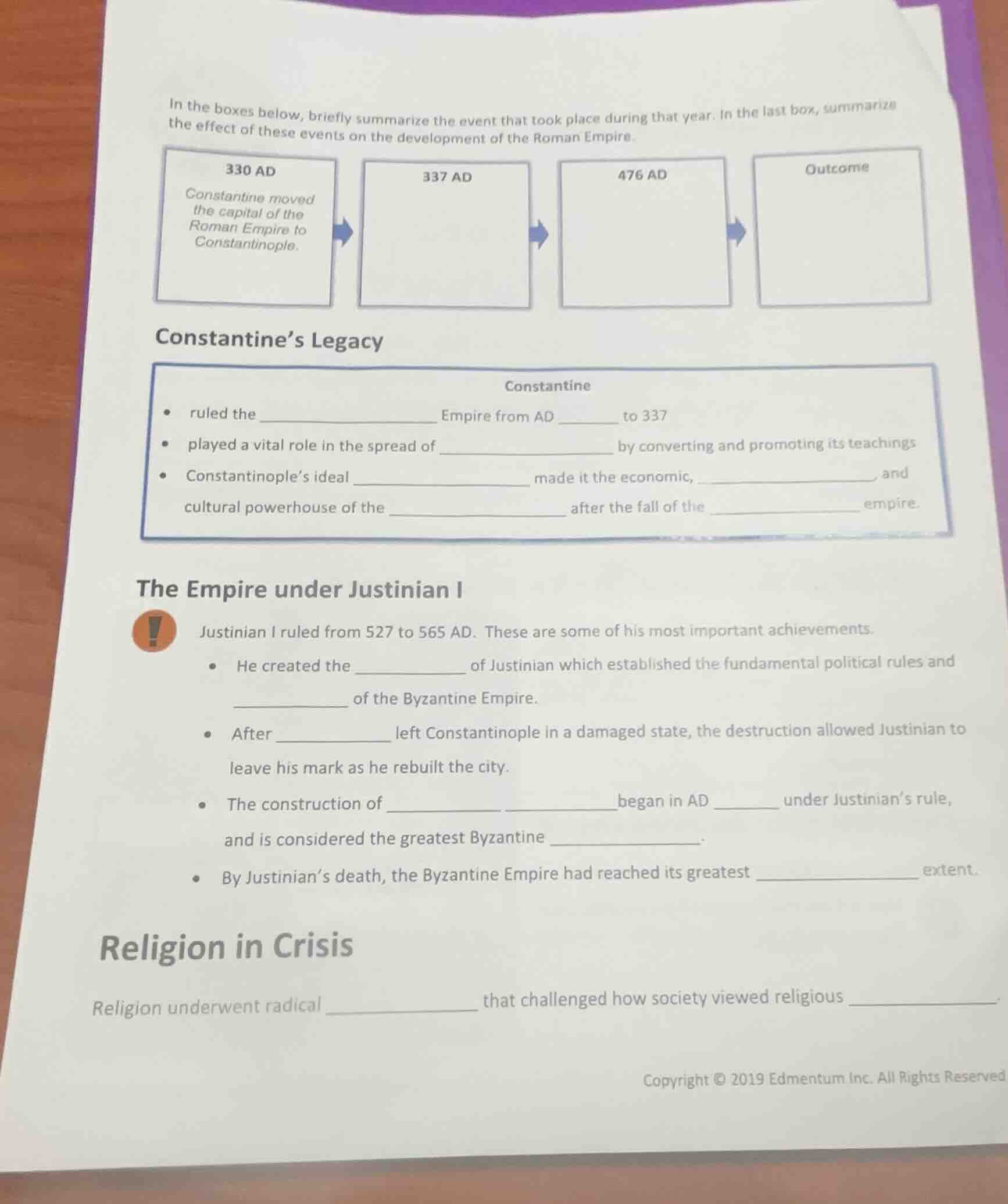
in the boxes below, briefly summarize the event that took place during that year. in the last box, summarize the effect of these events on the development of the roman empire.
330 ad
constantine moved
the capital of the
roman empire to
constantinople.
337 ad
476 ad
outcome
constantine’s legacy
constantine
- ruled the ____________ empire from ad ____ to 337
- played a vital role in the spread of ______________ by converting and promoting its teachings
- constantinople’s ideal ____________ made it the economic, ____________, and
cultural powerhouse of the ____________ after the fall of the ____________ empire.
the empire under justinian i
justin i ruled from 527 to 565 ad. these are some of his most important achievements.
- he created the _________ of justinian which established the fundamental political rules and
_________ of the byzantine empire.
- after _________ left constantinople in a damaged state, the destruction allowed justinian to
leave his mark as he rebuilt the city.
- the construction of _______ _____began in ad ____ under justinian’s rule,
and is considered the greatest byzantine ______________.
- by justinian’s death, the byzantine empire had reached its greatest ______________ extent.
religion in crisis
religion underwent radical ____________ that challenged how society viewed religious ____________.
copyright © 2019 edmentum inc. all rights reserved
Timeline Events
- 337 AD: Constantine the Great, the Roman Emperor who moved the capital to Constantinople, died, leading to a period of succession conflict.
- 476 AD: The last Western Roman Emperor, Romulus Augustulus, was deposed, marking the traditional end of the Western Roman Empire.
- Outcome: The split of the Roman Empire into Eastern (Byzantine) and Western halves was solidified; the Eastern Roman Empire (Byzantium) endured for nearly 1000 more years, while the Western Empire collapsed, leading to the early medieval period in Europe.
Constantine's Legacy
- Constantine ruled the Roman Empire from AD 306 to 337.
- He played a vital role in the spread of Christianity by converting and promoting its teachings.
- Constantinople's ideal location made it the economic, political, and cultural powerhouse of the Byzantine Empire after the fall of the Western Roman empire.
The Empire under Justinian I
- He created the Code of Justinian which established the fundamental political rules and laws of the Byzantine Empire.
- After the Nika Riots left Constantinople in a damaged state, the destruction allowed Justinian to leave his mark as he rebuilt the city.
- The construction of Hagia Sophia began in AD 532 under Justinian's rule, and is considered the greatest Byzantine architectural achievement.
- By Justinian’s death, the Byzantine Empire had reached its greatest territorial extent.
Religion in Crisis
Religion underwent radical changes/schisms that challenged how society viewed religious authority/doctrine.

Snap & solve any problem in the app
Get step-by-step solutions on Sovi AI
Photo-based solutions with guided steps
Explore more problems and detailed explanations
Timeline Events
337 AD: Constantine the Great died, sparking succession conflicts.
476 AD: Western Roman Empire fell with Romulus Augustulus' deposition.
Outcome: Roman Empire split; Eastern (Byzantine) Empire endured, Western Empire collapsed.
Constantine's Legacy
- ruled the Roman Empire from AD 306 to 337
- played a vital role in the spread of Christianity by converting and promoting its teachings
- Constantinople's ideal location made it the economic, political, and cultural powerhouse of the Byzantine Empire after the fall of the Western Roman empire
The Empire under Justinian I
- He created the Code of Justinian which established the fundamental political rules and laws of the Byzantine Empire.
- After the Nika Riots left Constantinople in a damaged state, the destruction allowed Justinian to leave his mark as he rebuilt the city.
- The construction of Hagia Sophia began in AD 532 under Justinian's rule, and is considered the greatest Byzantine architectural achievement.
- By Justinian’s death, the Byzantine Empire had reached its greatest territorial extent.
Religion in Crisis
Religion underwent radical changes/schisms that challenged how society viewed religious authority/doctrine.