QUESTION IMAGE
Question
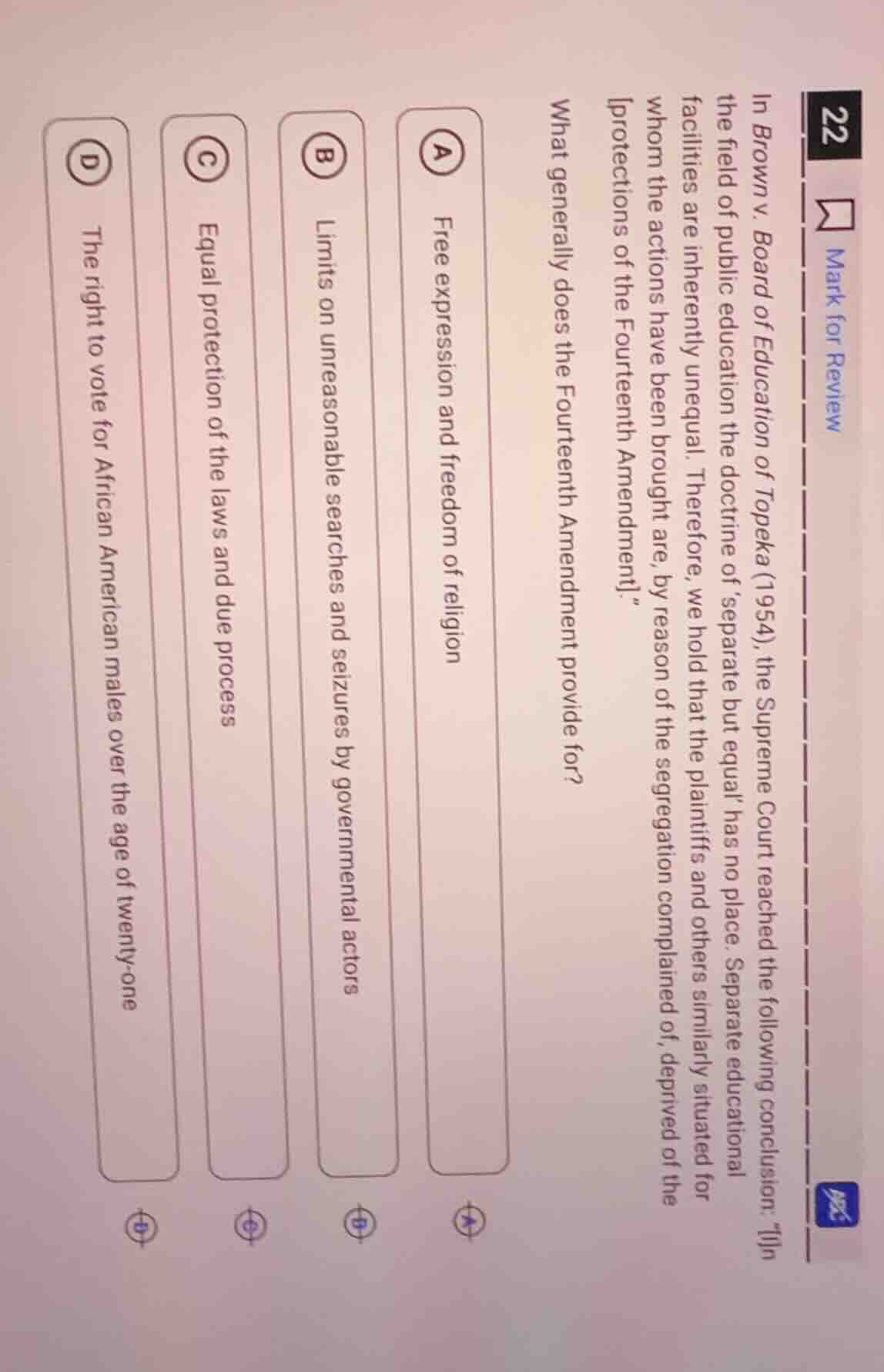
in brown v. board of education of topeka (1954), the supreme court reached the following conclusion: “in the field of public education the doctrine of ‘separate but equal’ has no place. separate educational facilities are inherently unequal. therefore, we hold that the plaintiffs and others similarly situated for whom the actions have been brought are, by reason of the segregation complained of, deprived of the protections of the fourteenth amendment.” what generally does the fourteenth amendment provide for? a free expression and freedom of religion b limits on unreasonable searches and seizures by governmental actors c equal protection of the laws and due process d the right to vote for african american males over the age of twenty - one
The Fourteenth Amendment's core provisions include the Equal Protection Clause and the Due Process Clause, which are referenced in the Brown v. Board of Education excerpt about ending segregated (unequal) public education. Option A relates to the First Amendment, Option B relates to the Fourth Amendment, and Option D relates to the Fifteenth Amendment.

Snap & solve any problem in the app
Get step-by-step solutions on Sovi AI
Photo-based solutions with guided steps
Explore more problems and detailed explanations
C. Equal protection of the laws and due process