QUESTION IMAGE
Question
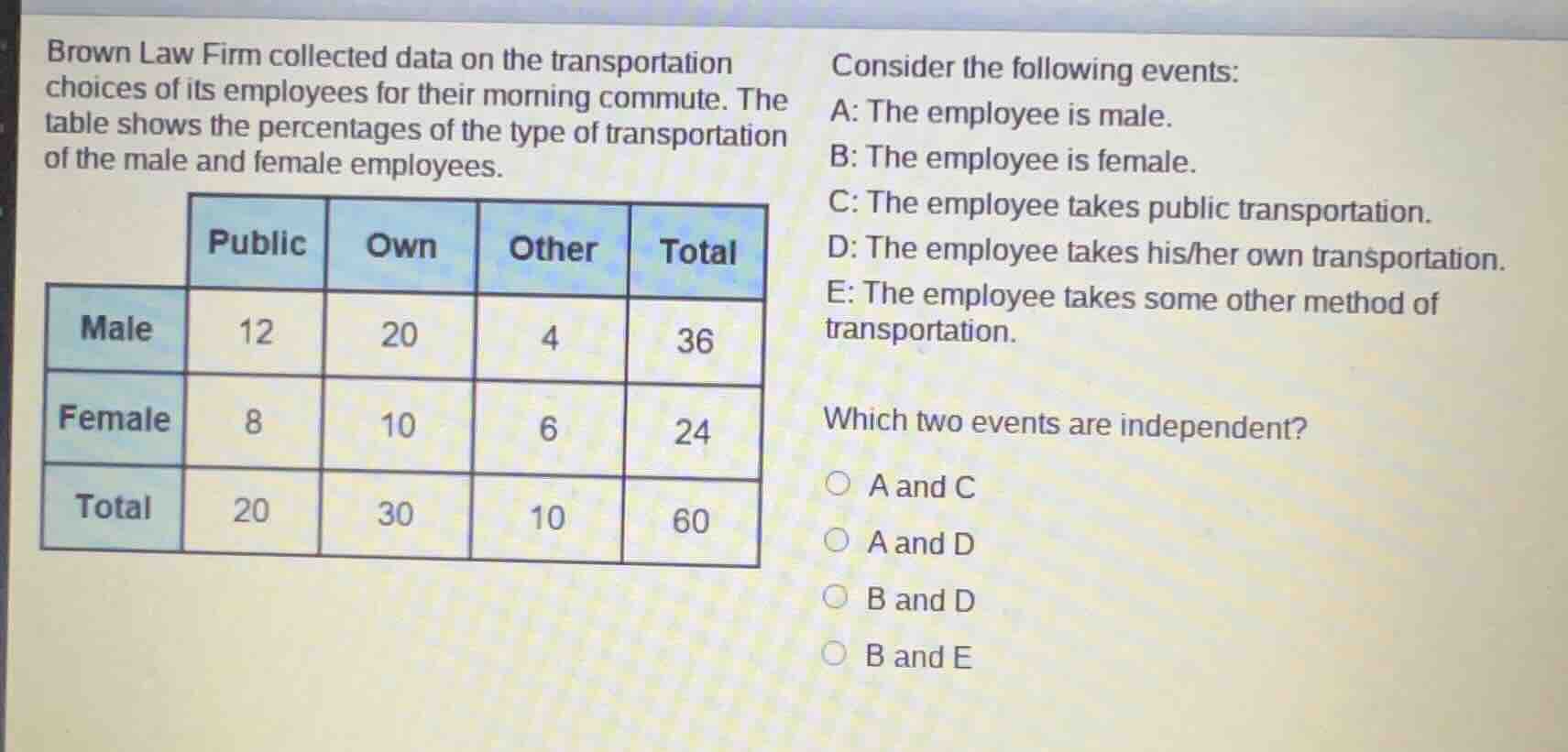
brown law firm collected data on the transportation choices of its employees for their morning commute. the table shows the percentages of the type of transportation of the male and female employees. consider the following events: a: the employee is male. b: the employee is female. c: the employee takes public transportation. d: the employee takes his/her own transportation. e: the employee takes some other method of transportation. which two events are independent? a and c a and d b and d b and e
To determine independent events, we use the rule: Two events \( X \) and \( Y \) are independent if \( P(X \cap Y) = P(X) \times P(Y) \).
Step 1: Recall Probability Formulas
- \( P(X) = \frac{\text{Number of favorable outcomes for } X}{\text{Total number of outcomes}} \)
- \( P(X \cap Y) = \frac{\text{Number of favorable outcomes for both } X \text{ and } Y}{\text{Total number of outcomes}} \)
Step 2: Analyze Option A (A and C)
- \( A \): Male (Total males = 36, Total = 60) so \( P(A) = \frac{36}{60} = 0.6 \)
- \( C \): Public transportation (Total public = 20, Total = 60) so \( P(C) = \frac{20}{60} = \frac{1}{3} \approx 0.333 \)
- \( A \cap C \): Male and public transportation (Count = 12) so \( P(A \cap C) = \frac{12}{60} = 0.2 \)
- Check \( P(A) \times P(C) = 0.6 \times \frac{1}{3} = 0.2 \). Wait, but let's check other options too to be sure.
Step 3: Analyze Option B (A and D)
- \( D \): Own transportation (Total own = 30, Total = 60) so \( P(D) = \frac{30}{60} = 0.5 \)
- \( A \cap D \): Male and own transportation (Count = 20) so \( P(A \cap D) = \frac{20}{60} = \frac{1}{3} \approx 0.333 \)
- \( P(A) \times P(D) = 0.6 \times 0.5 = 0.3 \). But \( \frac{1}{3} \approx 0.333
eq 0.3 \), so not independent.
Step 4: Analyze Option C (B and D)
- \( B \): Female (Total females = 24, Total = 60) so \( P(B) = \frac{24}{60} = 0.4 \)
- \( D \): Own transportation (Total own = 30, Total = 60) so \( P(D) = 0.5 \)
- \( B \cap D \): Female and own transportation (Count = 10) so \( P(B \cap D) = \frac{10}{60} = \frac{1}{6} \approx 0.1667 \)
- \( P(B) \times P(D) = 0.4 \times 0.5 = 0.2 \). \( \frac{1}{6} \approx 0.1667
eq 0.2 \), not independent.
Step 5: Analyze Option D (B and E)
- \( E \): Other transportation (Total other = 10, Total = 60) so \( P(E) = \frac{10}{60} = \frac{1}{6} \approx 0.1667 \)
- \( B \cap E \): Female and other transportation (Count = 6) so \( P(B \cap E) = \frac{6}{60} = 0.1 \)
- \( P(B) \times P(E) = 0.4 \times \frac{1}{6} = \frac{0.4}{6} \approx 0.0667
eq 0.1 \), not independent. Wait, but earlier for A and C, \( P(A) \times P(C) = 0.6 \times \frac{1}{3} = 0.2 \) and \( P(A \cap C) = 0.2 \). Wait, but let's recheck A and D. Wait, maybe I made a mistake. Wait, let's re - calculate A and D:
Wait, \( P(A) = \frac{36}{60} = 0.6 \), \( P(D) = \frac{30}{60} = 0.5 \), \( P(A \cap D) = \frac{20}{60} \approx 0.333 \). \( 0.6 \times 0.5 = 0.3
eq 0.333 \). For A and C: \( P(A) = 0.6 \), \( P(C) = \frac{20}{60} = \frac{1}{3} \), \( 0.6 \times \frac{1}{3} = 0.2 \), and \( P(A \cap C) = \frac{12}{60} = 0.2 \). Wait, but let's check the other options again. Wait, maybe the correct answer is A and C? Wait, no, let's check the original table again. Wait, the total number of employees is 60. For event A (male): 36, event D (own transportation): 30. \( A \cap D \): male and own transportation is 20. So \( P(A) = 36/60 = 0.6 \), \( P(D) = 30/60 = 0.5 \), \( P(A \cap D) = 20/60 = 1/3 \approx 0.333 \). \( 0.6 \times 0.5 = 0.3
eq 0.333 \). For event B (female): 24, event D (own transportation): 30. \( B \cap D \): 10. \( P(B) = 24/60 = 0.4 \), \( P(D) = 0.5 \), \( P(B \cap D) = 10/60 = 1/6 \approx 0.1667 \). \( 0.4 \times 0.5 = 0.2
eq 0.1667 \). For event B (female): 24, event E (other): 10. \( B \cap E \): 6. \( P(B) = 0.4 \), \( P(E) = 10/60 = 1/6 \approx 0.1667 \), \( P(B \cap E) = 6/60 = 0.1 \). \( 0.4 \times 1/6 = 0.0667
eq 0.1 \). Wait, but for A and C: \( P(A) = 36/60 = 0.6 \), \( P(C) = 20/60 = 1/3 \approx 0.333 \), \( P(A \cap C) = 12/60 = 0.2 \). \( 0.6 \times 1/3 = 0.2 \), which matches. But wait, t…

Snap & solve any problem in the app
Get step-by-step solutions on Sovi AI
Photo-based solutions with guided steps
Explore more problems and detailed explanations
A. A and C