QUESTION IMAGE
Question
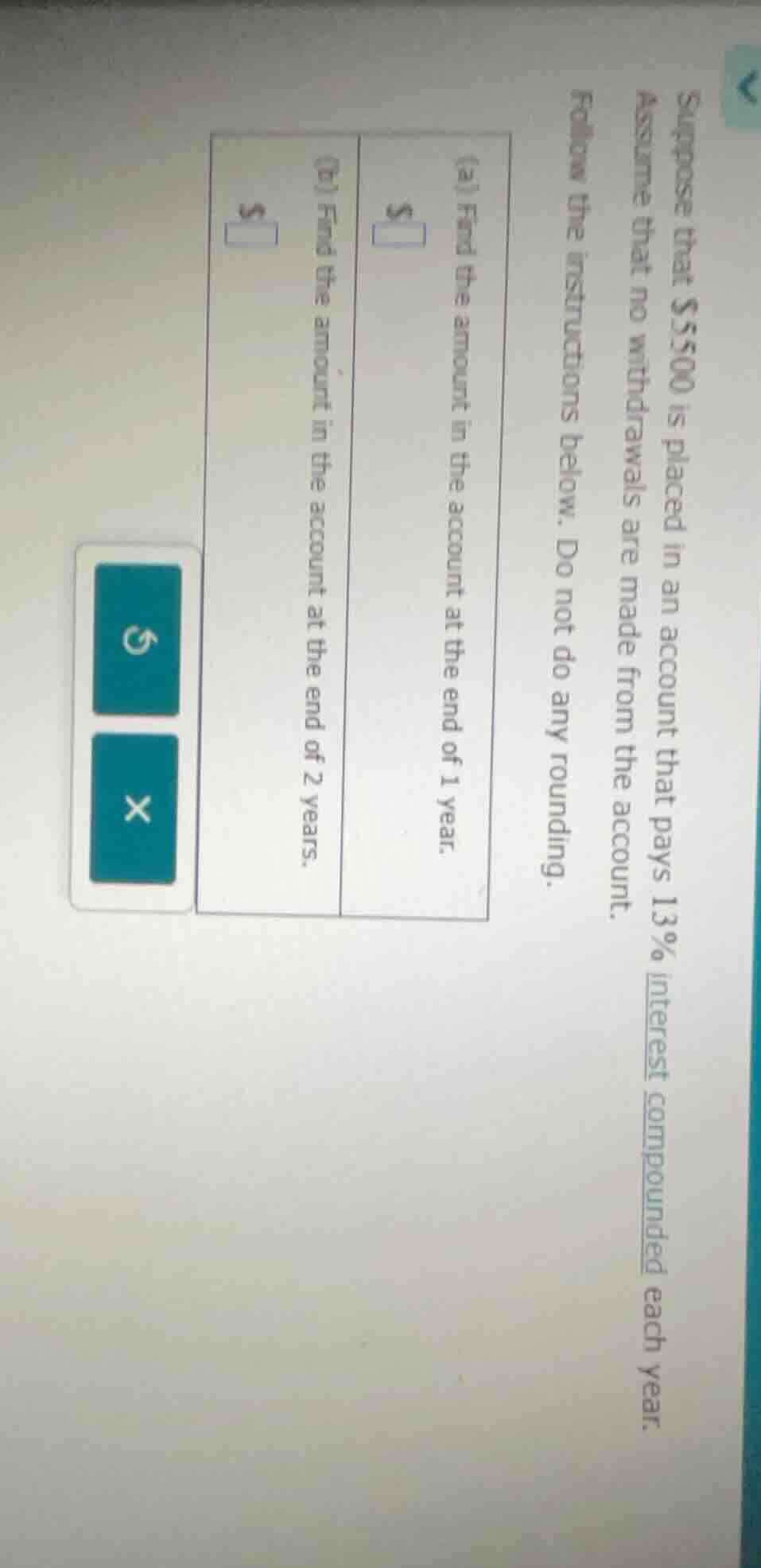
suppose that $5500 is placed in an account that pays 13% interest compounded each year. assume that no withdrawals are made from the account. follow the instructions below. do not do any rounding. (a) find the amount in the account at the end of 1 year. $\square$ (b) find the amount in the account at the end of 2 years. $\square$
Step1: Define compound interest formula
The annual compound interest formula is $A = P(1 + r)^t$, where $P=\$5500$, $r=0.13$, and $t$ is time in years.
Step2: Calculate 1-year amount
Substitute $t=1$ into the formula.
$A = 5500(1 + 0.13)^1 = 5500 \times 1.13$
$A = 6215$
Step3: Calculate 2-year amount
Substitute $t=2$ into the formula.
$A = 5500(1 + 0.13)^2 = 5500 \times (1.13)^2$
$A = 5500 \times 1.2769 = 7022.95$

Snap & solve any problem in the app
Get step-by-step solutions on Sovi AI
Photo-based solutions with guided steps
Explore more problems and detailed explanations
(a) $\$6215$
(b) $\$7022.95$