QUESTION IMAGE
Question
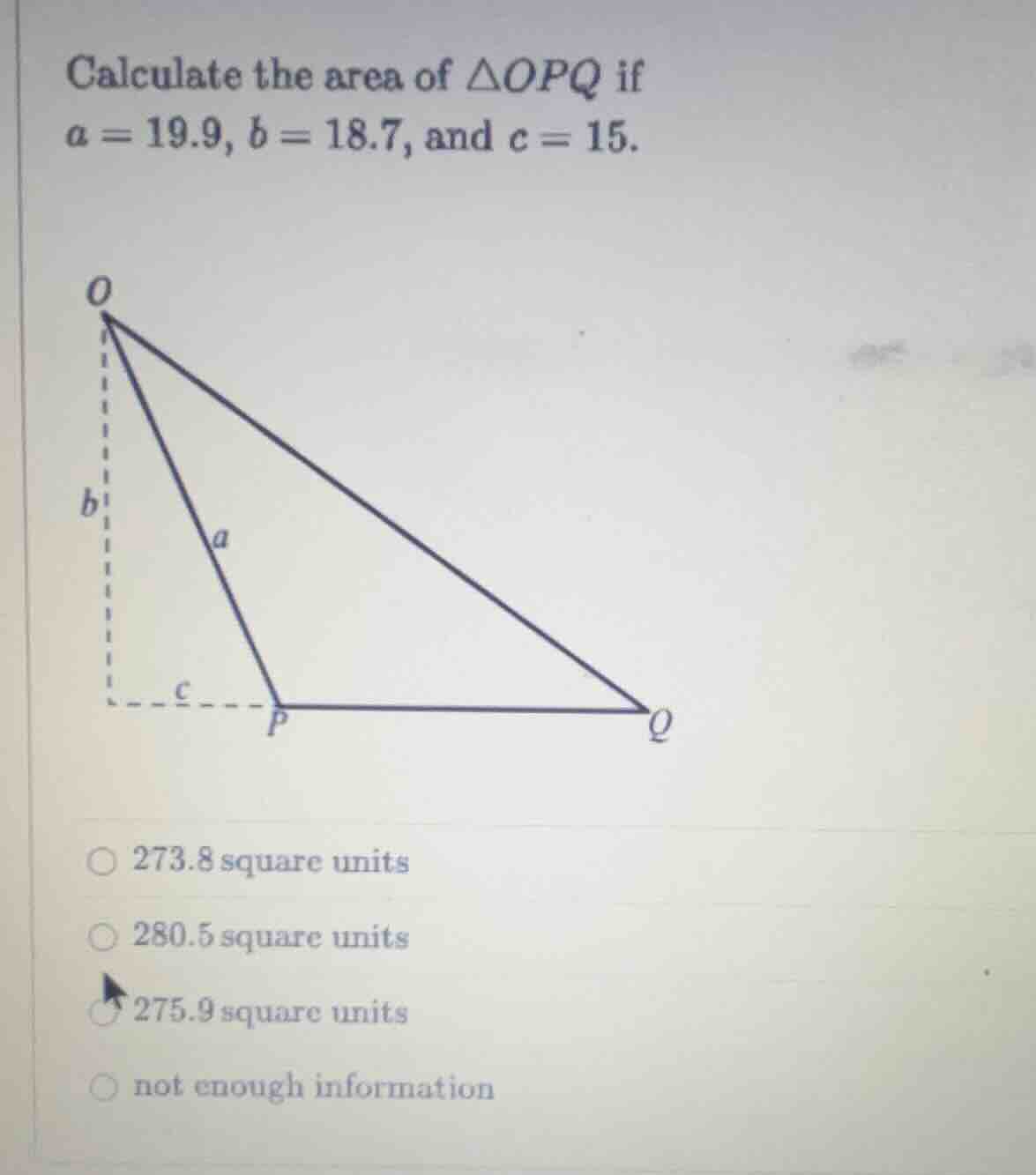
calculate the area of $\triangle opq$ if $a = 19.9$, $b = 18.7$, and $c = 15$.\
\
$\bigcirc$ 273.8 square units\
$\bigcirc$ 280.5 square units\
$\bigcirc$ 275.9 square units\
$\bigcirc$ not enough information
Step1: Find the length of PQ
First, we can use the Pythagorean theorem in the right triangle (the dashed lines) to find the horizontal segment from the base of \( b \) to \( P \), but actually, we can find the length of \( PQ \) by considering the triangle with sides \( a \), \( b \), and the horizontal segment. Wait, actually, let's first find the length of the base \( PQ \). Let's denote the horizontal segment from the right angle to \( P \) as \( x \). Then by Pythagoras, \( x = \sqrt{a^2 - b^2} \)? Wait, no, wait the diagram: the dashed lines are a right angle, so the vertical side is \( b = 18.7 \), the hypotenuse of the small right triangle (with vertical side \( b \) and horizontal side \( c = 15 \))? Wait, no, the side \( a = 19.9 \) is the hypotenuse of a right triangle with vertical side \( b = 18.7 \) and horizontal side \( x \). So by Pythagoras, \( x = \sqrt{a^2 - b^2} \). Let's calculate that:
\( x = \sqrt{19.9^2 - 18.7^2} \)
First, calculate \( 19.9^2 = 396.01 \), \( 18.7^2 = 349.69 \)
Then \( 396.01 - 349.69 = 46.32 \), so \( x = \sqrt{46.32} \approx 6.81 \)
Then the length of \( PQ \) is \( c + x = 15 + 6.81 = 21.81 \)? Wait, no, maybe I misinterpret the diagram. Wait, actually, the triangle \( OPQ \) has a height of \( b = 18.7 \), and the base \( PQ \) can be found by first finding the horizontal component from the right angle to \( P \), then adding \( c = 15 \). Wait, maybe another approach: the area of a triangle can also be found using Heron's formula, but maybe it's easier to find the base. Wait, no, actually, let's look at the diagram again: the dashed lines are a right angle, so the vertical side is \( b = 18.7 \), the horizontal side from the right angle to \( Q \) is \( c + PQ_{horizontal} \)? Wait, no, maybe the base of triangle \( OPQ \) is \( c + \sqrt{a^2 - b^2} \), and the height is \( b \). Wait, let's recast:
Let’s denote the right triangle with legs \( b \) and \( x \), and hypotenuse \( a \). So \( x = \sqrt{a^2 - b^2} \). Then the base of triangle \( OPQ \) is \( c + x \), and the height is \( b \). Wait, no, the height is \( b \), and the base is \( PQ \), which is \( c + x \). Wait, but maybe I made a mistake. Alternatively, maybe the length of \( PQ \) is \( c + \sqrt{a^2 - b^2} \), and then the area is \( \frac{1}{2} \times \text{base} \times \text{height} \). Wait, no, the height is \( b = 18.7 \), and the base is \( PQ \). Wait, let's calculate \( x = \sqrt{19.9^2 - 18.7^2} \):
\( 19.9^2 = (20 - 0.1)^2 = 400 - 4 + 0.01 = 396.01 \)
\( 18.7^2 = (18 + 0.7)^2 = 324 + 25.2 + 0.49 = 349.69 \)
So \( 19.9^2 - 18.7^2 = 396.01 - 349.69 = 46.32 \)
\( \sqrt{46.32} \approx 6.81 \)
Then the base \( PQ = c + x = 15 + 6.81 = 21.81 \)
Then the area of \( \triangle OPQ \) is \( \frac{1}{2} \times \text{base} \times \text{height} = \frac{1}{2} \times 21.81 \times 18.7 \)
Calculate that: \( 21.81 \times 18.7 \approx 21.81 \times 18 + 21.81 \times 0.7 = 392.58 + 15.267 = 407.847 \)
Then \( \frac{1}{2} \times 407.847 \approx 203.92 \). Wait, that's not matching the options. Wait, maybe I misinterpret the diagram. Wait, maybe the triangle \( OPQ \) has a height of \( b = 18.7 \), and the base is \( c + \) something else. Wait, maybe the diagram is such that the horizontal side is \( c = 15 \), and the other part is \( \sqrt{a^2 - b^2} \), so the total base is \( 15 + \sqrt{19.9^2 - 18.7^2} \), but maybe I made a mistake. Wait, alternatively, maybe the area can be found by Heron's formula. Let's try Heron's formula. The sides of triangle \( OPQ \): we need to find all three sides. Wait, we know \(…

Snap & solve any problem in the app
Get step-by-step solutions on Sovi AI
Photo-based solutions with guided steps
Explore more problems and detailed explanations
280.5 square units