QUESTION IMAGE
Question
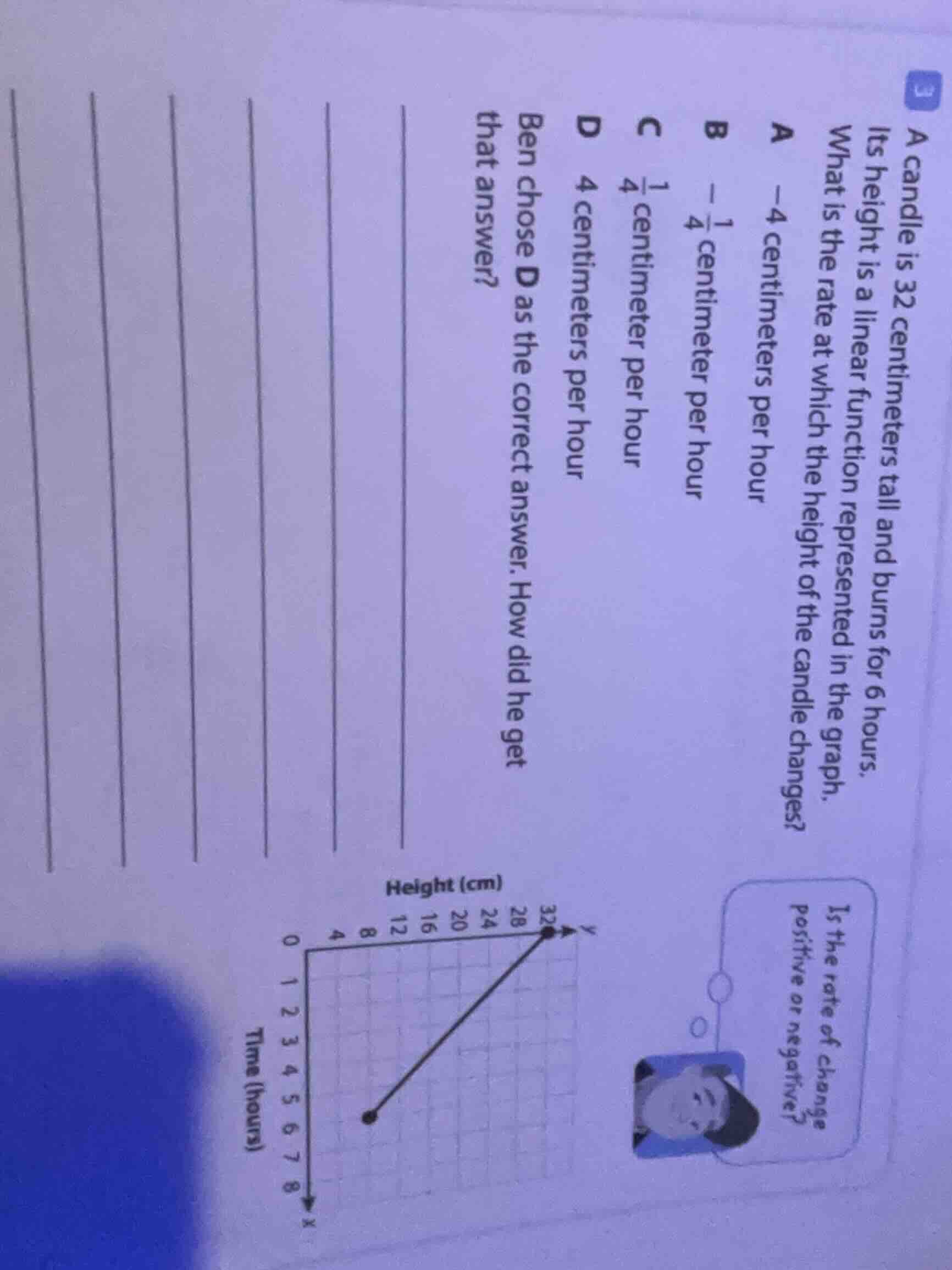
a candle is 32 centimeters tall and burns for 6 hours. its height is a linear function represented in the graph. what is the rate at which the height of the candle changes?
a (-4) centimeters per hour
b (-\frac{1}{4}) centimeter per hour
c (\frac{1}{4}) centimeter per hour
d (4) centimeters per hour
ben chose d as the correct answer. how did he get that answer?
graph: x - time (hours), y - height (cm). points at (0, 32) and (6, 8)
is the rate of change positive or negative? two radio buttons
Step1: Identify the two points
The initial point is at (0, 32) (time = 0 hours, height = 32 cm) and the final point is at (6, 8) (time = 6 hours, height = 8 cm). Wait, but Ben chose D, which is 4 cm per hour. Wait, maybe he misread the graph. Let's check the graph again. Wait, the y - axis is height (cm) and x - axis is time (hours). The starting point is (0, 32) and the ending point is (8, 0)? Wait, no, the graph shows at x = 6 (time 6 hours), what's the height? Wait, maybe the graph has a point at (6, 8)? Wait, no, maybe Ben made a mistake. Wait, the rate of change for a linear function is the slope, which is $\frac{\text{change in }y}{\text{change in }x}$. If the candle is burning, the height should decrease, so the slope should be negative. But Ben chose D (4 cm per hour, positive). Let's see: if he thought the height increases, but the candle burns, so height should decrease. Wait, maybe he took the change in x over change in y. Let's calculate the correct slope first. The correct slope: initial height $y_1 = 32$ at $x_1 = 0$, final height $y_2$ at $x_2 = 6$. Wait, from the graph, at x = 6, the height is 8? Wait, 32 - 24 = 8? Wait, 32 - 4*6 = 32 - 24 = 8. So the correct slope is $\frac{8 - 32}{6 - 0}=\frac{-24}{6}=-4$ cm per hour (option A). But Ben chose D (4 cm per hour). So how did he get that? Maybe he calculated $\frac{32 - 8}{6}$? Wait, no, 32 - 8 = 24, 24/6 = 4. Oh! He probably took the initial height (32) and the final height (8) as 32 - 8 = 24, then divided by 6 hours, but he didn't consider the direction (he took the absolute value or thought height increases). So he did $\frac{32 - 8}{6}=\frac{24}{6}=4$, so he got 4 cm per hour (option D), but actually, the height is decreasing, so the rate should be - 4 cm per hour.
Step2: Analyze Ben's mistake
Ben likely calculated the rate as the absolute change in height divided by time, without considering that the height is decreasing (so the rate should be negative). He took the initial height (32 cm) and the final height (8 cm) after 6 hours, calculated the difference in height as 32 - 8 = 24 cm, then divided by 6 hours: $\frac{24}{6}=4$ cm per hour, hence choosing option D. But the correct rate should be negative because the height is decreasing (slope of the line is negative).

Snap & solve any problem in the app
Get step-by-step solutions on Sovi AI
Photo-based solutions with guided steps
Explore more problems and detailed explanations
Ben calculated the rate as the absolute change in height (32 - 8 = 24 cm) divided by time (6 hours), so $\frac{24}{6}=4$ cm per hour, ignoring the fact that height decreases (so the rate should be negative).