QUESTION IMAGE
Question
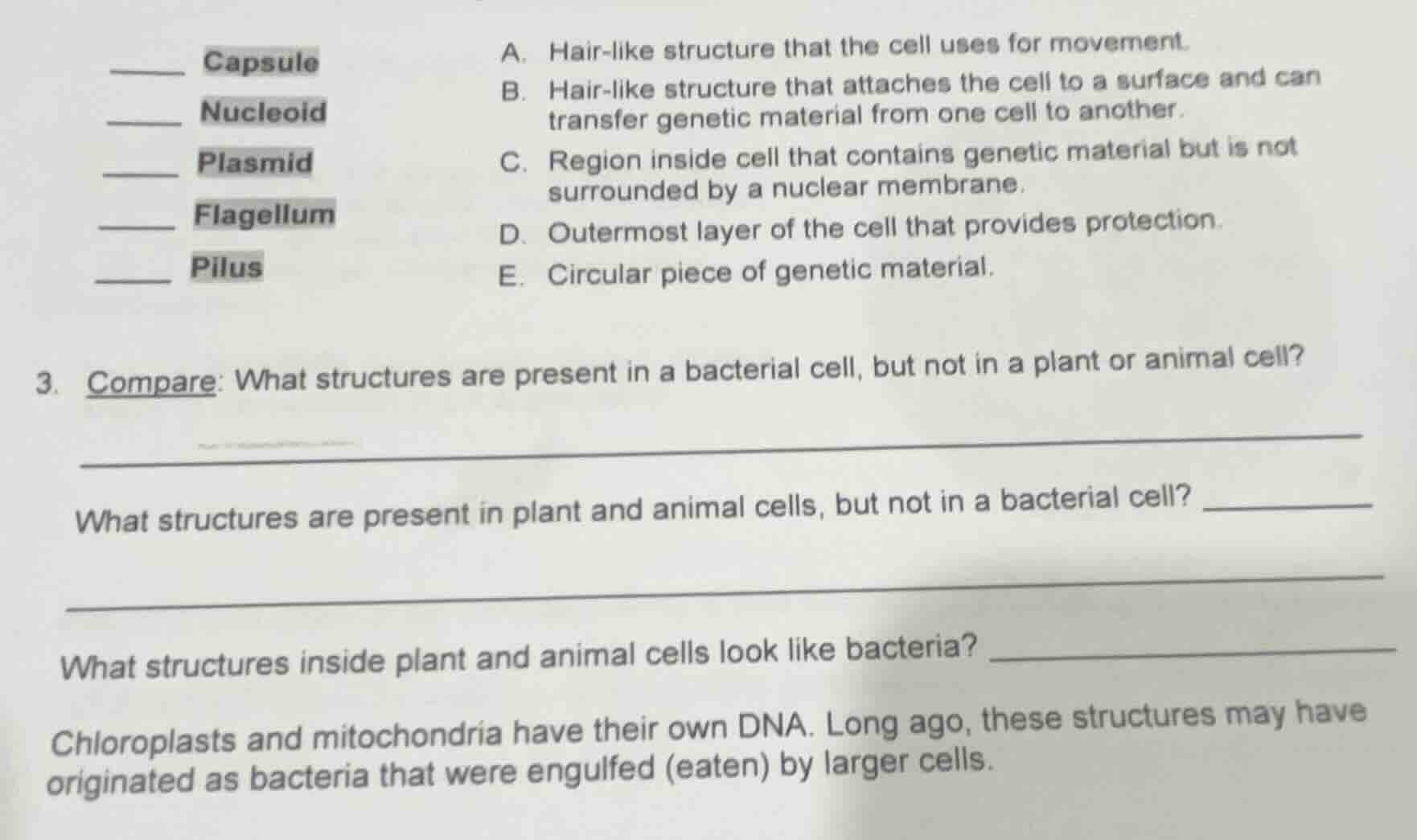
_____ capsule
_____ nucleoid
_____ plasmid
_____ flagellum
_____ pilus
a. hair - like structure that the cell uses for movement.
b. hair - like structure that attaches the cell to a surface and can transfer genetic material from one cell to another.
c. region inside cell that contains genetic material but is not surrounded by a nuclear membrane.
d. outermost layer of the cell that provides protection.
e. circular piece of genetic material.
- compare: what structures are present in a bacterial cell, but not in a plant or animal cell?
_____________________________________________________
what structures are present in plant and animal cells, but not in a bacterial cell? ____________
_____________________________________________________
what structures inside plant and animal cells look like bacteria? ___________________________
chloroplasts and mitochondria have their own dna. long ago, these structures may have originated as bacteria that were engulfed (eaten) by larger cells.
Matching Part (1 - 5)
Step 1: Analyze "Capsule"
The capsule is the outermost protective layer of some bacterial cells. So it matches option D.
Step 2: Analyze "Nucleoid"
The nucleoid is the region in a prokaryotic (bacterial) cell that contains genetic material (DNA) and is not surrounded by a nuclear membrane. So it matches option C.
Step 3: Analyze "Plasmid"
A plasmid is a small, circular piece of extra - chromosomal genetic material in bacteria. So it matches option E.
Step 4: Analyze "Flagellum"
A flagellum is a hair - like (whip - like) structure that bacteria use for movement. So it matches option A.
Step 5: Analyze "Pilus"
A pilus is a hair - like structure that helps bacteria attach to surfaces and can transfer genetic material (conjugation) between cells. So it matches option B.
Question 3 (Compare)
Part 1: Structures in bacterial cell but not in plant/animal cell
Bacterial cells have structures like capsule, nucleoid, plasmid, flagellum (in some bacteria), and pilus. These structures are not found in typical plant or animal cells. Plant and animal cells are eukaryotic, with a true nucleus (surrounded by a nuclear membrane), while bacteria are prokaryotic with a nucleoid. Also, plant and animal cells do not have plasmids (in the same form as bacterial plasmids), and most plant and animal cells do not have flagella or pili like bacteria, and the capsule is a bacterial - specific outer layer.
Part 2: Structures in plant/animal cell but not in bacterial cell
Plant and animal cells (eukaryotic cells) have a nucleus (with a nuclear membrane), membrane - bound organelles like mitochondria, endoplasmic reticulum, Golgi apparatus, and (in plant cells) chloroplasts and a large central vacuole. Bacterial cells (prokaryotic) lack these membrane - bound organelles and a true nucleus.
Part 3: Structures inside plant/animal cells that look like bacteria
Mitochondria and chloroplasts (in plant cells) look like bacteria. This is related to the endosymbiotic theory, which suggests that these organelles were once free - living bacteria that were engulfed by larger cells and became symbiotic. They have their own DNA (like bacteria), a double - membrane structure (similar to the cell membrane of bacteria), and their own ribosomes (similar to bacterial ribosomes).
Matching Answers:
- Capsule - D
- Nucleoid - C
- Plasmid - E
- Flagellum - A
- Pilus - B
Question 3 Answers:
- Structures present in a bacterial cell, but not in a plant or animal cell: Capsule, Nucleoid, Plasmid, Flagellum (in some bacteria), Pilus.
- Structures present in plant and animal cells, but not in a bacterial cell: Nucleus (with nuclear membrane), membrane - bound organelles (mitochondria, endoplasmic reticulum, Golgi apparatus, chloroplasts in plant cells, large central vacuole in plant cells).
- Structures inside plant and animal cells that look like bacteria: Mitochondria (and chloroplasts in plant cells).

Snap & solve any problem in the app
Get step-by-step solutions on Sovi AI
Photo-based solutions with guided steps
Explore more problems and detailed explanations
Matching Part (1 - 5)
Step 1: Analyze "Capsule"
The capsule is the outermost protective layer of some bacterial cells. So it matches option D.
Step 2: Analyze "Nucleoid"
The nucleoid is the region in a prokaryotic (bacterial) cell that contains genetic material (DNA) and is not surrounded by a nuclear membrane. So it matches option C.
Step 3: Analyze "Plasmid"
A plasmid is a small, circular piece of extra - chromosomal genetic material in bacteria. So it matches option E.
Step 4: Analyze "Flagellum"
A flagellum is a hair - like (whip - like) structure that bacteria use for movement. So it matches option A.
Step 5: Analyze "Pilus"
A pilus is a hair - like structure that helps bacteria attach to surfaces and can transfer genetic material (conjugation) between cells. So it matches option B.
Question 3 (Compare)
Part 1: Structures in bacterial cell but not in plant/animal cell
Bacterial cells have structures like capsule, nucleoid, plasmid, flagellum (in some bacteria), and pilus. These structures are not found in typical plant or animal cells. Plant and animal cells are eukaryotic, with a true nucleus (surrounded by a nuclear membrane), while bacteria are prokaryotic with a nucleoid. Also, plant and animal cells do not have plasmids (in the same form as bacterial plasmids), and most plant and animal cells do not have flagella or pili like bacteria, and the capsule is a bacterial - specific outer layer.
Part 2: Structures in plant/animal cell but not in bacterial cell
Plant and animal cells (eukaryotic cells) have a nucleus (with a nuclear membrane), membrane - bound organelles like mitochondria, endoplasmic reticulum, Golgi apparatus, and (in plant cells) chloroplasts and a large central vacuole. Bacterial cells (prokaryotic) lack these membrane - bound organelles and a true nucleus.
Part 3: Structures inside plant/animal cells that look like bacteria
Mitochondria and chloroplasts (in plant cells) look like bacteria. This is related to the endosymbiotic theory, which suggests that these organelles were once free - living bacteria that were engulfed by larger cells and became symbiotic. They have their own DNA (like bacteria), a double - membrane structure (similar to the cell membrane of bacteria), and their own ribosomes (similar to bacterial ribosomes).
Matching Answers:
- Capsule - D
- Nucleoid - C
- Plasmid - E
- Flagellum - A
- Pilus - B
Question 3 Answers:
- Structures present in a bacterial cell, but not in a plant or animal cell: Capsule, Nucleoid, Plasmid, Flagellum (in some bacteria), Pilus.
- Structures present in plant and animal cells, but not in a bacterial cell: Nucleus (with nuclear membrane), membrane - bound organelles (mitochondria, endoplasmic reticulum, Golgi apparatus, chloroplasts in plant cells, large central vacuole in plant cells).
- Structures inside plant and animal cells that look like bacteria: Mitochondria (and chloroplasts in plant cells).