QUESTION IMAGE
Question
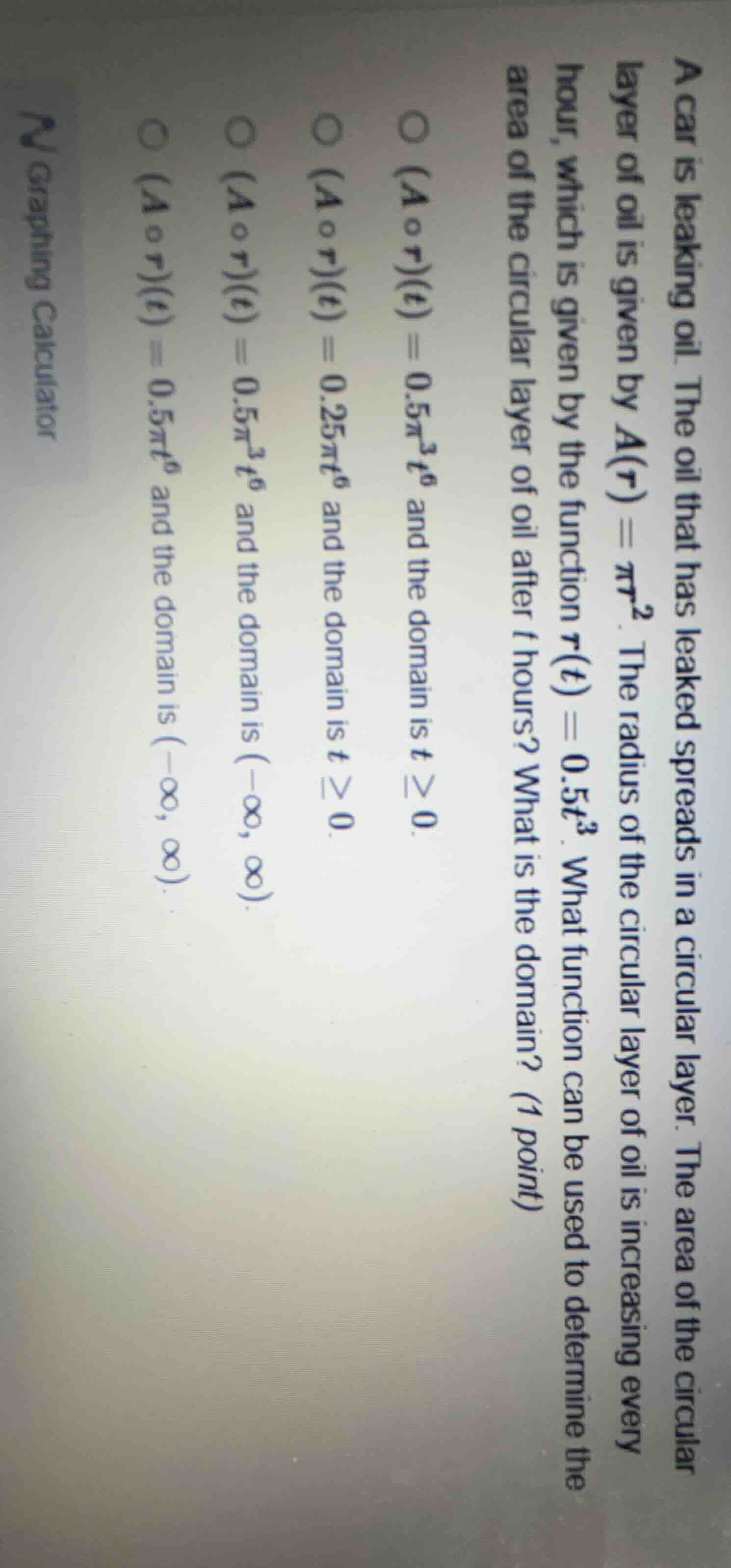
a car is leaking oil. the oil that has leaked spreads in a circular layer. the area of the circular layer of oil is given by ( a(r) = pi r^2 ). the radius of the circular layer of oil is increasing every hour, which is given by the function ( r(t) = 0.5t^3 ). what function can be used to determine the area of the circular layer of oil after ( t ) hours? what is the domain? (1 point)
(a) ( (a circ r)(t) = 0.5pi^2 t^6 ) and the domain is ( t geq 0 ).
(a) ( (a circ r)(t) = 0.25pi t^6 ) and the domain is ( t geq 0 ).
(a) ( (a circ r)(t) = 0.5pi^2 t^6 ) and the domain is ( (-infty, infty) ).
(a) ( (a circ r)(t) = 0.5pi t^6 ) and the domain is ( (-infty, infty) ).
Step1: Find the composition \((A \circ r)(t)\)
The composition of functions \(A(r)\) and \(r(t)\) is \(A(r(t))\). We know \(A(r)=\pi r^{2}\) and \(r(t) = 0.5t^{3}\). Substitute \(r(t)\) into \(A(r)\):
\[
\]
Wait, no, wait. Wait, \(r(t)=0.5t^{3}\), so \((0.5t^{3})^{2}=0.25t^{6}\)? Wait, no, \(0.5=\frac{1}{2}\), so \((\frac{1}{2}t^{3})^{2}=\frac{1}{4}t^{6} = 0.25t^{6}\), then \(A(r(t))=\pi\times0.25t^{6}=0.25\pi t^{6}\)? But wait, let's check the options. Wait, maybe I made a mistake. Wait, \(r(t) = 0.5t^{3}\), so \(A(r(t))=\pi(0.5t^{3})^{2}=\pi\times0.25t^{6}=0.25\pi t^{6}\)? But the first option in the choices (the first radio button) is \((A\circ r)(t)=0.5\pi t^{6}\)? Wait, no, let's re - calculate:
Wait, \(r(t)=0.5t^{3}\), so \(A(r(t))=\pi\times(0.5t^{3})^{2}=\pi\times0.25t^{6}=0.25\pi t^{6}\)? But the options:
Wait, the first option (top - most) is \((A\circ r)(t)=0.5\pi t^{6}\) and domain \(t\geq0\)? No, wait, maybe I misread \(r(t)\). Wait, maybe \(r(t)=0.5t^{3}\) is wrong? Wait, no, let's check again. Wait, \(A(r)=\pi r^{2}\), \(r(t)=0.5t^{3}\). Then \((A\circ r)(t)=\pi(0.5t^{3})^{2}=\pi\times0.25t^{6}=0.25\pi t^{6}\). But the third option (counting from top) is \((A\circ r)(t)=0.25\pi t^{6}\) and domain \(t\geq0\). But wait, the second option (second from top) is \((A\circ r)(t)=0.5\pi t^{6}\)? Wait, no, maybe \(r(t)=0.5t^{3}\), so \((0.5t^{3})^{2}=0.25t^{6}\), so \(A(r(t))=\pi\times0.25t^{6}=0.25\pi t^{6}\). And the domain: since \(t\) represents time (hours), time cannot be negative, so the domain of \(t\) is \(t\geq0\).
Wait, but let's check the options again. The options are:
- \((A\circ r)(t)=0.5\pi t^{6}\) and domain \(t\geq0\)
- \((A\circ r)(t)=0.25\pi t^{6}\) and domain \(t\geq0\)
- \((A\circ r)(t)=0.5\pi t^{6}\) and domain \((-\infty,\infty)\)
- \((A\circ r)(t)=0.5\pi t^{6}\) and domain \((-\infty,\infty)\)
Wait, I think I made a mistake in the calculation. Wait, \(r(t)=0.5t^{3}\), so \((0.5t^{3})^{2}=0.25t^{6}\), so \(A(r(t))=\pi\times0.25t^{6}=0.25\pi t^{6}\), and the domain of \(t\) (since \(t\) is time) is \(t\geq0\). So the correct function is \((A\circ r)(t)=0.25\pi t^{6}\) with domain \(t\geq0\), which is the third option (the third radio button: \((A\circ r)(t)=0.25\pi t^{6}\) and \(t\geq0\)). But wait, maybe I misread \(r(t)\) as \(0.5t^{3}\), but maybe \(r(t)=0.5t^{3}\) is \(r(t)=\frac{1}{2}t^{3}\), then \((\frac{1}{2}t^{3})^{2}=\frac{1}{4}t^{6}\), so \(A(r(t))=\pi\times\frac{1}{4}t^{6}=0.25\pi t^{6}\). And since \(t\) represents the number of hours, \(t\) must be non - negative (\(t\geq0\)), because we can't have negative time.
Wait, but let's check the options again. The first option: \((A\circ r)(t)=0.5\pi t^{6}\), domain \(t\geq0\). Second: \((A\circ r)(t)=0.5\pi t^{6}\), domain \((-\infty,\infty)\). Third: \((A\circ r)(t)=0.25\pi t^{6}\), domain \(t\geq0\). Fourth: \((A\circ r)(t)=0.5\pi t^{6}\), domain \((-\infty,\infty)\).
Wait, I think I made a mistake in the calculation. Wait, \(r(t)=0.5t^{3}\), so \(A(r(t))=\pi(0.5t^{3})^{2}=\pi\times0.25t^{6}=0.25\pi t^{6}\), and the domain is \(t\geq0\) (because \(t\) is time, so \(t\) can't be negative). So the correct function is \((A\circ r)(t)=0.25\pi t^{6}\) with domain \(t\geq0\), which is the third option (the third radio button: \((A\circ r)(t)=0.25\pi t^{6}\) and \(t\geq0\)).
But wait, maybe the original \(r(t)\) is \(r(t)=\sqrt{0.5}t^{3}\)? No, the problem says \(r(t)=0.5t^{3}\).
Wait, let's re - express \(0.5\) as \(\…

Snap & solve any problem in the app
Get step-by-step solutions on Sovi AI
Photo-based solutions with guided steps
Explore more problems and detailed explanations
The correct option is the third one (the radio button with \((A\circ r)(t)=0.25\pi t^{6}\) and \(t\geq0\)). In the given options, it is the third option (if we count from the top: first option: \((A\circ r)(t)=0.5\pi t^{6}\), \(t\geq0\); second: \((A\circ r)(t)=0.5\pi t^{6}\), \((-\infty,\infty)\); third: \((A\circ r)(t)=0.25\pi t^{6}\), \(t\geq0\); fourth: \((A\circ r)(t)=0.5\pi t^{6}\), \((-\infty,\infty)\)). So the answer is the third option: \((A\circ r)(t)=0.25\pi t^{6}\) and the domain is \(t\geq0\).