QUESTION IMAGE
Question
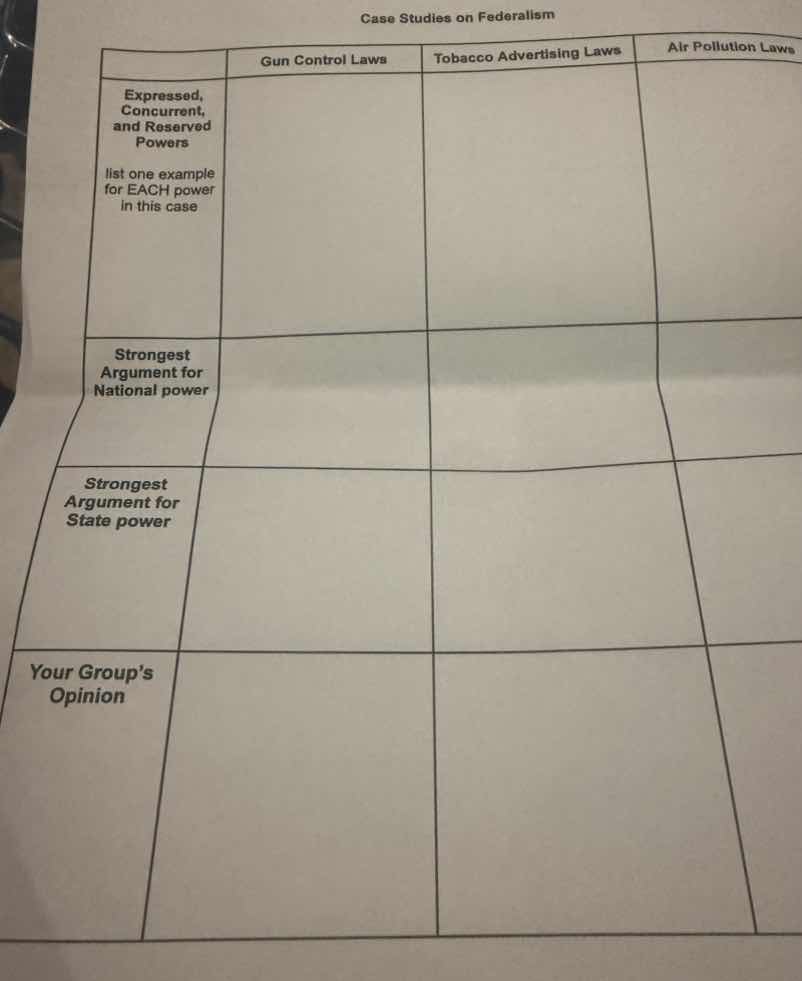
case studies on federalism
gun control laws\ttobacco advertising laws\tair pollution laws
expressed, concurrent, and reserved powers
list one example for each power in this case
\t\t
strongest argument for national power
\t\t
strongest argument for state power
\t\t
your group’s opinion
\t\t
To complete this case study on federalism, we analyze each law (Gun Control, Tobacco Advertising, Air Pollution) across the four sections:
1. Expressed, Concurrent, and Reserved Powers (Example for Each Law)
- Gun Control Laws:
- Expressed Power: National government regulates interstate gun sales (via Commerce Clause, an expressed power in the Constitution).
- Concurrent Power: Both states and the national government can regulate gun safety (e.g., background checks, state-level waiting periods + federal NICS system).
- Reserved Power: States set local gun-carry laws (e.g., concealed carry regulations) as public safety is a reserved power (10th Amendment).
- Tobacco Advertising Laws:
- Expressed Power: National government regulates tobacco ads on interstate media (e.g., TV, online) via the Commerce Clause.
- Concurrent Power: Both states and the national government can restrict tobacco ads (e.g., state bans on ads near schools + federal FDA tobacco marketing rules).
- Reserved Power: States regulate tobacco ads in local print media (e.g., state newspapers) as local commerce is a reserved power.
- Air Pollution Laws:
- Expressed Power: National government regulates interstate air pollution (e.g., EPA’s Clean Air Act) via the Commerce Clause (interstate commerce in energy production).
- Concurrent Power: Both states and the national government regulate air quality (e.g., state vehicle emission standards + federal EPA limits).
- Reserved Power: States set local air pollution rules (e.g., city-level idling bans) as environmental protection for local communities is a reserved power.
2. Strongest Argument for National Power (Each Law)
- Gun Control: National power is strongest for interstate gun trafficking—guns move across state lines, so a unified national policy (e.g., background checks) prevents states with lax laws from undermining stricter states.
- Tobacco Advertising: National power is strongest for interstate media—tobacco ads on national TV/online cross state lines, so a uniform national standard (e.g., FDA bans) avoids inconsistent state rules.
- Air Pollution: National power is strongest for interstate pollution—air pollution drifts across state lines (e.g., acid rain from Midwest to Northeast), so a national approach (e.g., Clean Air Act) is needed to address transboundary pollution.
3. Strongest Argument for State Power (Each Law)
- Gun Control: State power is strongest for local context—states know their communities best (e.g., rural states vs. urban states have different gun needs). States can tailor laws (e.g., open carry rules) to local values.
- Tobacco Advertising: State power is strongest for local media/communities—states can ban ads in areas with high youth smoking (e.g., near schools) or align with local health priorities (e.g., California’s strict tobacco ad laws).
- Air Pollution: State power is strongest for local sources—states can regulate small-scale polluters (e.g., local factories, urban traffic) more effectively than a one-size-fits-all national rule.
4. Your Group’s Opinion (Balanced View)
- Gun Control: A mix of national (interstate trafficking) and state (local carry laws) power balances safety and local autonomy.
- Tobacco Advertising: National rules for interstate media + state rules for local ads ensure consistency across state lines while addressing local health concerns.
- Air Pollution: National rules for transboundary pollution + state rules for local sources (e.g.,…

Snap & solve any problem in the app
Get step-by-step solutions on Sovi AI
Photo-based solutions with guided steps
Explore more problems and detailed explanations
To complete this case study on federalism, we analyze each law (Gun Control, Tobacco Advertising, Air Pollution) across the four sections:
1. Expressed, Concurrent, and Reserved Powers (Example for Each Law)
- Gun Control Laws:
- Expressed Power: National government regulates interstate gun sales (via Commerce Clause, an expressed power in the Constitution).
- Concurrent Power: Both states and the national government can regulate gun safety (e.g., background checks, state-level waiting periods + federal NICS system).
- Reserved Power: States set local gun-carry laws (e.g., concealed carry regulations) as public safety is a reserved power (10th Amendment).
- Tobacco Advertising Laws:
- Expressed Power: National government regulates tobacco ads on interstate media (e.g., TV, online) via the Commerce Clause.
- Concurrent Power: Both states and the national government can restrict tobacco ads (e.g., state bans on ads near schools + federal FDA tobacco marketing rules).
- Reserved Power: States regulate tobacco ads in local print media (e.g., state newspapers) as local commerce is a reserved power.
- Air Pollution Laws:
- Expressed Power: National government regulates interstate air pollution (e.g., EPA’s Clean Air Act) via the Commerce Clause (interstate commerce in energy production).
- Concurrent Power: Both states and the national government regulate air quality (e.g., state vehicle emission standards + federal EPA limits).
- Reserved Power: States set local air pollution rules (e.g., city-level idling bans) as environmental protection for local communities is a reserved power.
2. Strongest Argument for National Power (Each Law)
- Gun Control: National power is strongest for interstate gun trafficking—guns move across state lines, so a unified national policy (e.g., background checks) prevents states with lax laws from undermining stricter states.
- Tobacco Advertising: National power is strongest for interstate media—tobacco ads on national TV/online cross state lines, so a uniform national standard (e.g., FDA bans) avoids inconsistent state rules.
- Air Pollution: National power is strongest for interstate pollution—air pollution drifts across state lines (e.g., acid rain from Midwest to Northeast), so a national approach (e.g., Clean Air Act) is needed to address transboundary pollution.
3. Strongest Argument for State Power (Each Law)
- Gun Control: State power is strongest for local context—states know their communities best (e.g., rural states vs. urban states have different gun needs). States can tailor laws (e.g., open carry rules) to local values.
- Tobacco Advertising: State power is strongest for local media/communities—states can ban ads in areas with high youth smoking (e.g., near schools) or align with local health priorities (e.g., California’s strict tobacco ad laws).
- Air Pollution: State power is strongest for local sources—states can regulate small-scale polluters (e.g., local factories, urban traffic) more effectively than a one-size-fits-all national rule.
4. Your Group’s Opinion (Balanced View)
- Gun Control: A mix of national (interstate trafficking) and state (local carry laws) power balances safety and local autonomy.
- Tobacco Advertising: National rules for interstate media + state rules for local ads ensure consistency across state lines while addressing local health concerns.
- Air Pollution: National rules for transboundary pollution + state rules for local sources (e.g., city-level emissions) leverages both levels of government.
Filling the Table (Example Row for Gun Control Laws):
| Category | Gun Control Laws | Tobacco Advertising Laws (Sample) | Air Pollution Laws (Sample) |
|---|---|---|---|
| Strongest Argument for National Power | Interstate gun trafficking requires uniform rules (e.g., background checks). | Interstate media (TV/online) needs national standards. | Transboundary pollution (e.g., acid rain) needs national coordination. |
| Strongest Argument for State Power | Local context (e.g., rural vs. urban) justifies state-specific carry laws. | Local health priorities (e.g., ads near schools) justify state bans. | Local sources (e.g., city traffic) are best regulated by states. |
| Your Group’s Opinion | Mix: National (interstate) + State (local carry) for balance. | Mix: National (interstate media) + State (local ads) for consistency. | Mix: National (transboundary) + State (local sources) for effectiveness. |
Adjust examples based on your group’s research or class discussions! For tobacco and air pollution, follow the same logic (interstate vs. local authority, 10th Amendment, Commerce Clause).