QUESTION IMAGE
Question
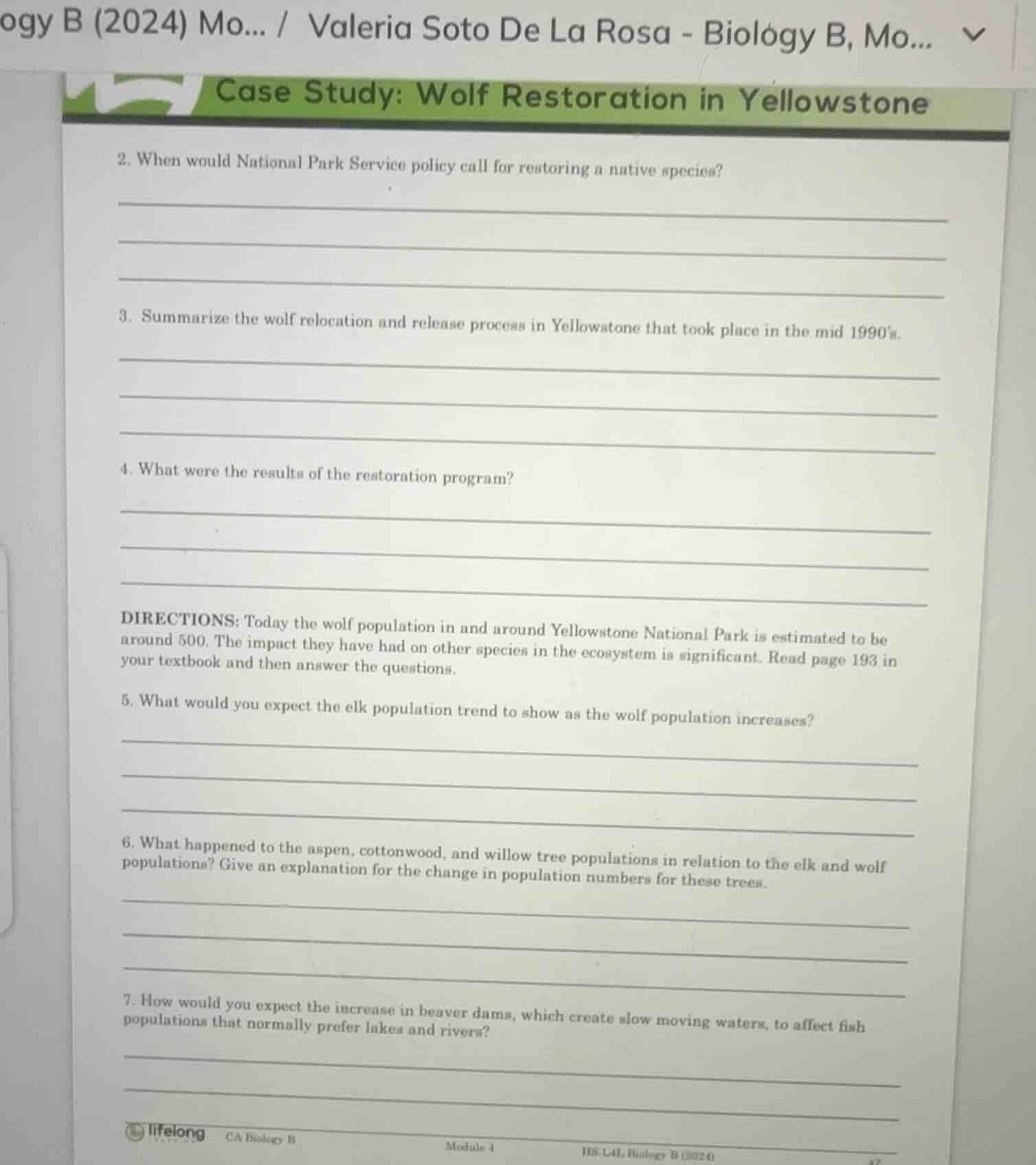
case study: wolf restoration in yellowstone
- when would national park service policy call for restoring a native species?
- summarize the wolf relocation and release process in yellowstone that took place in the mid 1990s.
- what were the results of the restoration program?
directions: today the wolf population in and around yellowstone national park is estimated to be around 500. the impact they have had on other species in the ecosystem is significant. read page 193 in your textbook and then answer the questions.
- what would you expect the elk population trend to show as the wolf population increases?
- what happened to the aspen, cottonwood, and willow tree populations in relation to the elk and wolf populations? give an explanation for the change in population numbers for these trees.
- how would you expect the increase in beaver dams, which create slow moving waters, to affect fish populations that normally prefer lakes and rivers?
Brief Explanations
- The National Park Service policy calls for restoring a native species when the species was extirpated from its historic range within the park due to human activities, and its reintroduction would support the ecological integrity and natural function of the park ecosystem.
- In the mid-1990s, 31 gray wolves were captured from wild populations in western Canada. They were transported to Yellowstone, held in acclimation pens in the park for several weeks to adjust to the environment, then released into the wild in Yellowstone's northern range in 1995 and 1996.
- The restoration reestablished a self-sustaining wolf population in Yellowstone (now ~500 individuals in/around the park). It rebalanced the ecosystem by controlling herbivore populations, which led to recovery of vegetation, and restored trophic cascades that had been missing since wolves were eliminated.
- As the wolf population increases, the elk population would show a decreasing or stabilized trend, as wolves prey on elk, limiting their overpopulation.
- Aspen, cottonwood, and willow populations increased after wolf reintroduction. With wolves preying on elk, elk browsing pressure on these young trees decreased, allowing more saplings to mature and grow into adult trees, reversing the decline caused by over-browsing by unchecked elk herds.
- An increase in beaver dams would create more slow-moving, shallow water habitats (like ponds) that are favorable for fish species adapted to lakes and rivers. This would likely increase the population of these fish, as the dams expand their suitable habitat, provide shelter from strong currents, and support more aquatic food sources.

Snap & solve any problem in the app
Get step-by-step solutions on Sovi AI
Photo-based solutions with guided steps
Explore more problems and detailed explanations
- When the species was extirpated by human activity, and its return would restore the park's natural ecological function.
- 31 Canadian gray wolves were captured, acclimated in Yellowstone pens, then released in 1995-1996.
- A self-sustaining wolf population (~500) was established; the ecosystem rebalanced via restored trophic cascades, with reduced herbivore overpopulation and recovering vegetation.
- The elk population would decrease or stabilize.
- The tree populations increased. Wolf predation reduced elk browsing, allowing more young trees to survive and mature.
- The fish populations would likely increase, as beaver dams expand their preferred slow-moving water habitat and boost food availability.