QUESTION IMAGE
Question
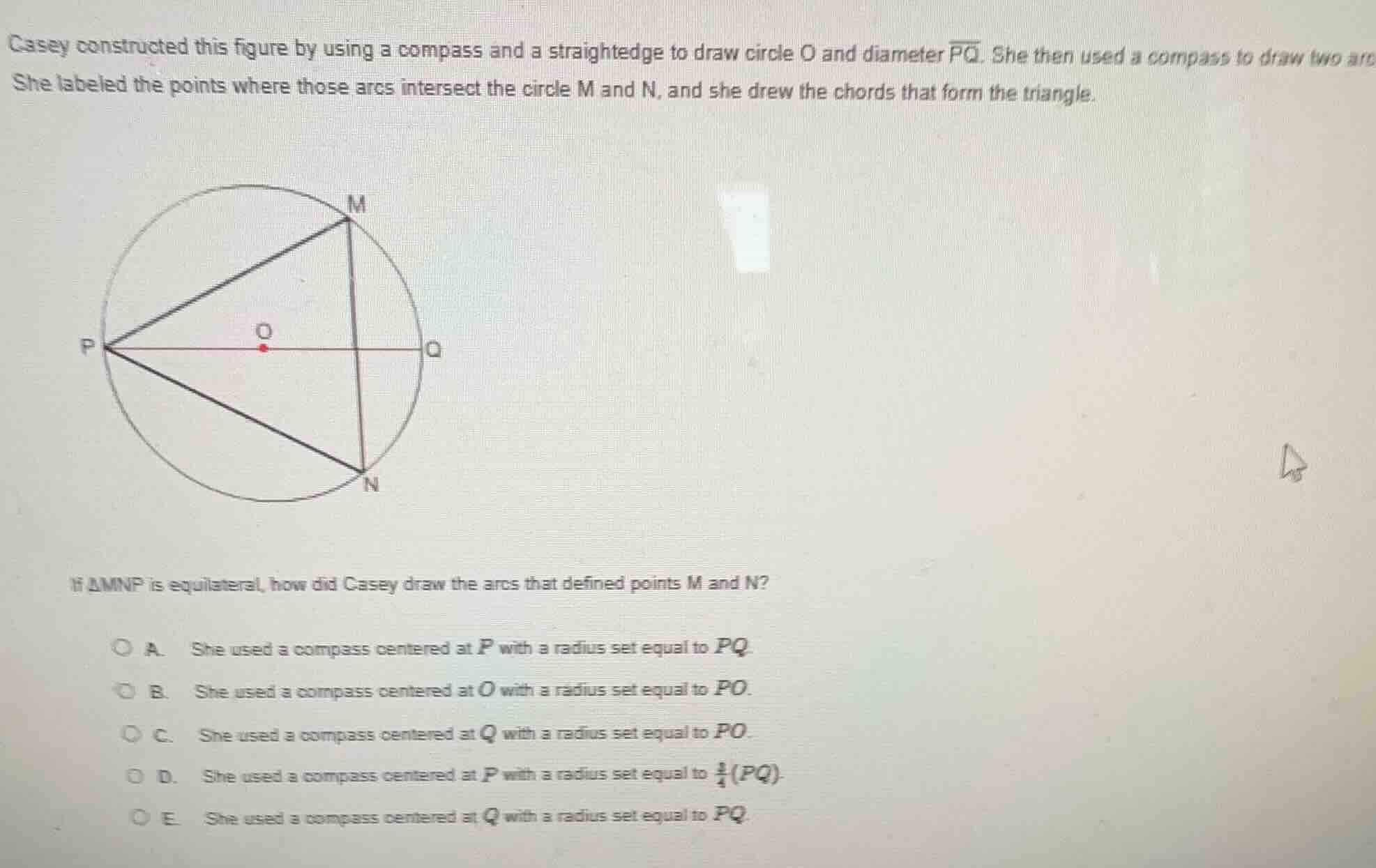
casey constructed this figure by using a compass and a straightedge to draw circle o and diameter (overline{pq}). she then used a compass to draw two arcs. she labeled the points where those arcs intersect the circle m and n, and she drew the chords that form the triangle.
if (\triangle mnp) is equilateral, how did casey draw the arcs that defined points m and n?
a. she used a compass centered at (p) with a radius set equal to (pq).
b. she used a compass centered at (o) with a radius set equal to (po).
c. she used a compass centered at (q) with a radius set equal to (po).
d. she used a compass centered at (p) with a radius set equal to (\frac{1}{4}(pq)).
e. she used a compass centered at (q) with a radius set equal to (pq).
Step1: Define circle parameters
Let the radius of circle O be $r$, so $PQ = 2r$, $PO=OQ=r$.
Step2: Analyze equilateral triangle requirement
For $\triangle MNP$ to be equilateral, $PM=PN=MN$. Since $P$ is on the circle, $PM$ and $PN$ are chords equal to the side of the equilateral triangle.
Step3: Test option E
If compass is centered at $Q$ with radius $PQ=2r$, the arcs intersect the circle at $M,N$. Then $QM=QN=PQ=2r$. In $\triangle QOP$, $OQ=OP=r$, $PQ=2r$, so $\angle QPO=30^\circ$. For points $M,N$ from this arc, $\angle MPN=60^\circ$, and $PM=PN=MN$, forming an equilateral triangle.
Step4: Eliminate other options
- A: Radius $PQ$ at $P$ would intersect the circle only at $Q$, no $M,N$.
- B: Radius $PO=r$ at $O$ gives the original circle, no new points.
- C: Radius $PO=r$ at $Q$ gives arcs intersecting the circle at $P$ and another point, not forming equilateral $\triangle MNP$.
- D: Radius $\frac{3}{4}PQ=\frac{3}{2}r$ at $P$ would create chords shorter than needed for an equilateral triangle with $P$ as a vertex.

Snap & solve any problem in the app
Get step-by-step solutions on Sovi AI
Photo-based solutions with guided steps
Explore more problems and detailed explanations
E. She used a compass centered at Q with a radius set equal to PQ.