QUESTION IMAGE
Question
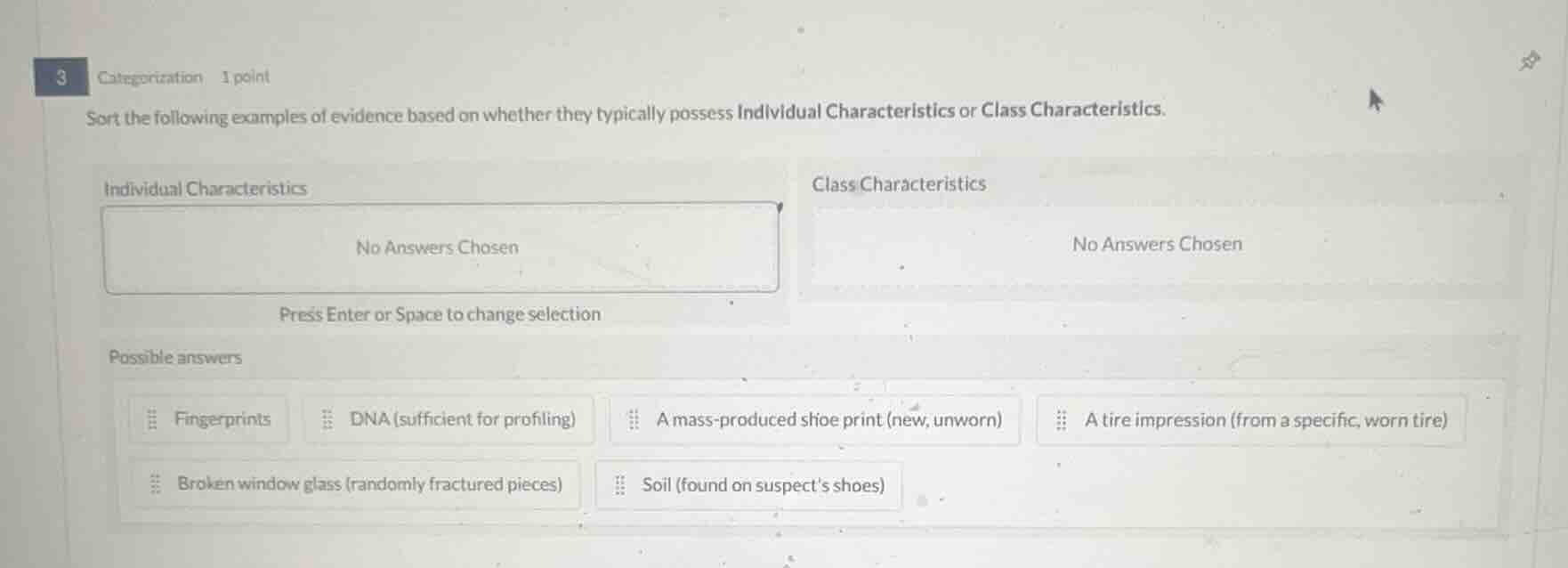
3 categorization 1 point sort the following examples of evidence based on whether they typically possess individual characteristics or class characteristics. individual characteristics no answers chosen class characteristics no answers chosen press enter or space to change selection possible answers fingerprints dna (sufficient for profiling) a mass - produced shoe print (new, unworn) a tire impression (from a specific, worn tire) broken window glass (randomly fractured pieces) soil (found on suspects shoes)
To solve this, we first recall the definitions: Individual Characteristics are unique to a single source (can be used to identify a specific individual/object), while Class Characteristics are common to a group (identify a class of objects).
- Individual Characteristics:
- Fingerprints: Unique to each person.
- DNA (sufficient for profiling): Unique to an individual (except identical twins, but profiling here implies uniqueness).
- A tire impression (from a specific, worn tire): Worn tires have unique wear patterns, so specific to one tire.
- Broken window glass (randomly fractured pieces): Random fractures create unique patterns, linking to a specific window.
- Class Characteristics:
- A mass - produced shoe print (new, unworn): New, mass - produced shoes have standard prints, common to all shoes of that model (class).
- Soil (found on suspect’s shoes): Soil type is shared by a region/class, not unique to one person/object.

Snap & solve any problem in the app
Get step-by-step solutions on Sovi AI
Photo-based solutions with guided steps
Explore more problems and detailed explanations
Individual Characteristics:
- Fingerprints
- DNA (sufficient for profiling)
- A tire impression (from a specific, worn tire)
- Broken window glass (randomly fractured pieces)
Class Characteristics:
- A mass - produced shoe print (new, unworn)
- Soil (found on suspect’s shoes)