QUESTION IMAGE
Question
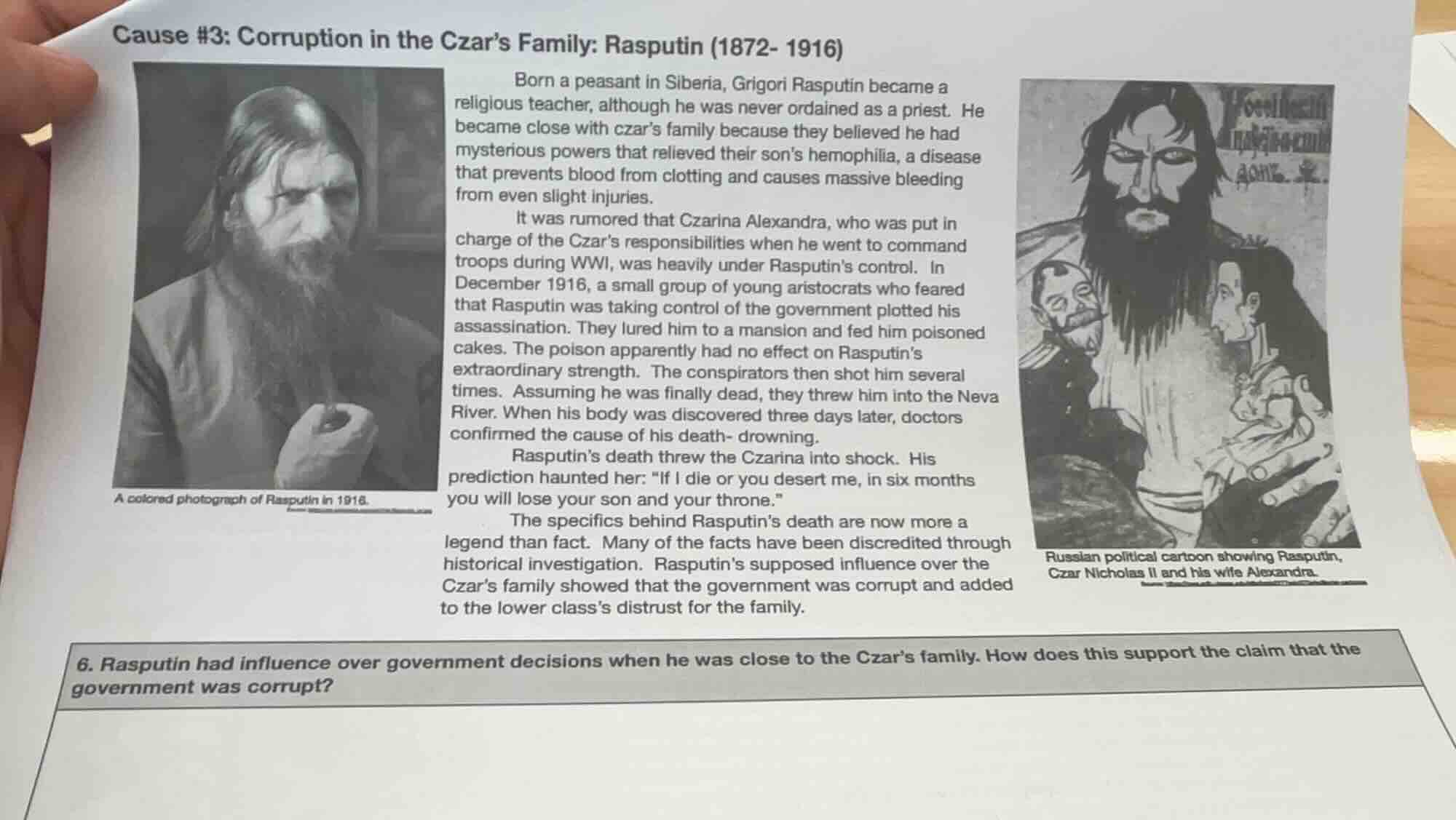
cause #3: corruption in the czar’s family: rasputin (1872- 1916)
born a peasant in siberia, grigori rasputin became a religious teacher, although he was never ordained as a priest. he became close with czar’s family because they believed he had mysterious powers that relieved their son’s hemophilia, a disease that prevents blood from clotting and causes massive bleeding from even slight injuries.
it was rumored that czarina alexandra, who was put in charge of the czar’s responsibilities when he went to command troops during wwi, was heavily under rasputins control. in december 1916, a small group of young aristocrats who feared that rasputin was taking control of the government plotted his assassination. they lured him to a mansion and fed him poisoned cakes. the poison apparently had no effect on rasputins extraordinary strength. the conspirators then shot him several times. assuming he was finally dead, they threw him into the neva river. when his body was discovered three days later, doctors confirmed the cause of his death- drowning.
rasputin’s death threw the czarina into shock. his prediction haunted her: “if i die or you desert me, in six months you will lose your son and your throne.”
the specifics behind rasputin’s death are now more a legend than fact. many of the facts have been discredited through historical investigation. rasputin’s supposed influence over the czar’s family showed that the government was corrupt and added to the lower class’s distrust for the family.
- rasputin had influence over government decisions when he was close to the czar’s family. how does this support the claim that the government was corrupt?
Rasputin was an unordained, non-elite peasant with no formal government training or legitimate political authority. His influence over Czarina Alexandra (who ran state affairs during the Czar's WWI military command) meant government decisions were shaped by a favored, unqualified outsider rather than established, accountable state structures. This bypass of proper governance processes, where access to power and policy influence came from personal favor with the royal family instead of merit or legal authority, demonstrated systemic corruption in the czarist government. It also fueled lower-class distrust, as it exposed that the state was run for the benefit of the royal family's personal connections rather than the public good.

Snap & solve any problem in the app
Get step-by-step solutions on Sovi AI
Photo-based solutions with guided steps
Explore more problems and detailed explanations
Rasputin was an unqualified, non-official figure with no legitimate political credentials, yet he gained sway over government decisions through his personal access to the czar's family. This showed that government power was being wielded based on royal favor rather than established, accountable systems or qualified leadership. This bypass of proper governance norms, where an unordained peasant with no formal role could shape state affairs, directly illustrates corruption: the czarist government was operating outside of its intended, transparent structures, prioritizing personal connections over the public good, which eroded trust in the ruling family and state.