QUESTION IMAGE
Question
cells
review
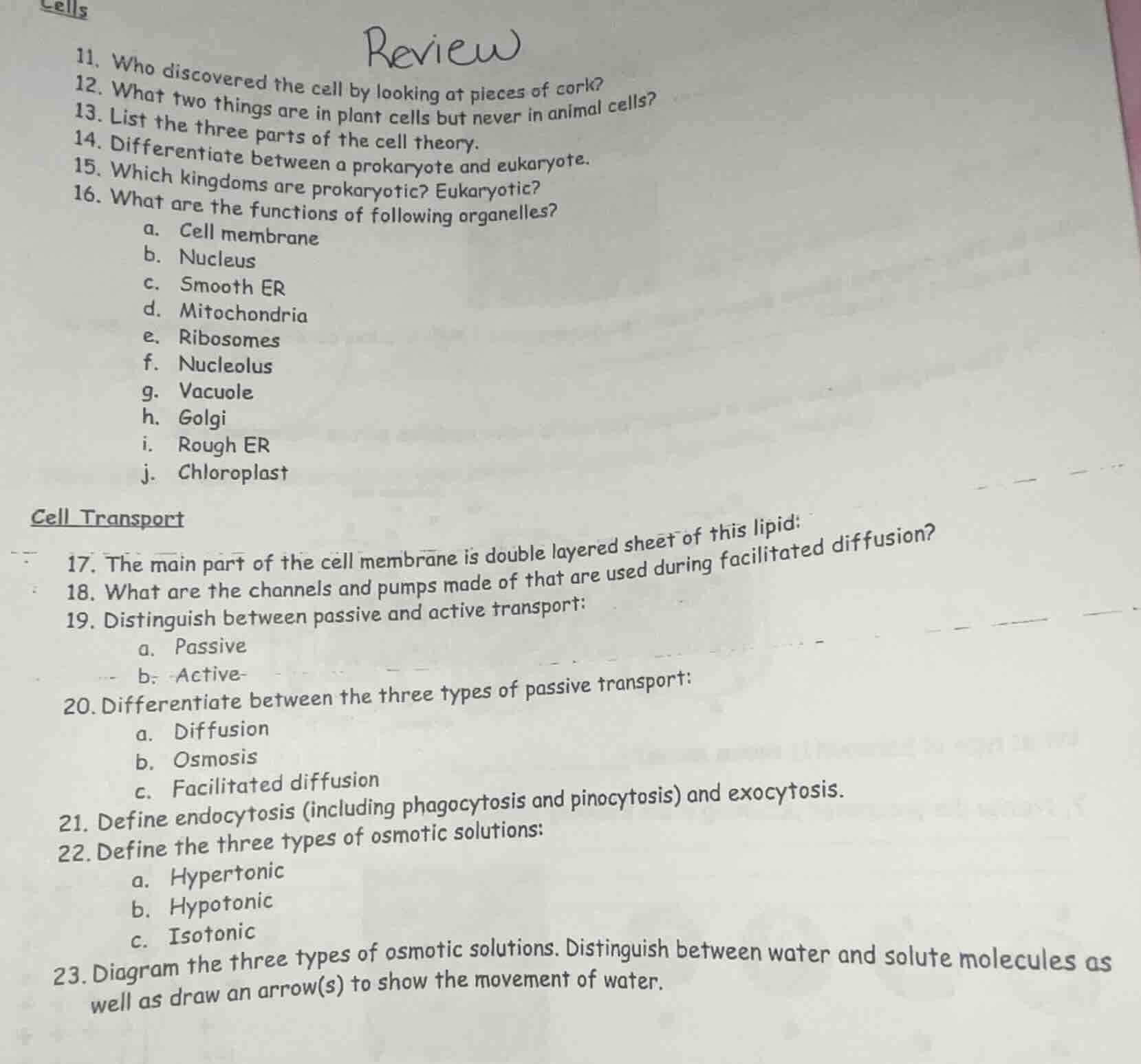
- who discovered the cell by looking at pieces of cork?
- what two things are in plant cells but never in animal cells?
- list the three parts of the cell theory.
- differentiate between a prokaryote and eukaryote.
- which kingdoms are prokaryotic? eukaryotic?
- what are the functions of following organelles?
a. cell membrane
b. nucleus
c. smooth er
d. mitochondria
e. ribosomes
f. nucleolus
g. vacuole
h. golgi
i. rough er
j. chloroplast
cell transport
- the main part of the cell membrane is double layered sheet of this lipid:
- what are the channels and pumps made of that are used during facilitated diffusion?
- distinguish between passive and active transport:
a. passive
b. active
- differentiate between the three types of passive transport:
a. diffusion
b. osmosis
c. facilitated diffusion
- define endocytosis and exocytosis.
- define the three types of osmotic solutions:
a. hypertonic
b. hypotonic
c. isotonic
- diagram the three types of osmotic solutions. distinguish between water and solute molecules as well as draw an arrow(s) to show the movement of water.
Cells Section
- Identified the scientist who first observed cork cells under a microscope.
- Named structures unique to plant cells, not present in animal cells.
- Listed the core tenets of cell theory.
- Compared key structural and organizational differences between prokaryotes and eukaryotes.
- Classified biological kingdoms into prokaryotic and eukaryotic groups.
- Summarized the core function of each listed organelle:
a. Cell membrane: Regulates substance movement in/out of cell
b. Nucleus: Stores genetic material, controls cell activity
c. Smooth ER: Synthesizes lipids, detoxifies substances
d. Mitochondria: Produces cellular energy (ATP)
e. Ribosomes: Synthesizes proteins
f. Nucleolus: Produces ribosomal subunits
g. Vacuole: Stores water, nutrients, waste (larger in plants)
h. Golgi: Modifies, sorts, packages proteins/lipids
i. Rough ER: Synthesizes and transports proteins (has ribosomes)
j. Chloroplast: Carries out photosynthesis (plant-specific)
Cell Transport Section
- Identified the main lipid component of the cell membrane bilayer.
- Named the biomolecule that forms channels and pumps for facilitated diffusion.
- Differentiated between passive and active transport based on energy use and movement direction:
a. Passive: No energy, moves down concentration gradient
b. Active: Uses ATP energy, moves against gradient
- Distinguished the three passive transport types by their mechanism and substances moved:
a. Diffusion: Movement of small, nonpolar substances down gradient
b. Osmosis: Movement of water across a semipermeable membrane
c. Facilitated diffusion: Movement of large/polar substances via protein channels
- Defined bulk transport processes, including sub-types of endocytosis:
- Endocytosis: Brings substances into the cell via membrane vesicles
- Phagocytosis: "Cell eating" of large particles
- Pinocytosis: "Cell drinking" of fluid/small solutes
- Exocytosis: Releases substances out of the cell via vesicle fusion
- Defined each osmotic solution based on solute concentration relative to a cell:
a. Hypertonic: Higher solute concentration outside the cell
b. Hypotonic: Lower solute concentration outside the cell
c. Isotonic: Equal solute concentration inside/outside the cell
- Described the visual representation of each osmotic solution with water movement:
- Hypertonic: More solute outside cell; water moves out (cell shrinks)
- Hypotonic: More solute inside cell; water moves in (cell swells)
- Isotonic: Equal solute; no net water movement (cell stays same)

Snap & solve any problem in the app
Get step-by-step solutions on Sovi AI
Photo-based solutions with guided steps
Explore more problems and detailed explanations
Cells Section
- Robert Hooke
- Cell wall, chloroplasts (large central vacuole is also acceptable)
- 1. All living things are made of cells; 2. Cells are the basic unit of structure and function in living things; 3. All cells come from pre-existing cells
- Prokaryotes have no nucleus or membrane-bound organelles, are smaller, and have circular DNA; eukaryotes have a nucleus, membrane-bound organelles, are larger, and have linear DNA
- Prokaryotic: Bacteria, Archaea; Eukaryotic: Protista, Fungi, Plantae, Animalia
- a. Regulates movement of materials in and out of the cell
b. Stores genetic material and controls cell activities
c. Synthesizes lipids and detoxifies harmful substances
d. Produces ATP (cellular energy) via cellular respiration
e. Synthesizes proteins
f. Produces and assembles ribosomal subunits
g. Stores water, nutrients, and waste (larger in plant cells)
h. Modifies, sorts, and packages proteins/lipids for transport
i. Synthesizes and transports proteins (studded with ribosomes)
j. Carries out photosynthesis to make glucose (plant cells only)
Cell Transport Section
- Phospholipids
- Proteins
- a. Passive transport: No energy required; substances move down their concentration gradient
b. Active transport: Requires ATP energy; substances move against their concentration gradient
- a. Diffusion: Movement of small, nonpolar molecules directly across the membrane down a concentration gradient
b. Osmosis: Movement of water across a semipermeable membrane down its concentration gradient
c. Facilitated diffusion: Movement of large/polar molecules down a concentration gradient via protein channels
- - Endocytosis: Process where the cell membrane engulfs substances to bring them into the cell:
- Phagocytosis: Endocytosis of large solid particles
- Pinocytosis: Endocytosis of fluid and small dissolved solutes
- Exocytosis: Process where vesicles fuse with the cell membrane to release substances out of the cell
- a. Hypertonic: A solution with a higher solute concentration than the inside of the cell
b. Hypotonic: A solution with a lower solute concentration than the inside of the cell
c. Isotonic: A solution with the same solute concentration as the inside of the cell
- - Hypertonic Solution:
- Solute: More solute molecules outside the cell; fewer inside
- Water: Arrow points from inside the cell to outside
- Cell appearance: Shrinks
- Hypotonic Solution:
- Solute: Fewer solute molecules outside the cell; more inside
- Water: Arrow points from outside the cell to inside
- Cell appearance: Swells
- Isotonic Solution:
- Solute: Equal number of solute molecules inside and outside the cell
- Water: No net movement (arrows pointing both ways equally)
- Cell appearance: Remains the same size