QUESTION IMAGE
Question
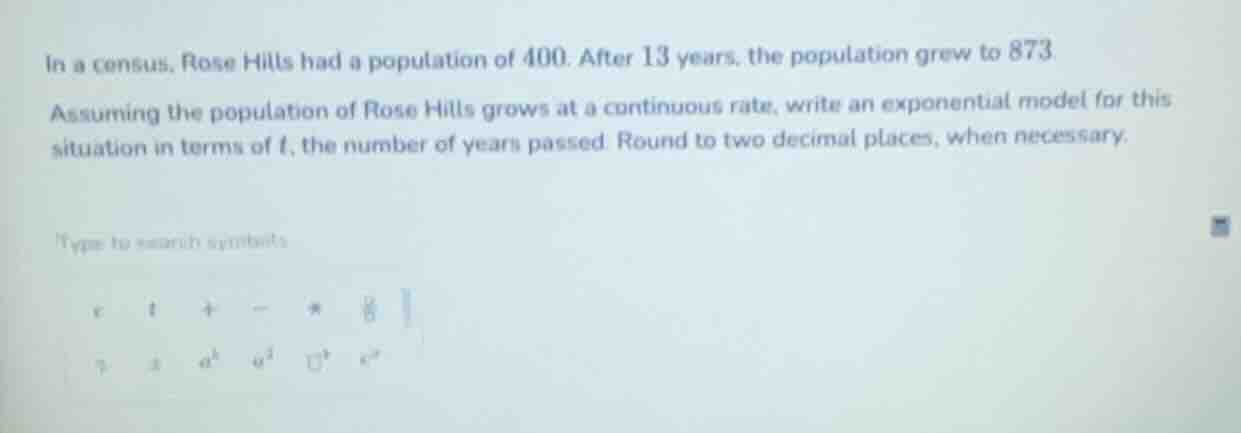
in a census, rose hills had a population of 400. after 13 years, the population grew to 873. assuming the population of rose hills grows at a continuous rate, write an exponential model for this situation in terms of t, the number of years passed. round to two decimal places, when necessary.
Step1: Recall continuous growth formula
The general model for continuous exponential growth is $P(t) = P_0 e^{rt}$, where $P_0$ is the initial population, $r$ is the continuous growth rate, and $t$ is time in years.
Step2: Identify known values
We know $P_0 = 400$, $t = 13$, and $P(13) = 873$. Substitute these into the formula:
$873 = 400 e^{13r}$
Step3: Isolate the exponential term
Divide both sides by 400:
$\frac{873}{400} = e^{13r}$
$2.1825 = e^{13r}$
Step4: Solve for $r$ using natural log
Take the natural logarithm of both sides:
$\ln(2.1825) = 13r$
Calculate $\ln(2.1825) \approx 0.779$, then:
$r = \frac{0.779}{13} \approx 0.06$
Step5: Write the final model
Substitute $P_0 = 400$ and $r \approx 0.06$ back into the original formula.

Snap & solve any problem in the app
Get step-by-step solutions on Sovi AI
Photo-based solutions with guided steps
Explore more problems and detailed explanations
$P(t) = 400e^{0.06t}$