QUESTION IMAGE
Question
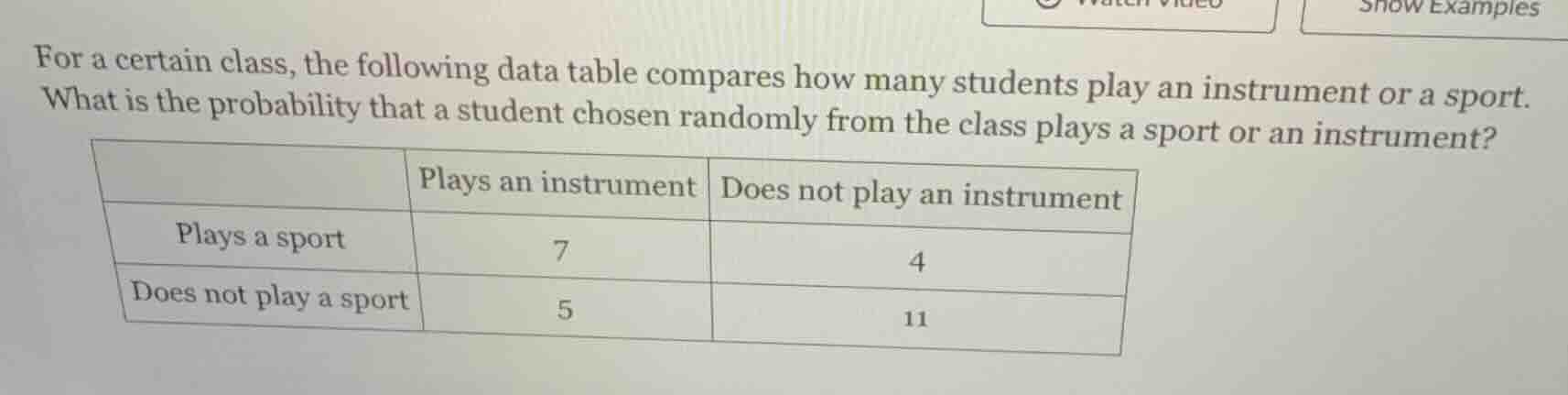
for a certain class, the following data table compares how many students play an instrument or a sport. what is the probability that a student chosen randomly from the class plays a sport or an instrument?
plays an instrument | does not play an instrument
--- | ---
plays a sport | 7 | 4
does not play a sport | 5 | 11
Step1: Find total number of students
First, we calculate the total number of students in the class by adding up all the values in the table. The values are 7, 4, 5, and 11. So, total students \(= 7 + 4 + 5 + 11 = 27\).
Step2: Find number of students who play sport or instrument
To find the number of students who play a sport or an instrument, we use the principle of inclusion - exclusion. The number of students who play a sport is \(7 + 4 = 11\), the number of students who play an instrument is \(7 + 5 = 12\), and the number of students who play both (the intersection) is 7. So, using the formula \(n(A\cup B)=n(A)+n(B)-n(A\cap B)\), we get \(11 + 12 - 7 = 16\). Alternatively, we can also calculate it by adding the number of students who play a sport, play an instrument, and subtract the overlap (but another way is to sum the cells that are in "Plays a sport" row or "Plays an instrument" column: \(7 + 4 + 5=16\) (since 7 is counted in both, we add 7 (plays sport and instrument), 4 (plays sport not instrument), 5 (plays instrument not sport))).
Step3: Calculate the probability
The probability is the number of favorable outcomes (students who play sport or instrument) divided by the total number of students. So, probability \(=\frac{16}{27}\).

Snap & solve any problem in the app
Get step-by-step solutions on Sovi AI
Photo-based solutions with guided steps
Explore more problems and detailed explanations
\(\frac{16}{27}\)