QUESTION IMAGE
Question
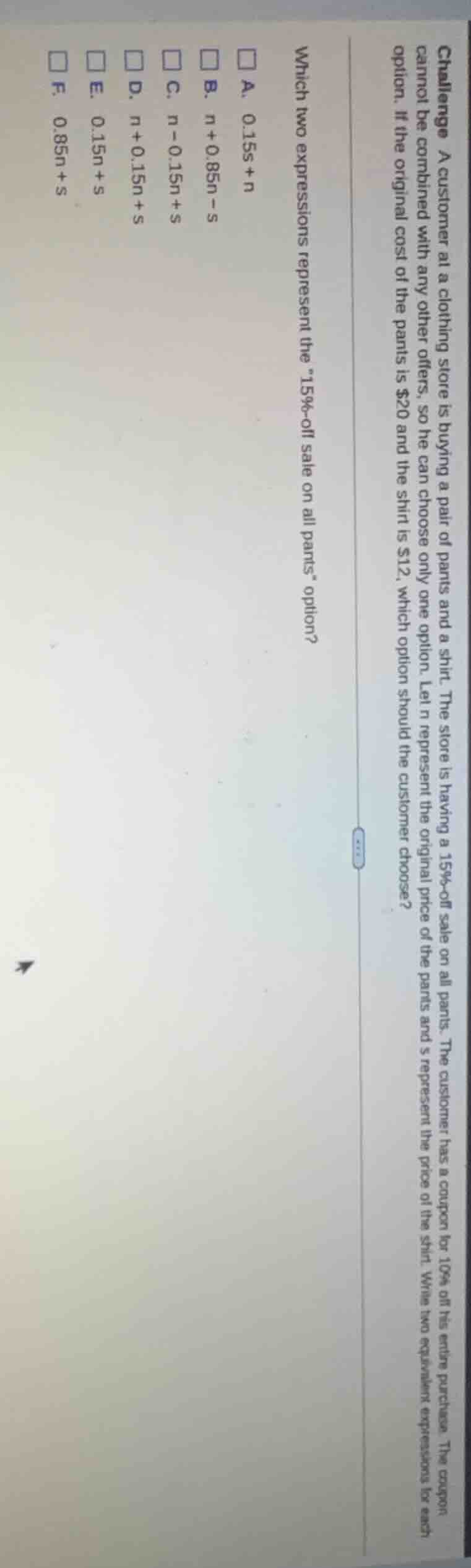
challenge a customer at a clothing store is buying a pair of pants and a shirt. the store is having a 15%-off sale on all pants. the customer has a coupon for 10% off his entire purchase. the coupon cannot be combined with any other offers, so he can choose only one option. let n represent the original price of the pants and s represent the price of the shirt. write two equivalent expressions for each option. if the original cost of the pants is $20 and the shirt is $12, which option should the customer choose?
which two expressions represent the \15%-off sale on all pants\ option?
a. 0.15s + n
b. n + 0.85n − s
c. n − 0.15n + s
d. n + 0.15n + s
e. 0.15n + s
f. 0.85n + s
Step1: Understand the discount on pants
A 15% - off sale on pants means the customer pays 100% - 15% = 85% of the original price of pants. So the price of pants after the sale is \(0.85n\) (since \(85\%=0.85\)). The price of the shirt is \(s\), so the total cost for the "15% - off sale on all pants" option is \(0.85n + s\) (which is option F) or we can also think of it as the original price of pants minus 15% of the original price of pants plus the shirt price. 15% of \(n\) is \(0.15n\), so the price of pants after discount is \(n-0.15n\), and then add the shirt price \(s\), so the total cost is \(n - 0.15n+s\) (which is option C).
Step2: Verify the expressions
- For option C: \(n-0.15n + s\) is equivalent to \((1 - 0.15)n+s=0.85n + s\) (by combining like terms for the pants' price).
- For option F: \(0.85n + s\) directly represents 85% of the pants' price (after 15% discount) plus the shirt's price.
Other options:
- Option A: \(0.15s + n\) involves a discount on the shirt, not the pants, so incorrect.
- Option B: \(n + 0.85n-s\) has an incorrect operation (adding and subtracting in a way that doesn't represent the discount on pants), incorrect.
- Option D: \(n+0.15n + s\) would be an increase in the pants' price, not a discount, incorrect.
- Option E: \(0.15n + s\) is only 15% of the pants' price plus the shirt, which is not the total cost after discount, incorrect.

Snap & solve any problem in the app
Get step-by-step solutions on Sovi AI
Photo-based solutions with guided steps
Explore more problems and detailed explanations
C. \(n - 0.15n + s\), F. \(0.85n + s\)