QUESTION IMAGE
Question
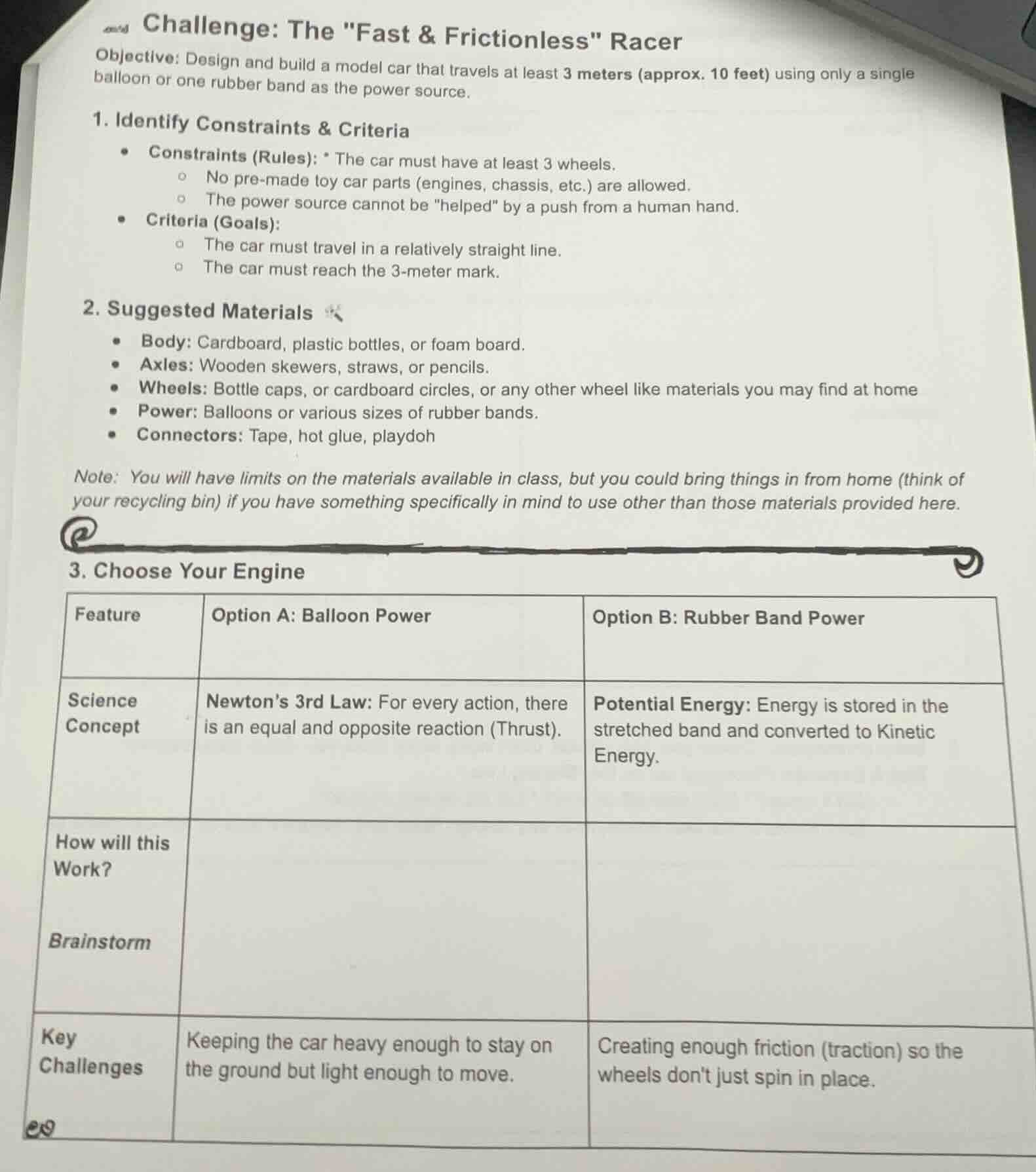
challenge: the \fast & frictionless\ racer
objective: design and build a model car that travels at least 3 meters (approx. 10 feet) using only a single balloon or one rubber band as the power source.
- identify constraints & criteria
- constraints (rules): * the car must have at least 3 wheels.
- no pre - made toy car parts (engines, chassis, etc.) are allowed.
- the power source cannot be \helped\ by a push from a human hand.
- criteria (goals):
- the car must travel in a relatively straight line.
- the car must reach the 3 - meter mark.
- suggested materials
- body: cardboard, plastic bottles, or foam board.
- axles: wooden skewers, straws, or pencils.
- wheels: bottle caps, or cardboard circles, or any other wheel like materials you may find at home
- power: balloons or various sizes of rubber bands.
- connectors: tape, hot glue, playdoh
note: you will have limits on the materials available in class, but you could bring things in from home (think of your recycling bin) if you have something specifically in mind to use other than those materials provided here.
- choose your engine
| feature | option a: balloon power | option b: rubber band power |
|---|---|---|
| how will this work? | ||
| brainstorm | ||
| key challenges | keeping the car heavy enough to stay on the ground but light enough to move. | creating enough friction (traction) so the wheels dont just spin in place. |
To complete the "How will this Work?" section for both options:
Option A: Balloon Power
Step1: Inflate the balloon
Blow up the balloon and seal it to trap air inside. This stores potential energy in the form of compressed air.
Step2: Attach to the car
Secure the balloon to the car (e.g., with tape or glue) such that the opening of the balloon is directed backward (opposite to the direction you want the car to move).
Step3: Release the air
Let go of the balloon's opening. The air will rush out of the balloon in one direction (action). According to Newton's 3rd Law, there will be an equal and opposite reaction force (thrust) pushing the car forward (in the direction opposite to the air flow). This thrust will cause the car to move along the ground.
Step4: Movement
As the air continues to escape from the balloon, the thrust will keep acting on the car, causing it to travel in a (hopefully) straight line until the balloon is deflated or the force of friction (from the wheels on the ground and air resistance) slows it down and stops it. If the thrust is greater than the opposing forces (friction and air resistance), the car will move at least 3 meters.
Option B: Rubber Band Power
Step1: Attach the rubber band
Secure one end of the rubber band to the car's body and the other end to the axle (the rod that holds the wheels). You may need to wind the rubber band around the axle a few times, depending on the setup.
Step2: Wind the rubber band
Turn the axle (either by hand or using a mechanism) to wind the rubber band around it. As you wind the rubber band, it stretches, and potential energy is stored in the stretched rubber band. The more you wind it (up to a point where it doesn't break), the more potential energy is stored.
Step3: Release the axle
Let go of the axle. The rubber band will try to return to its original (unstretched) length. As it unwinds, the potential energy stored in the rubber band is converted into kinetic energy, which causes the axle to rotate.
Step4: Wheel rotation and movement
The rotating axle will turn the wheels (since the wheels are attached to the axle). The rotation of the wheels creates friction (traction) with the ground. If the friction is sufficient (not too much or too little), the wheels will grip the ground and cause the car to move forward in a (hopefully) straight line. The car will continue to move as long as the rubber band is unwinding and providing enough rotational force to the wheels to overcome friction and air resistance. Ideally, it will travel at least 3 meters.
- Reduce weight: Use lightweight materials for the car body (e.g., thin cardboard, foam board) to make it easier for the balloon’s thrust to move it. But ensure it’s heavy enough to stay on the ground (e.g., add a small weight if needed).
- Streamline the design: Make the car’s shape aerodynamic (e.g., pointy front, smooth surfaces) to reduce air resistance, allowing it to travel farther.
- Stabilize the balloon: Attach the balloon in a way that keeps it pointing straight backward (e.g., use a straw or tube to guide the air flow) to ensure the thrust is directed straight, helping the car move in a straight line.
- Multiple balloons (if allowed, but the challenge says "a single balloon"—so maybe not, but if modifying, more balloons could provide more thrust). But since the challenge specifies one balloon, focus on optimizing the single balloon’s use.
- Wheel design: Use smooth wheels (e.g., bottle caps with minimal texture) to reduce friction with the ground, but not so smooth that they slip. Find a balance.
Option B: Rubber Band Power

Snap & solve any problem in the app
Get step-by-step solutions on Sovi AI
Photo-based solutions with guided steps
Explore more problems and detailed explanations
(for "How will this Work?" section):
- Option A (Balloon Power): Inflate the balloon, attach it to the car with the opening facing backward, and release the air. The escaping air (action) creates an equal and opposite thrust (reaction, per Newton’s 3rd Law) that pushes the car forward until the balloon deflates or friction/resistance stops it.
- Option B (Rubber Band Power): Attach the rubber band to the car and axle, wind the rubber band around the axle to store potential energy, then release the axle. The rubber band’s unwinding converts potential energy to kinetic energy, rotating the axle and wheels. Friction between the wheels and ground (traction) propels the car forward until the rubber band unwinds or friction/resistance stops it.
To complete the "Brainstorm" section (ideas to improve the design/overcome challenges):