QUESTION IMAGE
Question
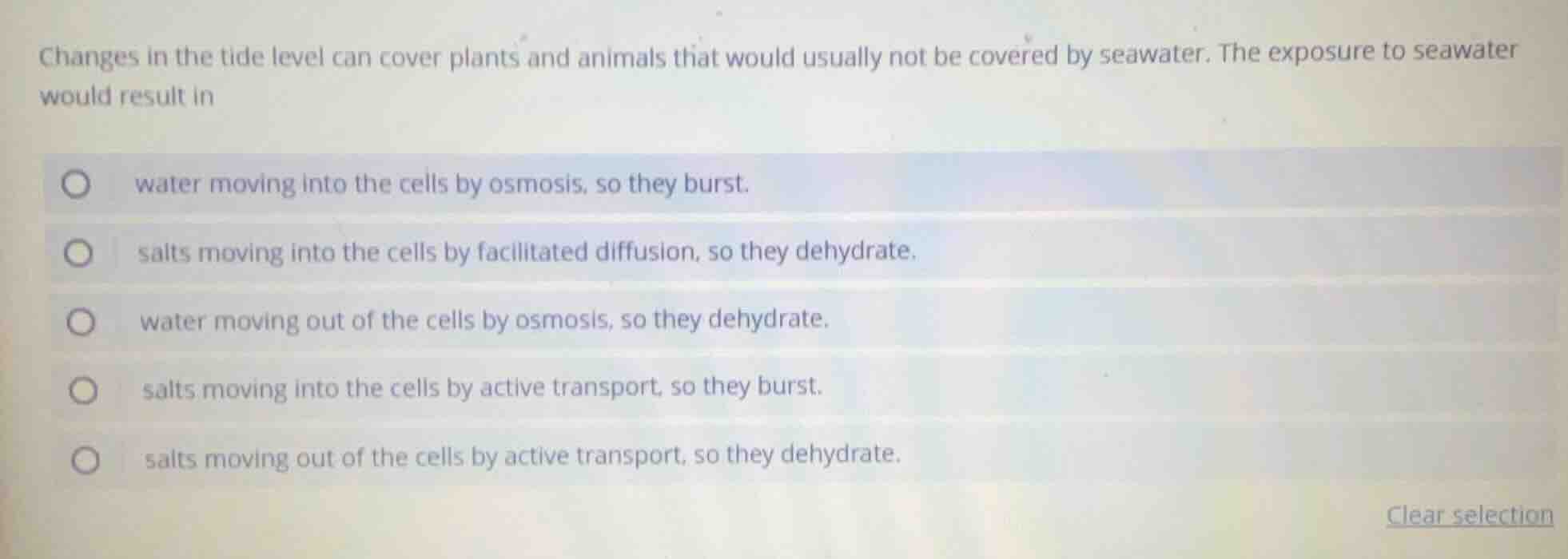
changes in the tide level can cover plants and animals that would usually not be covered by seawater. the exposure to seawater would result in
water moving into the cells by osmosis, so they burst.
salts moving into the cells by facilitated diffusion, so they dehydrate.
water moving out of the cells by osmosis, so they dehydrate.
salts moving into the cells by active transport, so they burst.
salts moving out of the cells by active transport, so they dehydrate.
Brief Explanations
- Recall the concept of osmosis: water moves from an area of lower solute concentration to higher solute concentration across a semi - permeable membrane.
- Seawater has a higher salt (solute) concentration than the cells of most plants and animals that are not adapted to seawater.
- So, when these cells are exposed to seawater, water will move out of the cells (from lower solute concentration inside the cell to higher solute concentration in seawater) by osmosis. This loss of water from the cells will lead to dehydration of the cells.
- Analyze other options:
- Option 1: Water moving into the cells would happen if the cell had a higher solute concentration than the surrounding, which is not the case here. Also, animal cells might burst, but most of these organisms' cells (especially plant cells with cell walls) won't burst in this scenario as described.
- Option 2: Salts moving into cells by facilitated diffusion - seawater has high salt, and cells have lower salt, so the direction of salt movement would not be into the cells to cause dehydration in this way.
- Option 4: Salts moving into cells by active transport and cells bursting - Active transport is against the concentration gradient, and the main issue here is water movement due to osmosis, not salt movement causing bursting.
- Option 5: Salts moving out of cells by active transport - The main driving force for water loss is osmosis due to solute concentration difference, not active transport of salts out.

Snap & solve any problem in the app
Get step-by-step solutions on Sovi AI
Photo-based solutions with guided steps
Explore more problems and detailed explanations
C. water moving out of the cells by osmosis, so they dehydrate.