QUESTION IMAGE
Question
changing social hierarchies from 1450 to 1750 quiz
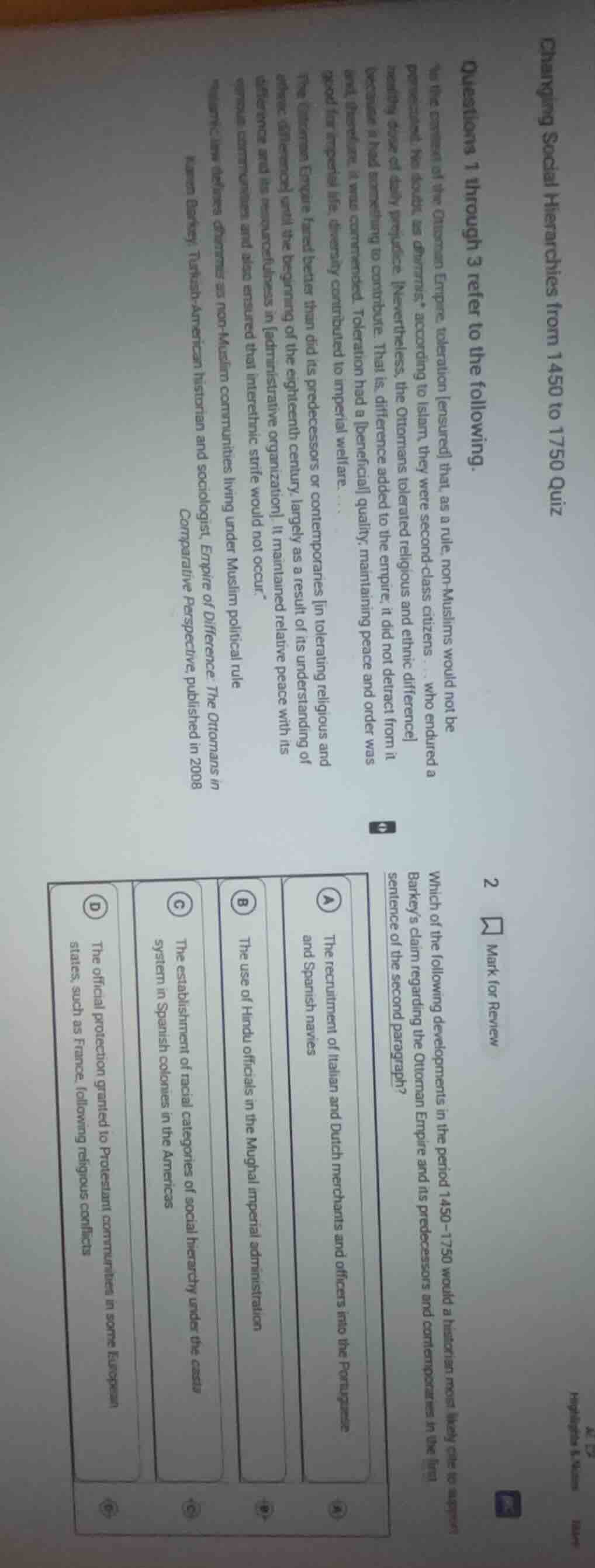
questions 1 through 3 refer to the following.
in the context of the ottoman empire, toleration ensured that, as a rule, non - muslims would not be persecuted. not shock as others, according to islam, they were second - class citizens... who endured a healthy dose of daily prejudice. nevertheless, the ottomans tolerated religious and ethnic difference because it had something to contribute. that is, difference added to the empire; it did not detract from it and therefore, it was continued. toleration had a beneficial quality: maintaining peace and order was good for imperial life, diversity contributed to imperial welfare....
the ottoman empire fared better than did its predecessors or contemporaries in tolerating religious and ethnic difference until the beginning of the eighteenth century, largely as a result of its understanding of difference and its resourcefulness in administrative organization. it maintained relative peace with its non - muslim communities and also ensured that interethnic strife would not occur.
karen barkey, turkish - american historian and sociologist, empire of difference: the ottomans in comparative perspective, published in 2008
2
mark for review
which of the following developments in the period 1450–1750 would a historian most likely cite to support barkey’s claim regarding the ottoman empire and its predecessors and contemporaries in the first sentence of the second paragraph?
a the recruitment of italian and dutch merchants and officers into the portuguese and spanish navies
b the use of hindu officials in the mughal imperial administration
c the establishment of racial categories of social hierarchy under the caste system in spanish colonies in the americas
d the official protection granted to protestant communities in some european states, following religious conflicts
The question is about the Ottoman Empire's tolerance and its comparison with predecessors/contemporaries. We need to find which option supports Barkey's claim.
- Option A: Recruitment of Italian/Dutch in Portuguese/Spanish navies doesn't relate to tolerance of diverse groups as in Ottomans.
- Option B: Mughal use of Hindu officials shows religious/ethnic inclusion in administration, similar to Ottoman tolerance (tolerating non - Muslim, non - elite groups). This supports the idea that Ottomans' tolerance (tolerating differences) was beneficial and comparable to predecessors (Mughals here) or contemporaries in maintaining peace.
- Option C: Spanish racial hierarchy in colonies is about exclusion, opposite of Ottoman tolerance.
- Option D: Protection of Protestants in some European states is about religious conflict aftermath, not about imperial tolerance like Ottomans.

Snap & solve any problem in the app
Get step-by-step solutions on Sovi AI
Photo-based solutions with guided steps
Explore more problems and detailed explanations
B. The use of Hindu officials in the Mughal imperial administration