QUESTION IMAGE
Question
chapter 02 quiz: the research enterprise in psychology
total points: ~/20 attempts left: 3
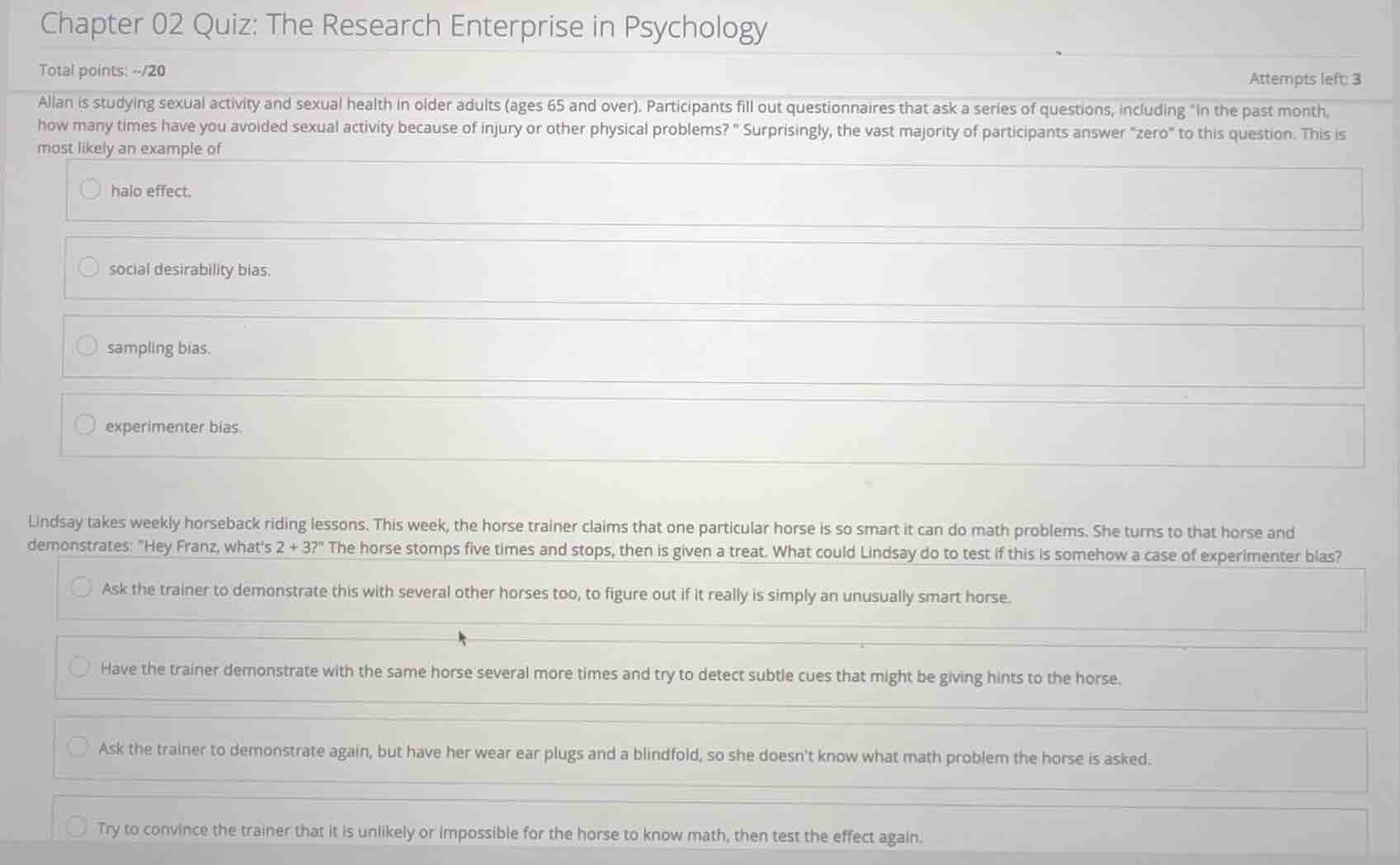
allan is studying sexual activity and sexual health in older adults (ages 65 and over). participants fill out questionnaires that ask a series of questions, including \in the past month, how many times have you avoided sexual activity because of injury or other physical problems?\ surprisingly, the vast majority of participants answer \zero\ to this question. this is most likely an example of
- halo effect.
- social desirability bias.
- sampling bias.
- experimenter bias.
lindsay takes weekly horseback riding lessons. this week, the horse trainer claims that one particular horse is so smart it can do math problems. she turns to that horse and demonstrates: \hey franz, whats 2 + 3?\ the horse stomps five times and stops, then is given a treat. what could lindsay do to test if this is somehow a case of experimenter bias?
- ask the trainer to demonstrate this with several other horses too, to figure out if it really is simply an unusually smart horse.
- have the trainer demonstrate with the same horse several more times and try to detect subtle cues that might be giving hints to the horse.
- ask the trainer to demonstrate again, but have her wear ear plugs and a blindfold, so she doesnt know what math problem the horse is asked.
- try to convince the trainer that it is unlikely or impossible for the horse to know math, then test the effect again.
For the first question: Social desirability bias occurs when participants answer in a way they perceive as socially acceptable, rather than truthfully. Admitting to avoiding sexual activity due to physical issues may feel embarrassing or undesirable to older adult participants, leading them to underreport this behavior.
For the second question: Experimenter bias happens when an unknowing experimenter gives subtle cues to a subject. To test this, the experimenter (trainer) must be kept unaware of the question, so they cannot accidentally signal the correct answer. A blindfold and earplugs ensure the trainer has no knowledge of the math problem, removing the chance of giving hints.

Snap & solve any problem in the app
Get step-by-step solutions on Sovi AI
Photo-based solutions with guided steps
Explore more problems and detailed explanations
- social desirability bias.
- Ask the trainer to demonstrate again, but have her wear ear plugs and a blindfold, so she doesn't know what math problem the horse is asked.