QUESTION IMAGE
Question
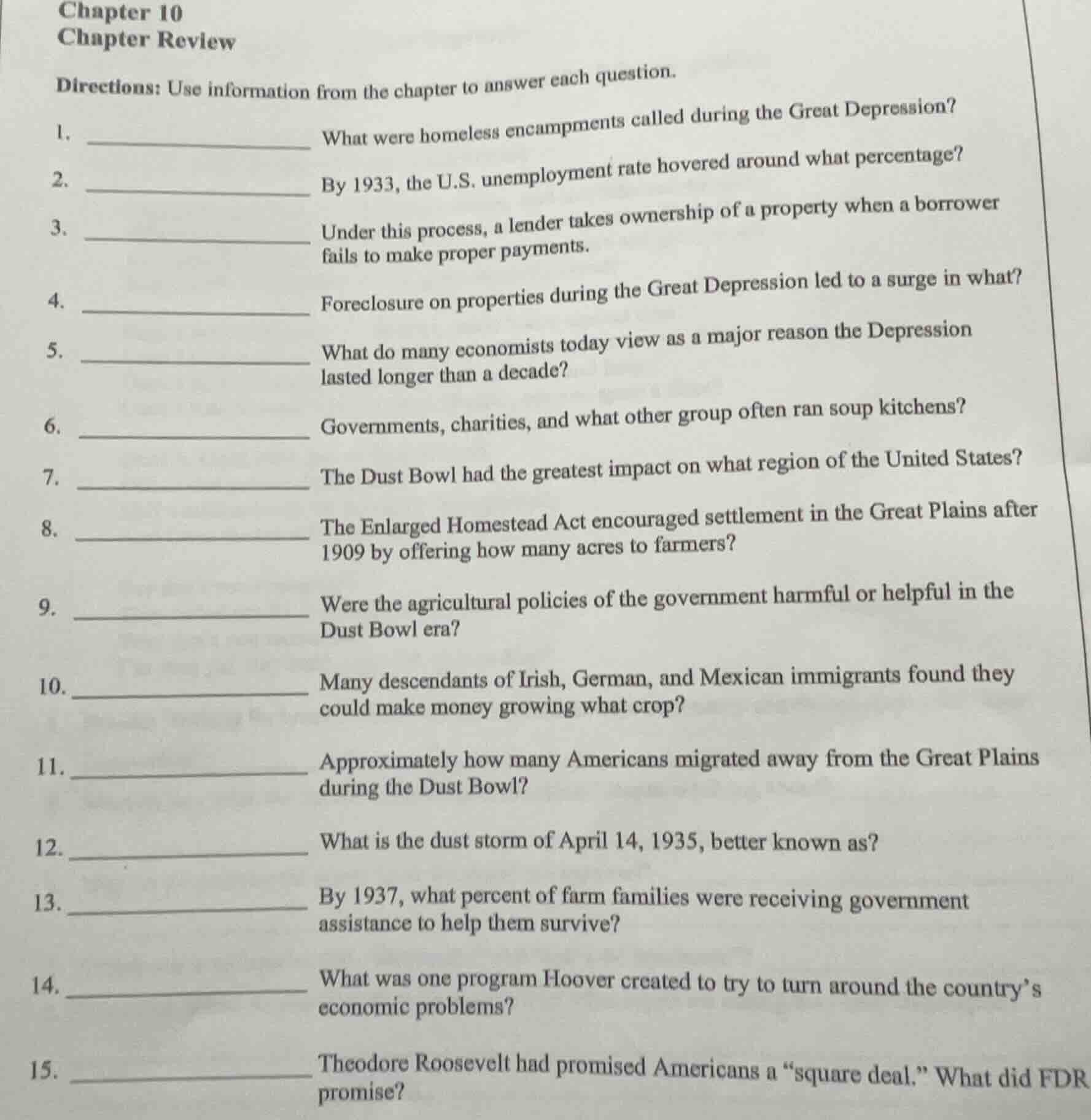
chapter 10
chapter review
directions: use information from the chapter to answer each question.
- \twhat were homeless encampments called during the great depression?
- \tby 1933, the u.s. unemployment rate hovered around what percentage?
- \tunder this process, a lender takes ownership of a property when a borrower fails to make proper payments.
- \tforeclosure on properties during the great depression led to a surge in what?
- \twhat do many economists today view as a major reason the depression lasted longer than a decade?
- \tgovernments, charities, and what other group often ran soup kitchens?
- \tthe dust bowl had the greatest impact on what region of the united states?
- \tthe enlarged homestead act encouraged settlement in the great plains after 1909 by offering how many acres to farmers?
- \twere the agricultural policies of the government harmful or helpful in the dust bowl era?
- \tmany descendants of irish, german, and mexican immigrants found they could make money growing what crop?
- \tapproximately how many americans migrated away from the great plains during the dust bowl?
- \twhat is the dust storm of april 14, 1935, better known as?
- \tby 1937, what percent of farm families were receiving government assistance to help them survive?
- \twhat was one program hoover created to try to turn around the country’s economic problems?
- \ttheodore roosevelt had promised americans a “square deal.” what did fdr promise?
These questions are about the Great Depression and related historical events, so they fall under the Social Science discipline, specifically the subfield of History. Here are the answers to each question:
Question 1
During the Great Depression, homeless encampments were called "Hoovervilles" as a way to criticize President Hoover's perceived inaction during the economic crisis.
By 1933, the peak of the Great Depression, the U.S. unemployment rate was around 25% (some sources may give a range around this, but 25% is the commonly cited figure for the peak unemployment during this time).
When a borrower fails to make mortgage payments, the lender can take ownership of the property through the process of foreclosure. This was a common occurrence during the Great Depression as many people could not afford their home loans.

Snap & solve any problem in the app
Get step-by-step solutions on Sovi AI
Photo-based solutions with guided steps
Explore more problems and detailed explanations
Hoovervilles