QUESTION IMAGE
Question
chapter 2: angles
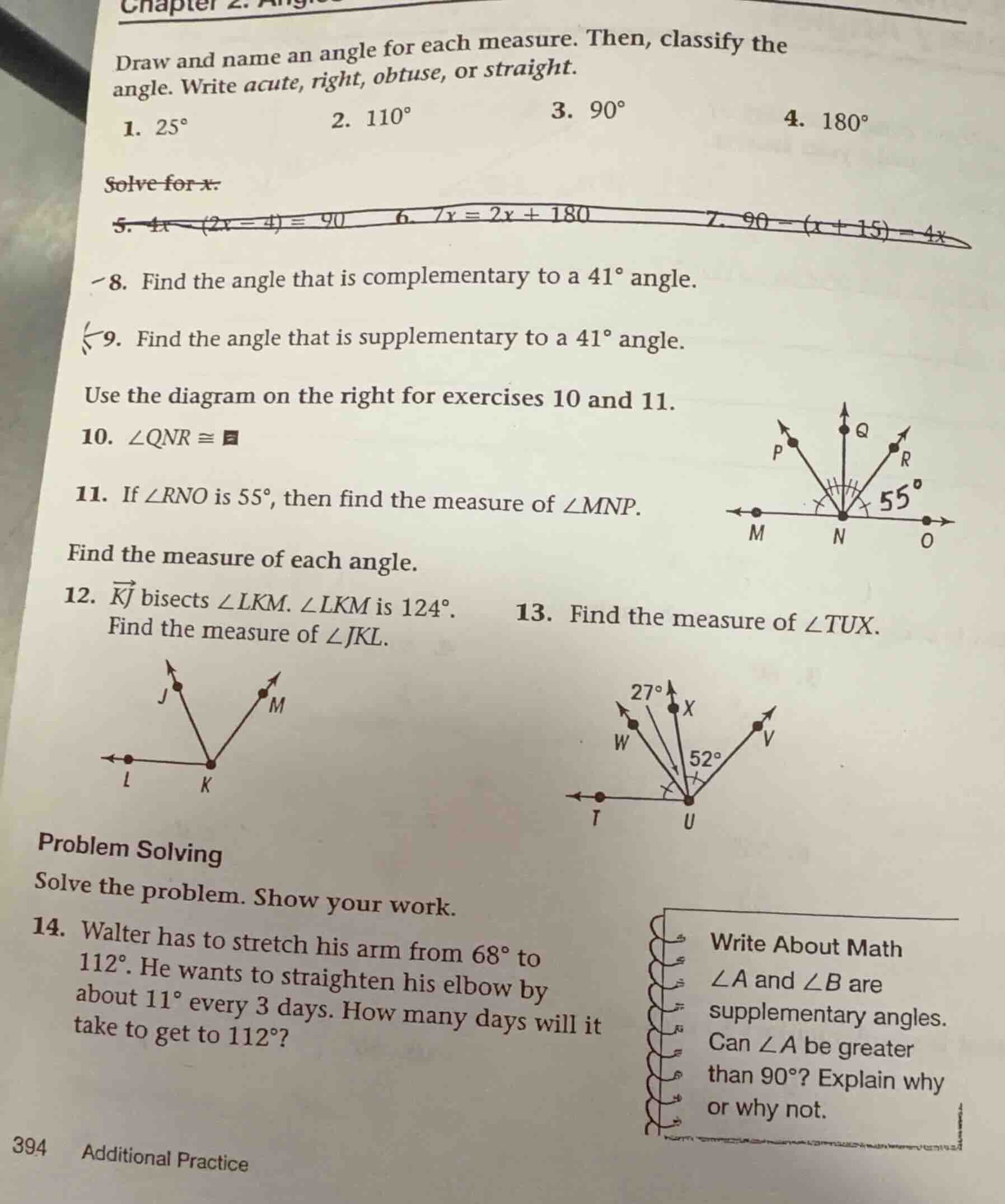
draw and name an angle for each measure. then, classify the angle. write acute, right, obtuse, or straight.
- 25° 2. 110° 3. 90° 4. 180°
solve for x:
- 4x - (2x - 4) = 90 6. 7x = 2x + 180 7. 90 - (x + 15) = 4x
- find the angle that is complementary to a 41° angle.
- find the angle that is supplementary to a 41° angle.
use the diagram on the right for exercises 10 and 11.
- ∠qnr ≅
- if ∠rno is 55°, then find the measure of ∠mnp.
find the measure of each angle.
- $overrightarrow{kj}$ bisects ∠lkm. ∠lkm is 124°. find the measure of ∠jkl.
- find the measure of ∠tux.
problem solving
solve the problem. show your work.
- walter has to stretch his arm from 68° to 112°. he wants to straighten his elbow by about 11° every 3 days. how many days will it take to get to 112°?
write about math
∠a and ∠b are supplementary angles. can ∠a be greater than 90°? explain why or why not.
Step1: Classify 25° angle
An acute angle is $0^\circ < \theta < 90^\circ$. $25^\circ$ fits this range.
Step2: Classify 110° angle
An obtuse angle is $90^\circ < \theta < 180^\circ$. $110^\circ$ fits this range.
Step3: Classify 90° angle
A right angle equals $90^\circ$.
Step4: Classify 180° angle
A straight angle equals $180^\circ$.
Step5: Solve for $x$ (Q5)
Simplify left side first:
$4x-(2x-4)=90$
$4x-2x+4=90$
$2x+4=90$
$2x=90-4=86$
$x=\frac{86}{2}=43$
Step6: Solve for $x$ (Q6)
Isolate $x$ terms:
$7x=2x+180$
$7x-2x=180$
$5x=180$
$x=\frac{180}{5}=36$
Step7: Solve for $x$ (Q7)
Simplify left side first:
$90-(x+15)=4x$
$90-x-15=4x$
$75-x=4x$
$75=5x$
$x=\frac{75}{5}=15$
Step8: Find complementary angle
Complementary angles sum to $90^\circ$.
$90^\circ - 41^\circ = 49^\circ$
Step9: Find supplementary angle
Supplementary angles sum to $180^\circ$.
$180^\circ - 41^\circ = 139^\circ$
Step10: Find congruent angle
Vertical angles are congruent. $\angle QNR$ and $\angle MNP$ are vertical angles, so $\angle QNR \cong \angle MNP$.
Step11: Calculate $\angle MNP$
First find $\angle QNR$: $\angle RNO=55^\circ$, $\angle QNO=90^\circ$, so $\angle QNR=90^\circ-55^\circ=35^\circ$. Since $\angle MNP=\angle QNR$, $\angle MNP=35^\circ$.
Step12: Calculate $\angle JKL$
A bisector splits an angle in half.
$\angle JKL=\frac{1}{2}\angle LKM=\frac{1}{2}\times124^\circ=62^\circ$
Step13: Calculate $\angle TUX$
First find the right angle complement:
$\angle TUX=90^\circ - (27^\circ+52^\circ)=90^\circ-79^\circ=11^\circ$
Step14: Calculate total angle change
Find the difference in angles:
$112^\circ-68^\circ=44^\circ$
Step15: Calculate number of 3-day intervals
Divide total change by daily rate:
$\frac{44^\circ}{11^\circ}=4$ intervals
Step16: Calculate total days
Multiply intervals by 3:
$4\times3=12$ days
Step17: Answer supplementary angle question
Supplementary angles sum to $180^\circ$. If $\angle A>90^\circ$, then $\angle B=180^\circ-\angle A<90^\circ$, which is valid.

Snap & solve any problem in the app
Get step-by-step solutions on Sovi AI
Photo-based solutions with guided steps
Explore more problems and detailed explanations
- Acute (Angle example: $\angle ABC=25^\circ$)
- Obtuse (Angle example: $\angle DEF=110^\circ$)
- Right (Angle example: $\angle GHI=90^\circ$)
- Straight (Angle example: $\angle JKL=180^\circ$)
- $x=43$
- $x=36$
- $x=15$
- $49^\circ$
- $139^\circ$
- $\angle MNP$
- $35^\circ$
- $62^\circ$
- $11^\circ$
- 12 days
- Yes, $\angle A$ can be greater than $90^\circ$. Supplementary angles sum to $180^\circ$, so if $\angle A>90^\circ$, $\angle B=180^\circ-\angle A$ will be less than $90^\circ$, and their sum will still equal $180^\circ$.