QUESTION IMAGE
Question
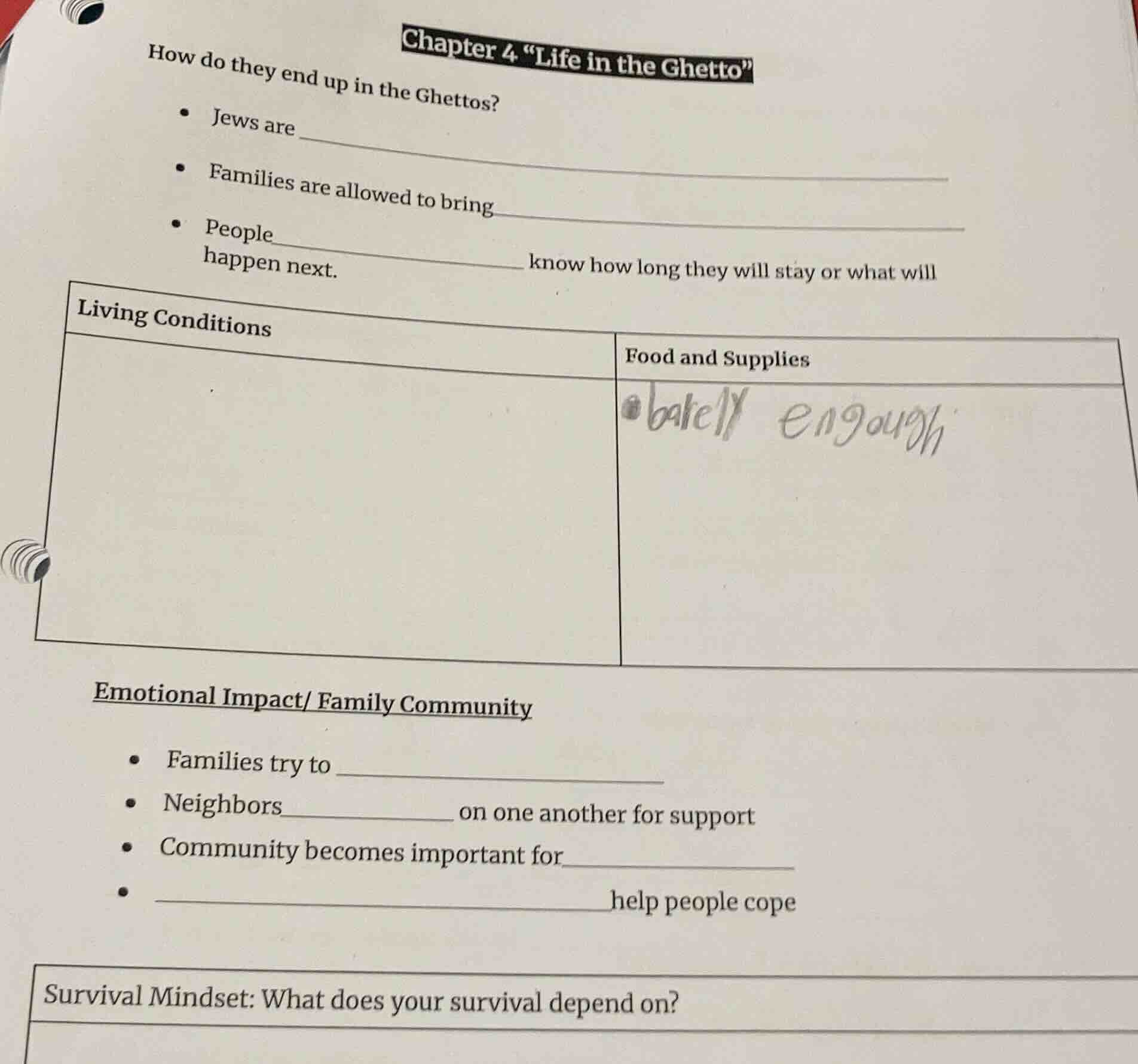
chapter 4 \life in the ghetto\
how do they end up in the ghettos?
- jews are
- families are allowed to bring
- people know how long they will stay or what will happen next.
living conditions\tfood and supplies
\t\tbarely enough
emotional impact/ family community
- families try to
- neighbors on one another for support
- community becomes important for
- help people cope
survival mindset: what does your survival depend on?
To answer these fill - in - the - blank questions about "Life in the Ghetto", we can draw on historical knowledge about the Holocaust and the establishment of ghettos for Jews:
1. "Jews are _"
During the Holocaust, Jews were forced to relocate (or "rounded up" / "deported") to ghettos by the Nazi regime. This was part of the Nazi's systematic persecution of Jews, where they were segregated from the non - Jewish population and confined to specific areas.
2. "Families are allowed to bring _"
Families were usually allowed to bring only a limited amount of their personal belongings (such as clothes, some small household items) with them. The Nazis restricted what Jews could take as they were often stripped of most of their possessions, and the space in the ghettos was extremely limited.
3. "People _ know how long they will stay or what will happen next."
People do not (or "cannot") know how long they will stay or what will happen next. The situation in the ghettos was highly uncertain. Jews were unaware of the full extent of the Nazi's plans (including the eventual mass extermination in concentration camps), and their future in the ghettos was very much in doubt.
Living Conditions
- Living Conditions column: The living conditions in the ghettos were extremely overcrowded, unsanitary, and lacked proper housing. There was a lack of clean water, proper sewage systems, and adequate shelter. So we could write "Overcrowded, unsanitary, lack of proper housing" (or similar descriptions).
- Food and Supplies column (the existing "barely enough" is a good start): Food and supplies were severely rationed. There was often not enough food to sustain the people, leading to widespread hunger and malnutrition. So we could expand it to "Food and supplies are barely enough, severely rationed, leading to hunger and malnutrition".
Emotional Impact/ Family Community
- "Families try to _": Families tried to stay together (or "support one another", "maintain normalcy as much as possible"). In the face of extreme adversity, keeping the family unit intact was a way to provide emotional support and a sense of stability.
- "Neighbors _ on one another for support": Neighbors rely (or "depend") on one another for support. In the harsh environment of the ghetto, people needed the help of their neighbors for things like sharing food, providing emotional comfort, or helping with daily tasks.
- "Community becomes important for _": Community becomes important for survival (both physical and emotional). The community provided a network of support, a sense of belonging, and sometimes even organized efforts to obtain food or resist (in small ways) the Nazi oppression.
- "_ help people cope": Religion, family bonds, and community activities (or "Hope, shared experiences") help people cope. These elements provided a psychological and emotional anchor for people in the face of the extreme trauma and uncertainty of ghetto life.
Survival Mindset: "What does your survival depend on?"
Survival in the ghetto depended on several factors:
- Resourcefulness: Being able to find food, water, and other necessary supplies in the limited and harsh environment of the ghetto.
- Support from family and community: The emotional and practical support from family members and neighbors was crucial.
- Hope (even if faint): Holding on to the hope that the situation would improve or that they would be able to survive until liberation.
- Physical and mental resilience: The ability to withstand the harsh living condition…

Snap & solve any problem in the app
Get step-by-step solutions on Sovi AI
Photo-based solutions with guided steps
Explore more problems and detailed explanations
To answer these fill - in - the - blank questions about "Life in the Ghetto", we can draw on historical knowledge about the Holocaust and the establishment of ghettos for Jews:
1. "Jews are _"
During the Holocaust, Jews were forced to relocate (or "rounded up" / "deported") to ghettos by the Nazi regime. This was part of the Nazi's systematic persecution of Jews, where they were segregated from the non - Jewish population and confined to specific areas.
2. "Families are allowed to bring _"
Families were usually allowed to bring only a limited amount of their personal belongings (such as clothes, some small household items) with them. The Nazis restricted what Jews could take as they were often stripped of most of their possessions, and the space in the ghettos was extremely limited.
3. "People _ know how long they will stay or what will happen next."
People do not (or "cannot") know how long they will stay or what will happen next. The situation in the ghettos was highly uncertain. Jews were unaware of the full extent of the Nazi's plans (including the eventual mass extermination in concentration camps), and their future in the ghettos was very much in doubt.
Living Conditions
- Living Conditions column: The living conditions in the ghettos were extremely overcrowded, unsanitary, and lacked proper housing. There was a lack of clean water, proper sewage systems, and adequate shelter. So we could write "Overcrowded, unsanitary, lack of proper housing" (or similar descriptions).
- Food and Supplies column (the existing "barely enough" is a good start): Food and supplies were severely rationed. There was often not enough food to sustain the people, leading to widespread hunger and malnutrition. So we could expand it to "Food and supplies are barely enough, severely rationed, leading to hunger and malnutrition".
Emotional Impact/ Family Community
- "Families try to _": Families tried to stay together (or "support one another", "maintain normalcy as much as possible"). In the face of extreme adversity, keeping the family unit intact was a way to provide emotional support and a sense of stability.
- "Neighbors _ on one another for support": Neighbors rely (or "depend") on one another for support. In the harsh environment of the ghetto, people needed the help of their neighbors for things like sharing food, providing emotional comfort, or helping with daily tasks.
- "Community becomes important for _": Community becomes important for survival (both physical and emotional). The community provided a network of support, a sense of belonging, and sometimes even organized efforts to obtain food or resist (in small ways) the Nazi oppression.
- "_ help people cope": Religion, family bonds, and community activities (or "Hope, shared experiences") help people cope. These elements provided a psychological and emotional anchor for people in the face of the extreme trauma and uncertainty of ghetto life.
Survival Mindset: "What does your survival depend on?"
Survival in the ghetto depended on several factors:
- Resourcefulness: Being able to find food, water, and other necessary supplies in the limited and harsh environment of the ghetto.
- Support from family and community: The emotional and practical support from family members and neighbors was crucial.
- Hope (even if faint): Holding on to the hope that the situation would improve or that they would be able to survive until liberation.
- Physical and mental resilience: The ability to withstand the harsh living conditions, hunger, and the constant fear of what the future held.
If we are to fill in the blanks with the most common and accurate historical answers:
- Jews are forced to move into ghettos
- Families are allowed to bring a few personal belongings
- People do not know how long they will stay or what will happen next
- Living Conditions: Overcrowded, unsanitary, poor housing; Food and Supplies: barely enough, rationed, causing hunger
- Emotional Impact/ Family Community:
- Families try to stay together
- Neighbors depend on one another for support
- Community becomes important for survival and emotional support
- Family, community, and hope help people cope
- Survival Mindset: Survival depends on resourcefulness, family/community support, hope, and resilience