QUESTION IMAGE
Question
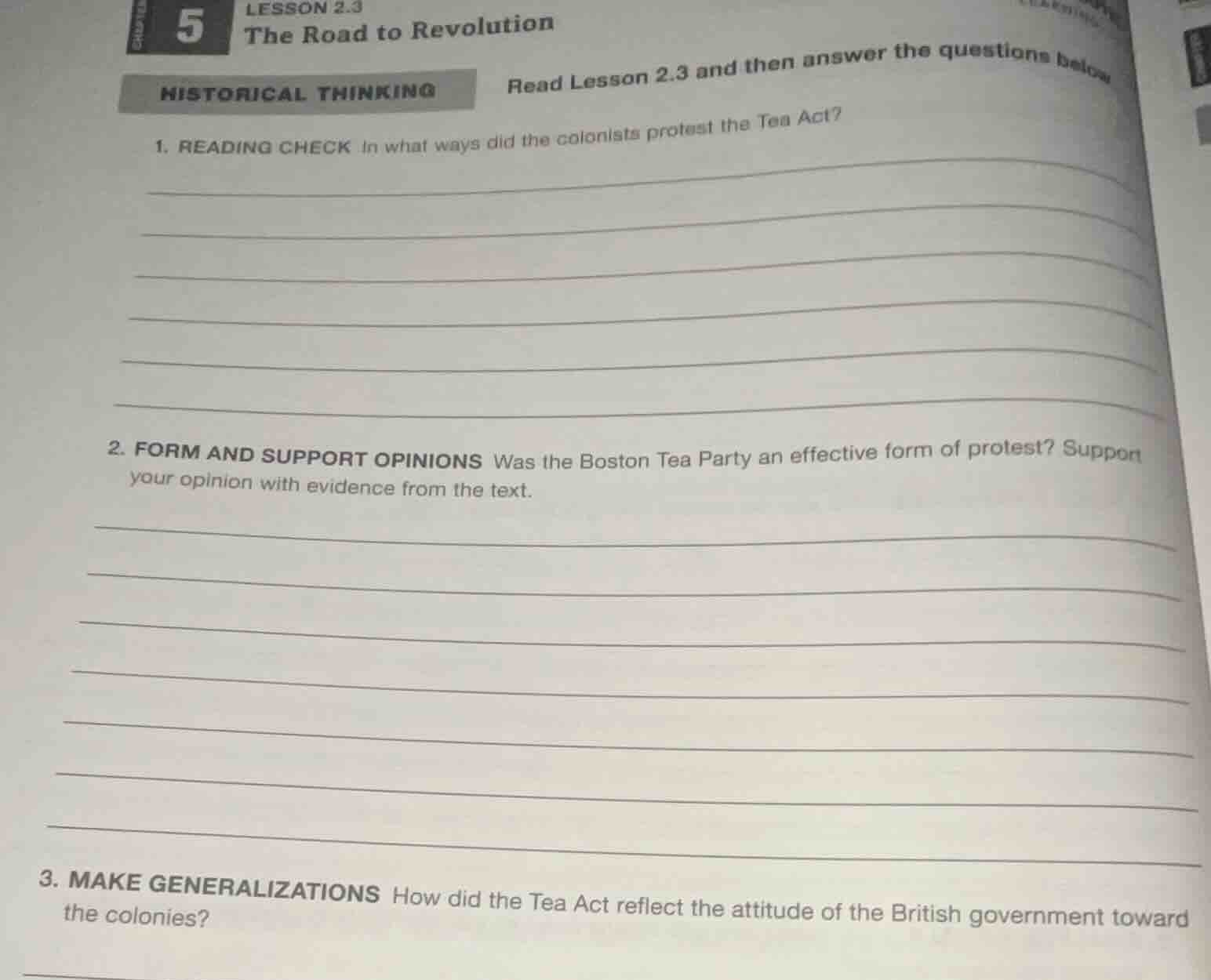
chapter 5 lesson 2.3 the road to revolution historical thinking read lesson 2.3 and then answer the questions below 1. reading check in what ways did the colonists protest the tea act? 2. form and support opinions was the boston tea party an effective form of protest? support your opinion with evidence from the text. 3. make generalizations how did the tea act reflect the attitude of the british government toward the colonies?
To answer these questions, we need to refer to the content of Lesson 2.3 "The Road to Revolution" (which is not fully provided here). However, based on historical knowledge:
Question 1:
Colonists protested the Tea Act in several ways. One prominent action was the Boston Tea Party, where colonists (disguised as Native Americans) dumped British tea into Boston Harbor to oppose the tax and British control over trade. Other colonists also boycotted British tea, refusing to buy or consume it, and some merchants refused to sell it.
Question 2:
Whether the Boston Tea Party was effective depends on perspective.
- Argument for effectiveness: It was a powerful symbolic act that galvanized colonial opposition to British rule. It showed the colonists’ willingness to take bold action against British policies, and it escalated tensions, leading to the Intolerable Acts (which in turn united the colonies further against Britain).
- Argument against effectiveness: It angered the British government, leading to harsher reprisals (the Intolerable Acts) that temporarily restricted colonial self - governance and increased military presence in Boston. However, these reprisals also pushed the colonies closer to revolution.
Question 3:
The Tea Act reflected a controlling and exploitative attitude of the British government toward the colonies. The act was designed to help the British East India Company (by giving it a monopoly on tea sales in the colonies) and to enforce the tea tax (the Townshend Duty) that the colonists had protested. It showed that Britain saw the colonies as a source of revenue and a market to be manipulated for the benefit of British businesses and the crown, with little regard for colonial self - governance or economic autonomy.
If you have the specific text of Lesson 2.3, you can use the evidence from it to support these answers more precisely.

Snap & solve any problem in the app
Get step-by-step solutions on Sovi AI
Photo-based solutions with guided steps
Explore more problems and detailed explanations
To answer these questions, we need to refer to the content of Lesson 2.3 "The Road to Revolution" (which is not fully provided here). However, based on historical knowledge:
Question 1:
Colonists protested the Tea Act in several ways. One prominent action was the Boston Tea Party, where colonists (disguised as Native Americans) dumped British tea into Boston Harbor to oppose the tax and British control over trade. Other colonists also boycotted British tea, refusing to buy or consume it, and some merchants refused to sell it.
Question 2:
Whether the Boston Tea Party was effective depends on perspective.
- Argument for effectiveness: It was a powerful symbolic act that galvanized colonial opposition to British rule. It showed the colonists’ willingness to take bold action against British policies, and it escalated tensions, leading to the Intolerable Acts (which in turn united the colonies further against Britain).
- Argument against effectiveness: It angered the British government, leading to harsher reprisals (the Intolerable Acts) that temporarily restricted colonial self - governance and increased military presence in Boston. However, these reprisals also pushed the colonies closer to revolution.
Question 3:
The Tea Act reflected a controlling and exploitative attitude of the British government toward the colonies. The act was designed to help the British East India Company (by giving it a monopoly on tea sales in the colonies) and to enforce the tea tax (the Townshend Duty) that the colonists had protested. It showed that Britain saw the colonies as a source of revenue and a market to be manipulated for the benefit of British businesses and the crown, with little regard for colonial self - governance or economic autonomy.
If you have the specific text of Lesson 2.3, you can use the evidence from it to support these answers more precisely.