QUESTION IMAGE
Question
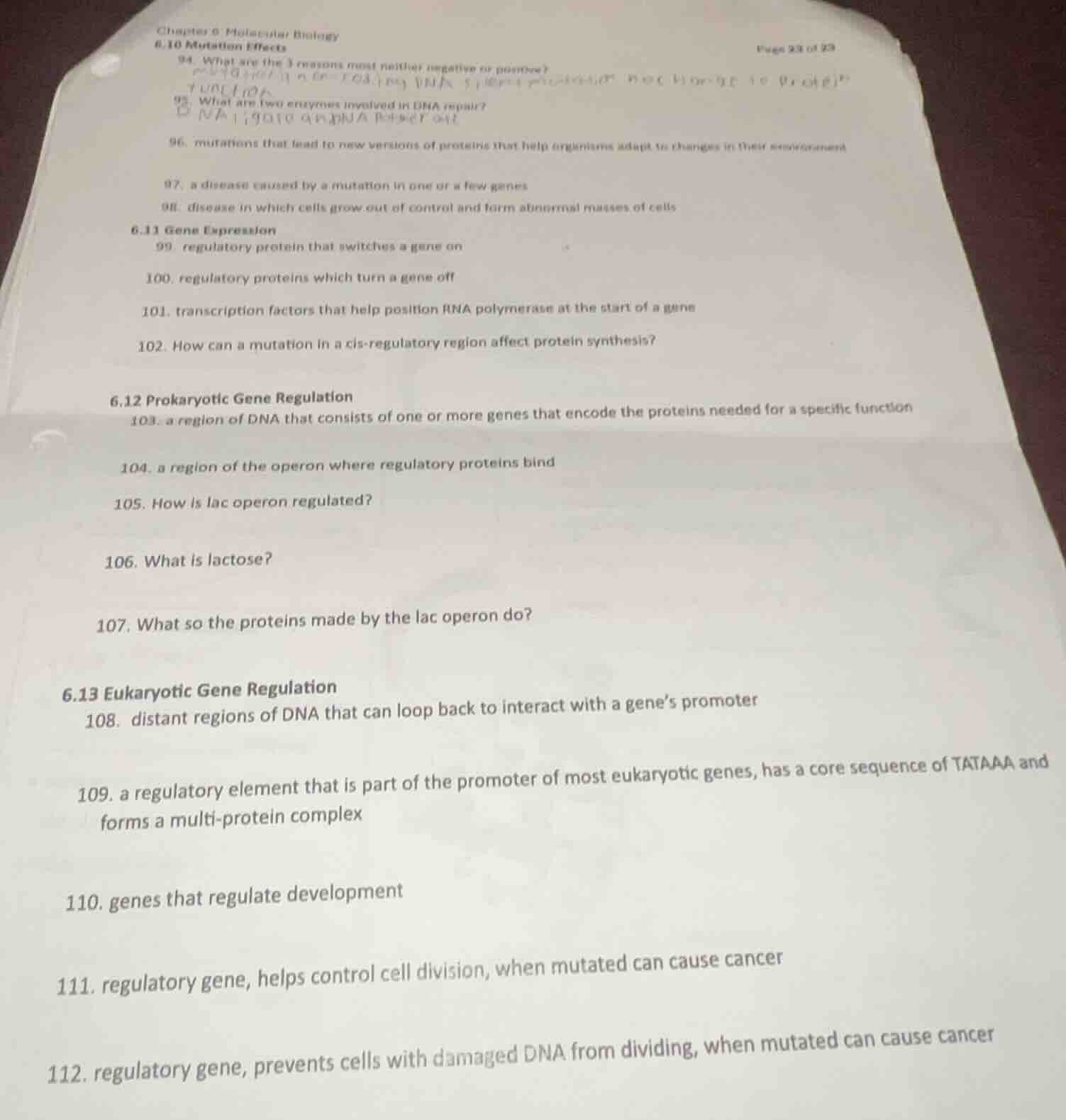
chapter 6 molecular biology
6.10 mutation effects
- what are the 3 reasons most neither negative nor positive?
- what are two enzymes involved in dna repair?
- mutations that lead to new versions of proteins that help organisms adapt to changes in their environment
- a disease caused by a mutation in one or a few genes
- disease in which cells grow out of control and form abnormal masses of cells
6.11 gene expression
- regulatory protein that switches a gene on
- regulatory proteins which turn a gene off
- transcription factors that help position rna polymerase at the start of a gene
- how can a mutation in a cis - regulatory region affect protein synthesis?
6.12 prokaryotic gene regulation
- a region of dna that consists of one or more genes that encode the proteins needed for a specific function
- a region of the operon where regulatory proteins bind
- how is lac operon regulated?
- what is lactose?
- what so the proteins made by the lac operon do?
6.13 eukaryotic gene regulation
- distant regions of dna that can loop back to interact with a gene’s promoter
- a regulatory element that is part of the promoter of most eukaryotic genes, has a core sequence of tataaa and forms a multi - protein complex
- genes that regulate development
- regulatory gene, helps control cell division, when mutated can cause cancer
- regulatory gene, prevents cells with damaged dna from dividing, when mutated can cause cancer
Brief Explanations
- 1. The mutation is in a non-coding/non-functional region of DNA. 2. The mutation is a silent mutation that does not change the encoded amino acid. 3. The mutation results in a functionally equivalent amino acid substitution.
- DNA ligase (seals DNA strand breaks) and DNA polymerase (fills in gaps during repair) are two key enzymes.
- This describes beneficial mutations.
- This is a genetic disorder (monogenic or oligogenic).
- This defines cancer.
- This is an activator protein.
- This is a repressor protein.
- These are general transcription factors (e.g., TFIID).
- A mutation in a cis-regulatory region can alter binding sites for regulatory proteins, changing the rate/timing of gene transcription, which reduces or increases the amount of protein synthesized, or prevents synthesis entirely.
- This is an operon (in prokaryotes).
- This is an operator region.
- The lac operon is negatively regulated by a repressor protein that binds the operator when lactose is absent, blocking transcription. When lactose is present, it is converted to allolactose, which binds the repressor, preventing it from attaching to the operator, allowing transcription. It is also positively regulated: when glucose is low, cAMP levels rise, bind CAP, and this complex binds the operon's promoter to enhance transcription.
- Lactose is a disaccharide sugar made of glucose and galactose, found in milk, that acts as an inducer for the lac operon.
- The lac operon encodes: β-galactosidase (breaks down lactose into glucose/galactose), lactose permease (transports lactose into the cell), and transacetylase (modifies toxic lactose analogs).
- These are enhancer regions.
- This is the TATA box.
- These are homeotic (Hox) genes.
- This is a proto-oncogene (when mutated, becomes an oncogene).
- This is a tumor suppressor gene (e.g., p53).

Snap & solve any problem in the app
Get step-by-step solutions on Sovi AI
Photo-based solutions with guided steps
Explore more problems and detailed explanations
- 1. Mutation in non-functional DNA; 2. Silent amino acid change; 3. Neutral amino acid substitution
- DNA ligase and DNA polymerase
- Beneficial mutations
- Monogenic/oligogenic genetic disorder
- Cancer
- Activator protein
- Repressor protein
- General transcription factors
- Alters regulatory protein binding, changing transcription (and thus protein synthesis) levels/timing
- Operon
- Operator region
- Negatively regulated by a repressor (inactivated by lactose/allolactose); positively regulated by CAP-cAMP complex (active when glucose is low)
- A disaccharide (glucose + galactose) that induces the lac operon
- Break down lactose, transport lactose into the cell, and modify toxic lactose analogs
- Enhancer regions
- TATA box
- Homeotic (Hox) genes
- Proto-oncogene
- Tumor suppressor gene