QUESTION IMAGE
Question
chapter review
concept items
11.1 temperature and thermal energy
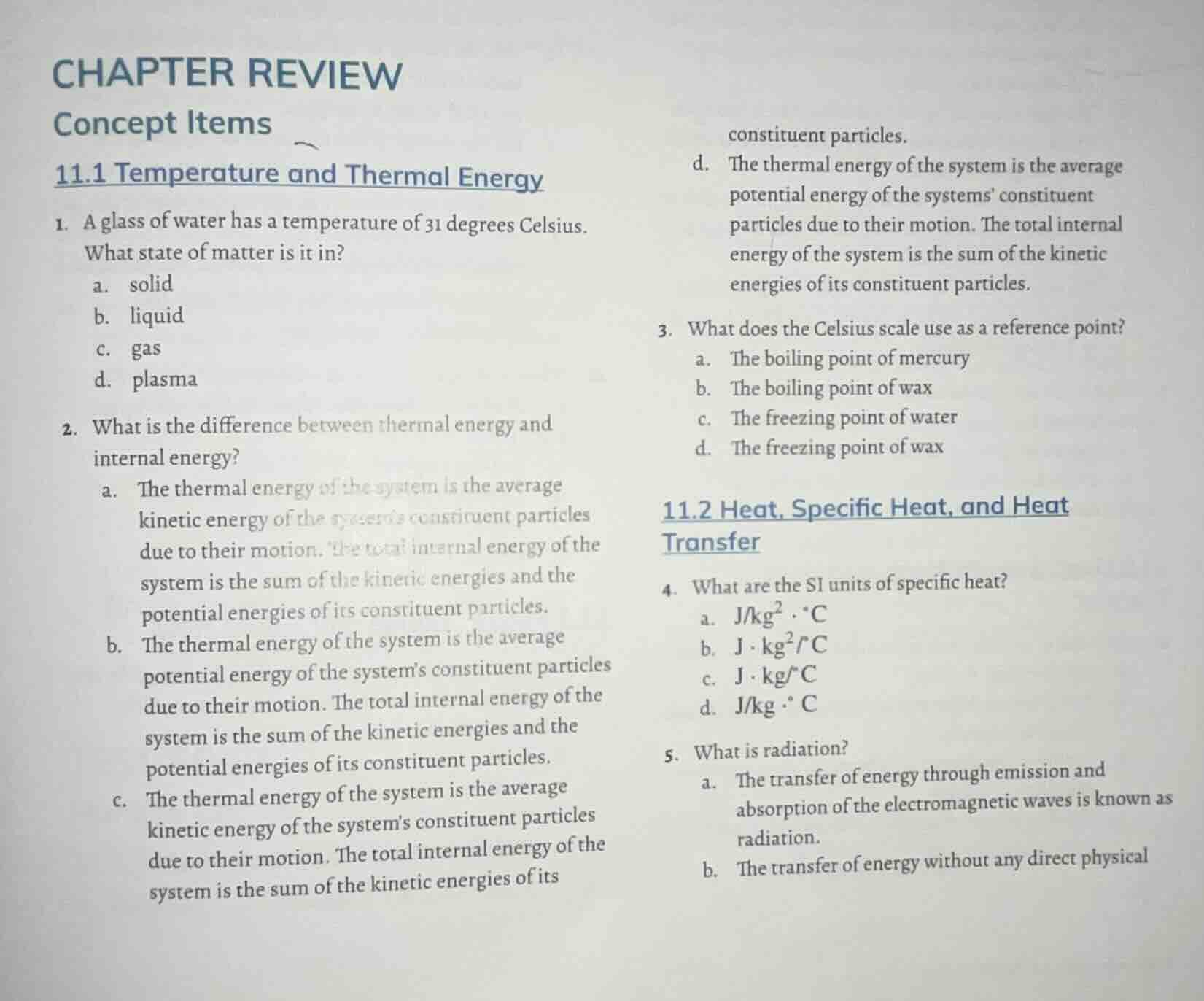
- a glass of water has a temperature of 31 degrees celsius. what state of matter is it in?
a. solid
b. liquid
c. gas
d. plasma
- what is the difference between thermal energy and internal energy?
a. the thermal energy of the system is the average kinetic energy of the systems constituent particles due to their motion. the total internal energy of the system is the sum of the kinetic energies and the potential energies of its constituent particles.
b. the thermal energy of the system is the average potential energy of the systems constituent particles due to their motion. the total internal energy of the system is the sum of the kinetic energies and the potential energies of its constituent particles.
c. the thermal energy of the system is the average kinetic energy of the systems constituent particles due to their motion. the total internal energy of the system is the sum of the kinetic energies of its constituent particles.
d. the thermal energy of the system is the average potential energy of the systems constituent particles due to their motion. the total internal energy of the system is the sum of the kinetic energies of its constituent particles.
- what does the celsius scale use as a reference point?
a. the boiling point of mercury
b. the boiling point of wax
c. the freezing point of water
d. the freezing point of wax
11.2 heat, specific heat, and heat transfer
- what are the si units of specific heat?
a. j/kg²·°c
b. j·kg²/°c
c. j·kg/°c
d. j/kg·°c
- what is radiation?
a. the transfer of energy through emission and absorption of the electromagnetic waves is known as radiation.
b. the transfer of energy without any direct physical
- Water is liquid between 0°C (freezing) and 100°C (boiling); 31°C falls in this range.
- Thermal energy relates to average kinetic energy of particles from motion; internal energy sums all kinetic and potential energies of particles.
- The Celsius scale defines 0°C as water's freezing point and 100°C as its boiling point, using water's phase changes as references.
- Specific heat is calculated as $\frac{Q}{m\Delta T}$, so units derive from joules (J) for heat, kilograms (kg) for mass, and °C for temperature change.
- Radiation is heat transfer via electromagnetic waves, which does not require a medium and occurs through emission/absorption of these waves.

Snap & solve any problem in the app
Get step-by-step solutions on Sovi AI
Photo-based solutions with guided steps
Explore more problems and detailed explanations
- b. liquid
- a. The thermal energy of the system is the average kinetic energy of the system's constituent particles due to their motion. The total internal energy of the system is the sum of the kinetic energies and the potential energies of its constituent particles.
- c. The freezing point of water
- d. $\text{J/kg} \cdot ^\circ\text{C}$
- a. The transfer of energy through emission and absorption of the electromagnetic waves is known as radiation.