QUESTION IMAGE
Question
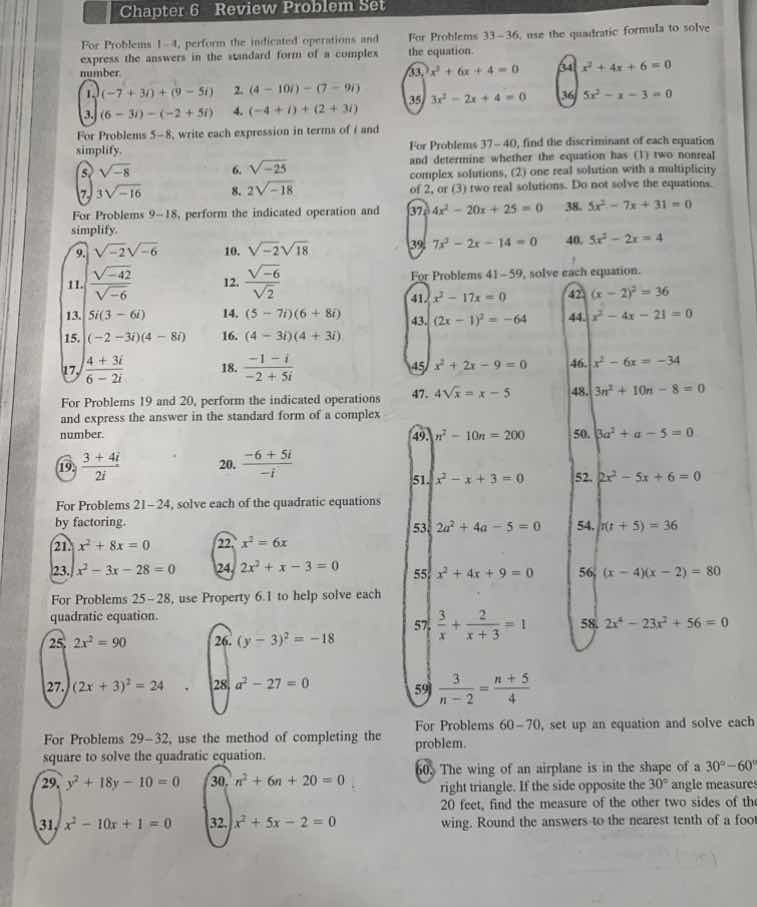
chapter 6 review problem set
for problems 1 - 4, perform the indicated operations and express the answers in the standard form of a complex number.
- ((-7 + 3i)+(9 - 5i)) 2. ((4 - 10i)-(7 - 9i))
- ((6 - 3i)-(-2 + 5i)) 4. ((-4 + i)+(2 + 3i))
for problems 5 - 8, write each expression in terms of (i) and simplify.
- (sqrt{-8}) 6. (sqrt{-25})
- (3sqrt{-16}) 8. (2sqrt{-18})
for problems 9 - 18, perform the indicated operation and simplify.
- (sqrt{-2}sqrt{-6}) 10. (sqrt{-2}sqrt{18})
- (\frac{sqrt{-42}}{sqrt{2}}) 12. (\frac{sqrt{-6}}{sqrt{2}})
- (5(3 - 6i)) 14. ((5 - 7i)(6 + 8i))
- ((-2 - 3i)(4 - 8i)) 16. ((4 - 3i)(4 + 3i))
- (\frac{4 + 3i}{6 - 2i}) 18. (\frac{-1 - i}{-2 + 5i})
for problems 19 and 20, perform the indicated operations and express the answer in the standard form of a complex number.
- (\frac{3 + 4i}{2i}) 20. (\frac{-6 + 5i}{-i})
for problems 21 - 24, solve each of the quadratic equations by factoring.
- (x^{2}+8x = 0) 22. (x^{2}=6x)
- (x^{2}-3x - 28 = 0) 24. (2x^{2}+x - 3 = 0)
for problems 25 - 28, use property 6.1 to help solve each quadratic equation.
- (2x^{2}=90) 26. ((y - 3)^{2}=-18)
- ((2x + 3)^{2}=24) 28. (a^{2}-27 = 0)
for problems 29 - 32, use the method of completing the square to solve the quadratic equation.
- (y^{2}+18y - 10 = 0) 30. (n^{2}+6n + 20 = 0)
- (x^{2}-10x + 1 = 0) 32. (x^{2}+5x - 2 = 0)
for problems 33 - 36, use the quadratic formula to solve the equation.
- (x^{2}+6x + 4 = 0) 34. (x^{2}+4x + 6 = 0)
- (3x^{2}-2x + 4 = 0) 36. (5x^{2}-x - 3 = 0)
for problems 37 - 40, find the discriminant of each equation and determine whether the equation has (1) two nonreal complex solutions, (2) one real solution with a multiplicity of 2, or (3) two real solutions. do not solve the equations.
- (4x^{2}-20x + 25 = 0) 38. (5x^{2}-7x + 31 = 0)
- (7x^{2}-2x - 14 = 0) 40. (5x^{2}-2x = 4)
for problems 41 - 59, solve each equation.
- (x^{2}-17x = 0) 42. ((x - 2)^{2}=36)
- ((2x - 1)^{2}=-64) 44. (x^{2}-4x - 21 = 0)
- (x^{2}+2x - 9 = 0) 46. (x^{2}-6x = -34)
- (4sqrt{x}=x - 5) 48. (3n^{2}+10n - 8 = 0)
- (n^{2}-10n = 200) 50. (3a^{2}+a - 5 = 0)
- (x^{2}-x + 3 = 0) 52. (2x^{2}-5x + 6 = 0)
- (2a^{2}+4a - 5 = 0) 54. (x(x + 5)=36)
- (x^{2}+4x + 9 = 0) 56. ((x - 4)(x - 2)=80)
- (\frac{3}{x}+\frac{2}{x + 3}=1) 58. (2x^{4}-23x^{2}+56 = 0)
- (\frac{3}{n - 2}=\frac{n + 5}{4})
for problems 60 - 70, set up an equation and solve each problem.
- the wing of an airplane is in the shape of a (30^{circ}-60^{circ}) right triangle. if the side opposite the (30^{circ}) angle measures 20 feet, find the measure of the other two sides of the wing. round the answers to the nearest tenth of a foot.
To solve these problems, we'll address a few examples from different sections (complex numbers, quadratic equations, etc.). Let's start with Problem 1: \((-7 + 3i) + (9 - 5i)\)
Step 1: Combine real parts and imaginary parts
For complex numbers \(a + bi\) and \(c + di\), addition is \((a + c) + (b + d)i\).
Real parts: \(-7 + 9 = 2\)
Imaginary parts: \(3i - 5i = -2i\)
Step 2: Write in standard form
Combine the results: \(2 - 2i\)
Final Answer for Problem 1:
\(\boldsymbol{2 - 2i}\)
---
Problem 5: \(\sqrt{-8}\)
Recall \(i = \sqrt{-1}\), so \(\sqrt{-8} = \sqrt{8 \cdot (-1)} = \sqrt{8} \cdot \sqrt{-1}\).
Step 1: Simplify \(\sqrt{8}\)
\(\sqrt{8} = \sqrt{4 \cdot 2} = \sqrt{4} \cdot \sqrt{2} = 2\sqrt{2}\)
Step 2: Substitute \(i\)
\(\sqrt{-8} = 2\sqrt{2} \cdot i = 2i\sqrt{2}\) (or \(2\sqrt{2}i\))
Final Answer for Problem 5:
\(\boldsymbol{2i\sqrt{2}}\) (or \(2\sqrt{2}i\))
---
Problem 21: \(x^2 + 8x = 0\) (solve by factoring)
Step 1: Factor out \(x\)
\(x(x + 8) = 0\)
Step 2: Apply the zero-product property
If \(ab = 0\), then \(a = 0\) or \(b = 0\).
- \(x = 0\)
- \(x + 8 = 0 \implies x = -8\)
Final Answers for Problem 21:
\(\boldsymbol{x = 0}\) or \(\boldsymbol{x = -8}\)
---
Problem 25: \(2x^2 = 90\) (solve using Property 6.1)
Step 1: Isolate \(x^2\)
Divide both sides by 2: \(x^2 = \frac{90}{2} = 45\)
Step 2: Take square roots
\(x = \pm\sqrt{45}\). Simplify \(\sqrt{45} = \sqrt{9 \cdot 5} = 3\sqrt{5}\)
Final Answers for Problem 25:
\(\boldsymbol{x = 3\sqrt{5}}\) or \(\boldsymbol{x = -3\sqrt{5}}\)
---
Problem 33: \(x^2 + 6x + 4 = 0\) (solve using quadratic formula)
Quadratic formula: \(x = \frac{-b \pm \sqrt{b^2 - 4ac}}{2a}\) for \(ax^2 + bx + c = 0\).
Step 1: Identify \(a, b, c\)
\(a = 1\), \(b = 6\), \(c = 4\)
Step 2: Compute discriminant (\(D = b^2 - 4ac\))
\(D = 6^2 - 4(1)(4) = 36 - 16 = 20\)
Step 3: Apply quadratic formula
\(x = \frac{-6 \pm \sqrt{20}}{2(1)} = \frac{-6 \pm 2\sqrt{5}}{2} = -3 \pm \sqrt{5}\)
Final Answers for Problem 33:
\(\boldsymbol{x = -3 + \sqrt{5}}\) or \(\boldsymbol{x = -3 - \sqrt{5}}\) (or decimal approximations: \(x \approx -0.76\) or \(x \approx -5.24\))
---
If you need help with a specific problem (e.g., complex division, completing the square, discriminant analysis), let me know! I can walk you through the steps.

Snap & solve any problem in the app
Get step-by-step solutions on Sovi AI
Photo-based solutions with guided steps
Explore more problems and detailed explanations
To solve these problems, we'll address a few examples from different sections (complex numbers, quadratic equations, etc.). Let's start with Problem 1: \((-7 + 3i) + (9 - 5i)\)
Step 1: Combine real parts and imaginary parts
For complex numbers \(a + bi\) and \(c + di\), addition is \((a + c) + (b + d)i\).
Real parts: \(-7 + 9 = 2\)
Imaginary parts: \(3i - 5i = -2i\)
Step 2: Write in standard form
Combine the results: \(2 - 2i\)
Final Answer for Problem 1:
\(\boldsymbol{2 - 2i}\)
---
Problem 5: \(\sqrt{-8}\)
Recall \(i = \sqrt{-1}\), so \(\sqrt{-8} = \sqrt{8 \cdot (-1)} = \sqrt{8} \cdot \sqrt{-1}\).
Step 1: Simplify \(\sqrt{8}\)
\(\sqrt{8} = \sqrt{4 \cdot 2} = \sqrt{4} \cdot \sqrt{2} = 2\sqrt{2}\)
Step 2: Substitute \(i\)
\(\sqrt{-8} = 2\sqrt{2} \cdot i = 2i\sqrt{2}\) (or \(2\sqrt{2}i\))
Final Answer for Problem 5:
\(\boldsymbol{2i\sqrt{2}}\) (or \(2\sqrt{2}i\))
---
Problem 21: \(x^2 + 8x = 0\) (solve by factoring)
Step 1: Factor out \(x\)
\(x(x + 8) = 0\)
Step 2: Apply the zero-product property
If \(ab = 0\), then \(a = 0\) or \(b = 0\).
- \(x = 0\)
- \(x + 8 = 0 \implies x = -8\)
Final Answers for Problem 21:
\(\boldsymbol{x = 0}\) or \(\boldsymbol{x = -8}\)
---
Problem 25: \(2x^2 = 90\) (solve using Property 6.1)
Step 1: Isolate \(x^2\)
Divide both sides by 2: \(x^2 = \frac{90}{2} = 45\)
Step 2: Take square roots
\(x = \pm\sqrt{45}\). Simplify \(\sqrt{45} = \sqrt{9 \cdot 5} = 3\sqrt{5}\)
Final Answers for Problem 25:
\(\boldsymbol{x = 3\sqrt{5}}\) or \(\boldsymbol{x = -3\sqrt{5}}\)
---
Problem 33: \(x^2 + 6x + 4 = 0\) (solve using quadratic formula)
Quadratic formula: \(x = \frac{-b \pm \sqrt{b^2 - 4ac}}{2a}\) for \(ax^2 + bx + c = 0\).
Step 1: Identify \(a, b, c\)
\(a = 1\), \(b = 6\), \(c = 4\)
Step 2: Compute discriminant (\(D = b^2 - 4ac\))
\(D = 6^2 - 4(1)(4) = 36 - 16 = 20\)
Step 3: Apply quadratic formula
\(x = \frac{-6 \pm \sqrt{20}}{2(1)} = \frac{-6 \pm 2\sqrt{5}}{2} = -3 \pm \sqrt{5}\)
Final Answers for Problem 33:
\(\boldsymbol{x = -3 + \sqrt{5}}\) or \(\boldsymbol{x = -3 - \sqrt{5}}\) (or decimal approximations: \(x \approx -0.76\) or \(x \approx -5.24\))
---
If you need help with a specific problem (e.g., complex division, completing the square, discriminant analysis), let me know! I can walk you through the steps.